Nittaku Acoustic Carbon Blade Review: Woodsy Feel Meets Carbon Speed
Pros
- Keeps wood-like dwell and feel despite the outer FE Carbon layers
- Large sweet spot with strong balance between speed and control
- Speed score of 9.2 matches TBALC and beats Viscaria and Tenor
- Sharp short game and stable blocking — pushes, flicks, and drops
- Soaks up sticky and tacky rubbers like NEO Hurricane 3 without trampolining
- Trusted by professional players including Ayane Morita
- Priced below comparable Butterfly carbon blades
Cons
- Heavy — most units land at or around 90g, demanding careful rubber selection
- Steep learning curve; the bounce can feel unruly until technique adapts
- Medium throw angle and head-heavy balance require adjustment from all-wood players
- Less forgiving for looping far from the table, where the stiffer feel limits dwell
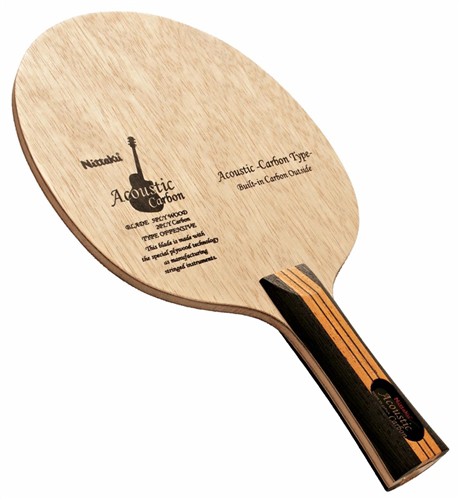
The Nittaku Acoustic Carbon is the carbon-fed sibling of the Nittaku Acoustic, a blade loved for the resonant, musical-wood feel Nittaku builds in with String Instrument Technology. The original Acoustic is all-wood, aimed at controlled OFF- play. The Acoustic Carbon adds two outer layers of FE Carbon, Nittaku’s Feel Carbon material, softer than standard carbon fiber and closer to ALC in how it damps. That makes a 7-ply blade (Limba - FE Carbon - Limba - Tung - Limba - FE Carbon - Limba), rated OFF, 5.5mm thick, averaging around 90g. It is aimed at players who love the original Acoustic but want a real speed bump without losing the Nittaku touch.
Performance
Speed and power are where the Acoustic Carbon breaks from its all-wood predecessor. Community benchmarking on Revspin gives it a user speed score of 9.2 out of 10, level with the Timo Boll ALC (TBALC) and ahead of the Viscaria and Tenor. It comes alive on full-swing topspin loops close and mid-table, where the FE Carbon layers compress and snap back with a loud, crisp crack that tells you exactly what you did. At medium and full power, the blade outhits its weight class for a Japanese-made carbon.
Control is the surprise. The outer carbon sits where you would expect speed, yet the FE Carbon’s softer weave holds far more dwell than conventional carbon. Reviewers across Revspin, TableTennisDaily, and TableTennis-Reference independently say the blade feels like allwood in the short game — pushes, flicks, drops — and only shows its carbon side when you swing hard. The Revspin community control score sits at 9.0 out of 10, and TableTennisReference aggregates control at 8.3 across 57 reviews. Blocking stays stable for a blade this fast.
Sticky and tacky Chinese-style rubbers are a recurring high point. The dwell and slightly softer carbon soak up the rubber’s grip without the trampolining that wrecks harder outer-carbon blades. Players running NEO Hurricane 3 or similar on the forehand say the Acoustic Carbon supplies the speed those rubbers usually need help to find.
Throw angle is medium, trajectory is medium. Loops land consistently in the mid-to-long zone, but short-game flicks need a deliberate stroke to clear the net. The roughly 90g weight is the single clearest constraint: a full build can push total racket weight toward 195-200g, which tires the wrist and asks for physically strong players or very light rubbers.
What Reviewers Agree (and Disagree) On
Across all three sources — Revspin (24 ratings), TableTennisDaily (3 detailed reviews), and TableTennis-Reference (57 ratings) — there is near-universal agreement that the Acoustic Carbon fills a rare slot: carbon speed in a blade that still plays and feels like high-end all-wood. The pros line up cleanly: wood feel, large sweet spot, strong control, sharp short game, and a wide rubber range. The one criticism every source shares is the heavy weight. Difficulty of use draws a secondary split. Some experienced players, especially those coming off Butterfly ZLC blades, call it instantly accessible, while beginner and lower-intermediate reviewers report an unruly bounce that takes weeks to tame. Mid-to-long table performance splits opinion too: distance loopers find the stiffer feel less forgiving, while close-table attackers praise it across the board.
Who Should Buy It
The Nittaku Acoustic Carbon suits intermediate to advanced attackers who loop mostly from close to mid-table and want feel and touch alongside carbon speed. It is a strong match for players on sticky or tacky forehand rubbers who want a blade that amplifies those rubbers rather than fighting them. Anyone stepping up from a pure all-wood Acoustic or a similar 5-ply will find the touch play familiar while gaining a clear speed edge on full attacks. Skip it if you are a beginner, lean heavily on far-from-table defense, or cannot carry a roughly 90g blade in your total setup.
FAQ
How does the Acoustic Carbon differ from the plain Nittaku Acoustic?
The original Acoustic is a 5-ply all-wood blade rated around OFF- to ALL+, prized for soft, resonant touch and precision. The Acoustic Carbon adds two outer layers of FE Carbon to make a 7-ply, OFF-speed blade. The carbon adds real speed — community scores put it alongside TBALC — and because Nittaku’s FE Carbon is softer than standard carbon, much of the all-wood feel and dwell survives. Treat it as the Acoustic with a higher speed floor, not a different blade.
What is FE Carbon and how does it affect play?
FE stands for FEEL Carbon, a Nittaku carbon fiber woven softer and more flexible than conventional carbon. It behaves closer to Butterfly’s ALC material than to hard outer carbon like ZLC. That keeps vibration damping higher and dwell longer than an outer-carbon blade usually allows, which is why so many reviewers call the Acoustic Carbon an allwood blade right up until the full-power smash.
Is the Acoustic Carbon good with Chinese sticky rubbers?
Yes. Revspin and TableTennis-Reference both flag its compatibility with sticky and tacky rubbers again and again. The softer FE Carbon absorbs the rubber’s grip instead of catapulting it the way harder carbon blades do. Reviewers run NEO Hurricane 3 or similar on the forehand and report the blade finds the speed those rubbers need without giving up control.
How heavy is it, and does the weight matter?
Most production samples land around 88-92g, with the community average close to 90g. That is heavy for a Japanese-made carbon blade. The weight starts to matter once you add two sheets of rubber: a full racket easily reaches 190-200g or more. If you are not used to heavier setups, expect wrist fatigue. Reviewers keep recommending light rubbers, around 40-45g each, to hold the total down.
What rubbers pair best with the Nittaku Acoustic Carbon?
Fastarc G-1 is the forehand pick across every source, matching the blade’s speed with enough spin. Fastarc S-1 is a softer option if you want more dwell. On the backhand, Fastarc C-1 or Hammond Z2 are popular. Chinese-rubber players report strong results with NEO Hurricane 3. Keep very bouncy premium tensors off the forehand, since the carbon already brings the speed and the extra bounce eats into your control.
Is there an inner-carbon version, and how does it compare?
Yes — the Nittaku Acoustic Carbon Inner places the FE Carbon layers further inside the blade structure, away from the outer wood plies. The inner version is softer in feel, has more dwell, and is somewhat easier to control. The outer version reviewed here is faster and more direct — better for players wanting an all-out offensive tool with that residual wood feel, while the inner version is preferred by players who want to preserve as much of the original Acoustic character as possible while adding some speed.