Butterfly Viscaria vs Nittaku Acoustic Carbon: Which Should You Buy?
| Butterfly Viscaria | Nittaku Acoustic Carbon | |
|---|---|---|
| Our rating | 9.0/10 | 8.8/10 |
| feel | medium-hard | Medium-hard outer carbon with surprising wood-like dwell and ball retention; crisp sound on contact |
| handle | FL/ST/AN | FL, ST (also Large Handle and Chinese Penhold variants available) |
| plies | 5W+2 Arylate-Carbon | 7 plies — 5 wood + 2 FE carbon (Limba - FE Carbon - Limba - Tung - Limba - FE Carbon - Limba) |
| speed | OFF | OFF |
| thickness_mm | 5.8 | 5.5mm |
| weight_g | 87 | approx 90g |
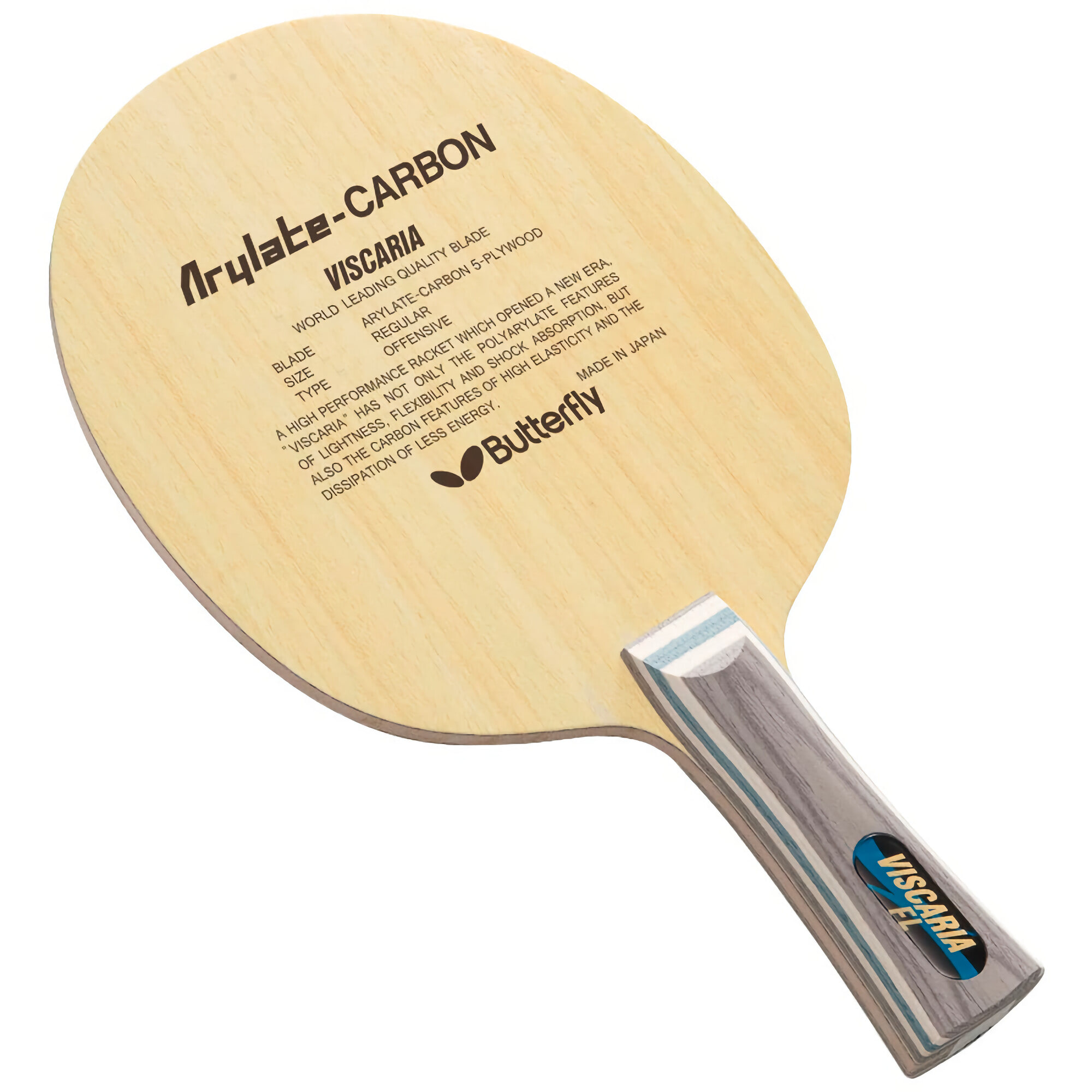
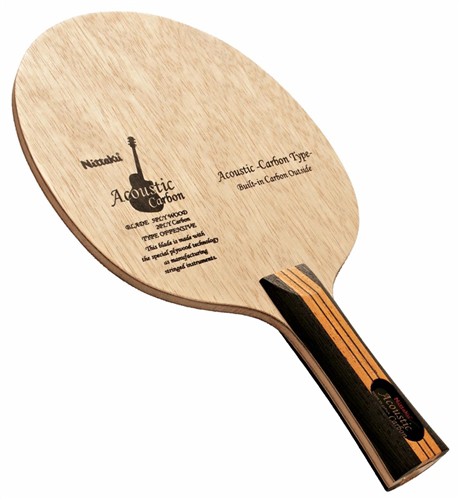
We may earn a commission from links on this page. Learn more.
Deep Power Versus Wood-Like Touch
The Butterfly Viscaria and the Nittaku Acoustic Carbon are close on the two headline numbers. Speed splits by just 0.2 points, 9.0 versus 9.2, Acoustic Carbon ahead, and control by the same 0.2 points, 8.8 versus 9.0, also Acoustic Carbon. Those are gaps you would struggle to feel in isolated play. The real separation is stiffness, at 1.2 points, 5.2 versus 6.4, with hardness following at 0.7 points, 5.7 versus 6.4. The Acoustic Carbon is the firmer, stiffer blade of the two by a real margin, not just a rounding difference.
Consistency runs the other way, favoring the Viscaria by 0.6 points, 9.2 versus 8.6. That tracks with what each blade’s own reviewers report. The Viscaria’s pros describe it as forgiving and consistent for a carbon blade, with a large sweet spot and a smooth transition from blocking to looping, exactly the profile of a higher-consistency blade. The Acoustic Carbon’s cons, by contrast, admit a real learning curve, noting the bounce can feel unruly until technique adapts, which lines up with its lower consistency score.
Elite Pedigree, Real Caveats
The Viscaria carries a specific, checkable claim in its pros list: its arylate-carbon structure carried Fan Zhendong to a treble early in his career. That is the kind of detail worth separating from marketing puffery. It is a documented pro-level usage claim, not a vague trusted by professionals line, though it should be read as evidence of what the blade can do in elite hands, not a promise of what it will do in yours. The Viscaria’s own cons list is honest about the gap between elite and club-level results: it demands an active stroke, and passive or borrowed-pace players will not unlock its deep power. A minority of reviewers also find it only medium-fast, per the blade’s own summary, and note that batch-to-batch weight varies.
The Acoustic Carbon makes a comparable pro-level claim, trusted by professional players including Ayane Morita, and pairs that with a genuinely different strength: a large sweet spot and a sharp short game, with reviewers at TableTennisDaily specifically praising its pushes, flicks, and drops. Its most specific limitation is practical rather than technical: most units land around 90 grams, which its own listing says demands careful rubber selection to avoid an overbuilt racket.
Sources on Both Sides
The Viscaria’s reputation draws on detailed writeups at Mogu Liao Pingpang and Heima Liao Pingpang alongside Megaspin’s customer review section, sources covering both technical breakdown and real buyer feedback. The Acoustic Carbon leans on Revspin’s blade database, a dedicated TableTennisDaily thread, and the spec listing at TableTennisReference. Both blades are backed by more than a single source, exactly the kind of cross-checking a 150-plus-dollar blade purchase deserves.
Should You Switch
If you are on a Viscaria and considering the Acoustic Carbon, the case for switching is thin on pure numbers. A 0.2-point gap on speed and control each is not a real gain, and you would be trading the Viscaria’s smoother, more consistent, more forgiving carbon feel for a stiffer blade with a real adaptation period, according to the Acoustic Carbon’s own cons. The switch makes more sense if you specifically want the Acoustic Carbon’s wood-like short-game touch and plan to pair sticky or tacky rubber like NEO Hurricane 3 on your forehand, which its reviewers note it handles without trampolining, a combination the Viscaria is not specifically praised for in the same way.
Coming from the Acoustic Carbon to the Viscaria makes sense if the Nittaku’s stiffer feel and learning curve have been working against your control, or if you want the higher consistency score and smoother block-to-loop transition the Viscaria’s reviewers describe.
Fit and Setup
Both are OFF-rated carbon blades at similar thickness, 5.8mm versus 5.5mm, with comparable weight, 87g versus roughly 90g. The Viscaria suits attacking shakehand players with an already-complete loop-driving stroke who want a forgiving, high-ceiling main blade. The Acoustic Carbon suits offensive players looping close to mid-table who want carbon-level speed without fully giving up an all-wood feel, particularly if they already favor tacky or sticky forehand rubber.
Frequently asked questions
Is the Nittaku Acoustic Carbon faster than the Butterfly Viscaria?
Marginally, by 0.2 points on the radar, 9.2 versus 9.0, a gap that is within normal review noise. The bigger difference is stiffness, where the Acoustic Carbon is 1.2 points firmer.
Which blade is more forgiving?
The Viscaria, by 0.6 points on consistency, 9.2 versus 8.6. Its own pros list describes a smooth transition from blocking to looping and a large sweet spot.
Has the Viscaria really been used by professional players?
Its own pros list states the arylate-carbon structure carried Fan Zhendong to a treble early in his career, and the Acoustic Carbon's listing separately cites use by professional player Ayane Morita.
Should I switch from the Viscaria to the Acoustic Carbon?
Only if you specifically want a stiffer, wood-like short game paired with sticky or tacky forehand rubber. The 0.2-point gaps on speed and control do not justify a switch on their own.