Nittaku Acoustic Carbon vs Stiga Offensive Classic: Which Should You Buy?
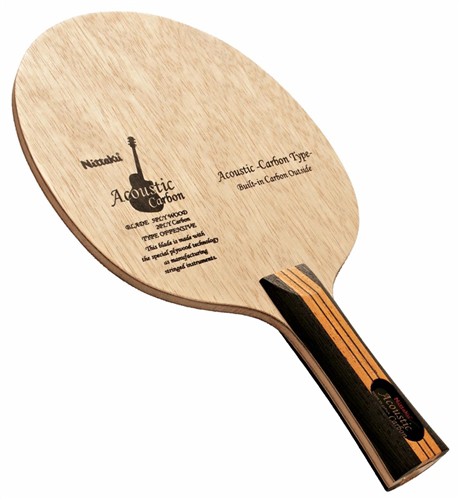
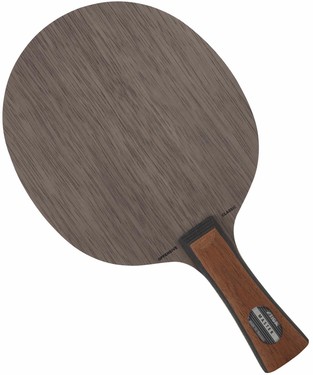
| Nittaku Acoustic Carbon | Stiga Offensive Classic | |
|---|---|---|
| Our rating | 8.8/10 | 8.4/10 |
| feel | Medium-hard outer carbon with surprising wood-like dwell and ball retention; crisp sound on contact | thin, flexible, soft-medium springy all-wood with strong vibration and feedback |
| handle | FL, ST (also Large Handle and Chinese Penhold variants available) | FL/ST/AN (WRB hollow-handle version also sold) |
| plies | 7 plies — 5 wood + 2 FE carbon (Limba - FE Carbon - Limba - Tung - Limba - FE Carbon - Limba) | 5W (all wood) — outer veneers commonly described as koto or limba over spruce and ayous |
| speed | OFF | OFF- (offensive minus; community-rated, occasionally felt as ALL+ to OFF) |
| thickness_mm | 5.5mm | 5.4 |
| weight_g | approx 90g | 83 |
We may earn a commission from links on this page. Learn more.
The core trade-off
Nittaku Acoustic Carbon rates 8.8 overall against the Stiga Offensive Classic’s 8.4, but the aggregate score hides where the real gap sits. The two blades are separated by 1.6 points on speed (9.2 vs 7.6) and, more tellingly, by 2.6 points on stiffness (6.4 vs 3.8) — the largest gap on this sheet. That stiffness number is the one worth paying attention to: it is the difference between a blade that gives instant, carbon-plate rebound and one that flexes visibly on a hard loop, absorbing energy before letting go of the ball. Players coming from an all-wood background usually feel that gap on the first rally, before they ever notice the raw speed number.
Where the numbers matter
The 1.6-point speed gap is real and shows up specifically on flat hits and counter-loops — the Acoustic Carbon reaches top gear on far less swing. Stiga’s Offensive Classic is rated OFF- against the Acoustic Carbon’s OFF, and its own con list states it “flexes a lot on power loops, so hard hits can sail long.” That is the stiffness delta translating directly into a real on-table failure mode, not a marketing footnote.
Control sits much closer: 9.0 versus 8.3, a 0.7-point edge for the Acoustic Carbon. That is real but modest — enough that reviewers still call the Nittaku the more precise blade in the short game, but not enough to make the Stiga feel loose or unpredictable. Consistency tells the same story, 8.6 versus 7.9, also a 0.7-point gap. Hardness (6.4 vs 5.4, delta 1.0) adds to the perceived crispness difference but is secondary to stiffness as the real driver of feel.
What the sources actually say
Revspin’s aggregated reviews put the Acoustic Carbon’s speed at 9.2, tied with Butterfly’s Timo Boll ALC and ahead of both Viscaria and the Tenor — genuinely elite territory for looping close to the table. On the Stiga side, Reddit’s r/tabletennis threads and Megaspin’s product reviews converge on the same theme across roughly two decades of write-ups: the Offensive Classic is “a classic,” prized for honest feedback and a forgiving learning curve rather than any claim to raw pace. TableTennisDaily’s user reviews back the same split — praise for the Nittaku’s carbon speed, praise for the Stiga’s price-to-control ratio.
Should you switch
If you already own the Offensive Classic and are wondering whether the Acoustic Carbon is worth the jump: it depends entirely on whether the Stiga’s flex is limiting your looping. If you are already generating your own power and the blade sails long on your hardest topspin, the extra 2.6 points of stiffness will address that — but expect a real adjustment period, since the Acoustic Carbon’s own con list flags a steep learning curve and an unruly bounce until technique adapts. If your game is built around close-to-table control, short game, and blocking rather than raw pace, the 0.7-point control edge is not large enough to justify giving up the Offensive Classic’s much lighter 83g build and forgiving feel.
Conversely, if you are on the Acoustic Carbon and finding it too fast or too heavy — it sits around 90g against the Stiga’s 83g — the Offensive Classic will hand back touch and lightness at the cost of that 1.6-point speed ceiling and the flex-related risk on your biggest swings.
Fit by player type
Pair the Acoustic Carbon with sticky or tacky rubbers — it is specifically built to soak up something like NEO Hurricane 3 without ballooning the trajectory, and it targets players who loop from close to mid-table and refuse to trade wood-like touch for carbon speed. The Offensive Classic wants medium or soft rubbers and rewards players still building their looping game, including Allround Classic graduates who want a touch more pace without losing feel. Neither blade is a beginner’s first purchase in the strictest sense, but the Stiga is meaningfully more forgiving of an incomplete stroke, while the Nittaku assumes you can already supply consistent, committed swings on demand.
Frequently asked questions
Is the Nittaku Acoustic Carbon actually faster than the Stiga Offensive Classic?
Yes, by 1.6 points on the aggregated speed axis (9.2 versus 7.6), and the Offensive Classic's own review notes it can flex and sail long on hard loops, which is the stiffness gap showing up as a real limitation.
Is the Stiga Offensive Classic too slow for competitive play?
It is rated OFF- rather than OFF, and reviewers note real-world speed is more moderate than expected, but it remains a strong choice for improving and intermediate attackers who supply their own power.
Should I upgrade from the Offensive Classic to the Acoustic Carbon?
Only if the Stiga's flex is actively limiting your looping. The control gap is a modest 0.7 points, and the Acoustic Carbon brings a real learning curve plus a heavier, more head-heavy build.
What rubbers work best on each blade?
The Acoustic Carbon is built to handle sticky and tacky rubbers like NEO Hurricane 3 without ballooning the trajectory. The Offensive Classic pairs better with medium or soft rubbers suited to its less stiff platform.