Butterfly Timo Boll ALC vs Nittaku Acoustic Carbon: Which Should You Buy?
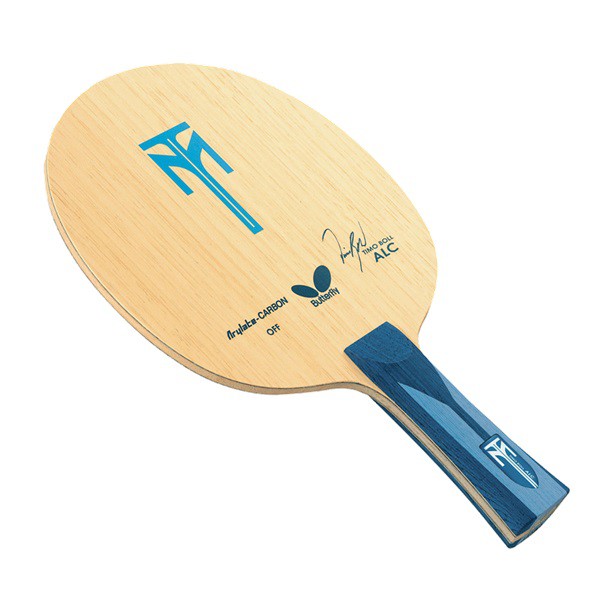
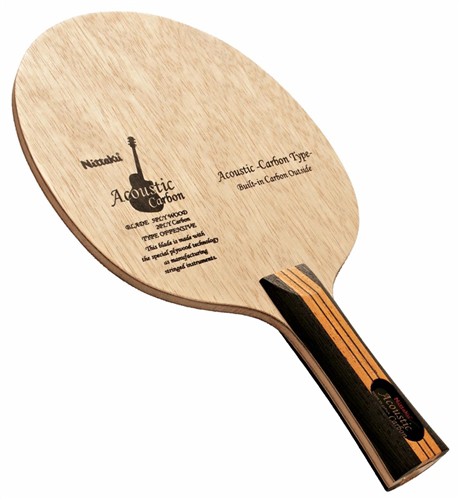
| Butterfly Timo Boll ALC | Nittaku Acoustic Carbon | |
|---|---|---|
| Our rating | 9.0/10 | 8.8/10 |
| feel | medium | Medium-hard outer carbon with surprising wood-like dwell and ball retention; crisp sound on contact |
| handle | FL/ST/AN | FL, ST (also Large Handle and Chinese Penhold variants available) |
| plies | 5W+2 Arylate-Carbon | 7 plies — 5 wood + 2 FE carbon (Limba - FE Carbon - Limba - Tung - Limba - FE Carbon - Limba) |
| speed | OFF | OFF |
| thickness_mm | 5.8 | 5.5mm |
| weight_g | 86 | approx 90g |
We may earn a commission from links on this page. Learn more.
Butterfly Timo Boll ALC and Nittaku Acoustic Carbon sit in the same speed class — both are rated OFF — and both carry near-identical overall scores (9.0 versus 8.8), which is exactly the kind of matchup where a lazy comparison page defaults to “both are great, pick your favorite brand.” The axis data says something more specific than that.
Where the numbers actually diverge
Look at consistency first, because it is the widest gap in this pair: ALC scores 9.3, Acoustic Carbon scores 8.6, a 0.7 point spread. On Revspin’s aggregated user data that is a real, feelable difference — it is the gap between a blade where “the whole face plays like one big sweet spot,” as ALC owners describe it, and a blade that TableTennisDaily and TableTennisReference reviewers still rate highly but flag with “the bounce can feel unruly until technique adapts.” If you rally at length and need the blade to behave the same way on ball 20 as it did on ball 2, ALC’s number is the one to trust more.
Stiffness is the second real gap: 5.8 for ALC against 6.4 for Acoustic Carbon, a 0.6 point delta. That tracks with the spec sheet — Nittaku’s FE Carbon layers sit inside a 7-ply wood-carbon-wood sandwich versus Butterfly’s 5-ply arylate-carbon build, and reviewers on Revspin specifically praise Acoustic Carbon for keeping “wood-like dwell” despite that stiffer carbon core. It is stiffer in the numbers but the user reports say it does not play as harsh as the stiffness score alone would suggest.
Axes that are basically a wash
Speed (9.0 vs 9.2, delta 0.2) and hardness (6.2 vs 6.4, delta 0.2) are inside the range where Revspin’s own review-to-review variance would produce that spread anyway. Do not let marketing copy about “9.2 speed beating Viscaria and Tenor” talk you into thinking Acoustic Carbon is meaningfully faster than ALC in a way you’d notice mid-rally — a 0.2 point gap on either of these axes is not something your opponent will feel from the other side of the table. Control (8.7 vs 9.0, delta 0.3) is a similarly small edge to Nittaku, worth knowing about but not worth basing a purchase on by itself.
Real-world weight difference
The one place raw spec numbers matter more than the radar axes is weight: ALC typically ships around 86 grams versus roughly 90 grams for Acoustic Carbon, and Nittaku’s own cons list calls it out directly — “most units land at or around 90g, demanding careful rubber selection.” A 4-gram difference sounds trivial until you are pairing sponge and topsheet; it means Acoustic Carbon leaves you less margin before your finished racket gets uncomfortably head-heavy.
Fit and rubber pairing
ALC’s bestFor case is the broad one: attacking shakehand players with a developed stroke who want a balanced, high-spin arylate-carbon blade and don’t mind the premium price — and it is the blade Butterfly is famously paired with alongside Tenergy 05. Acoustic Carbon’s case is narrower and more specific: intermediate to advanced offensive players who loop close to mid-table and specifically want carbon speed without losing wood-like touch, and who are running sticky or tacky rubbers — the pros list singles out NEO Hurricane 3 as a rubber Acoustic Carbon “soaks up… without trampolining.” If your game and rubber choice don’t match that description, the case for Acoustic Carbon over ALC weakens fast.
Switching from one to the other
If you already own ALC and are wondering whether Acoustic Carbon is worth the swap: probably not, unless you specifically play a tacky-rubber, close-to-table looping game and want the small speed and control bump badly enough to accept a heavier racket and the “steep learning curve” Nittaku’s own reviewers describe. The consistency drop (0.7 points) is a real cost, not a rounding error.
Going the other way — from Acoustic Carbon to ALC — makes more sense if you are finding the Nittaku’s bounce hard to predict or you are not running tacky rubbers to begin with. You give up a small amount of peak speed and control, but you gain the more forgiving, single-sweet-spot consistency ALC is known for, at a slightly lighter finished weight.
Bottom line
Both are legitimate OFF-class arylate and FE-carbon blades from proven manufacturers, both reviewed extensively on Revspin and TableTennisDaily, and neither is the wrong choice for a serious attacking player. The decision comes down to two numbers: how much you value the 0.7 point consistency edge ALC holds, against how much your rubber choice and playing distance line up with Acoustic Carbon’s tacky-rubber, close-to-table specialty. Everything else in the spec sheet is close enough to ignore.
Frequently asked questions
Is Nittaku Acoustic Carbon faster than Butterfly Timo Boll ALC?
Only marginally — 9.2 vs 9.0 on Revspin's aggregated speed axis, a 0.2 point gap that is not something you or an opponent would reliably feel across a rally.
Which blade is more consistent for long rallies?
Timo Boll ALC, by a real margin — 9.3 vs 8.6 on the consistency axis, the widest gap between these two blades.
Does Nittaku Acoustic Carbon work with any rubber?
It is specifically praised for tacky and sticky rubbers like NEO Hurricane 3; the tradeoff is a heavier finished racket (around 90g) and a steeper learning curve per Nittaku's own reviewers.
Is Timo Boll ALC worth the price premium over Acoustic Carbon?
If you want the widest working sweet spot and the steadiest feel across a long match, yes — that 0.7 point consistency edge is the main thing you're paying for.