Butterfly Innerforce Layer ALC vs Nittaku Acoustic Carbon: Which Should You Buy?
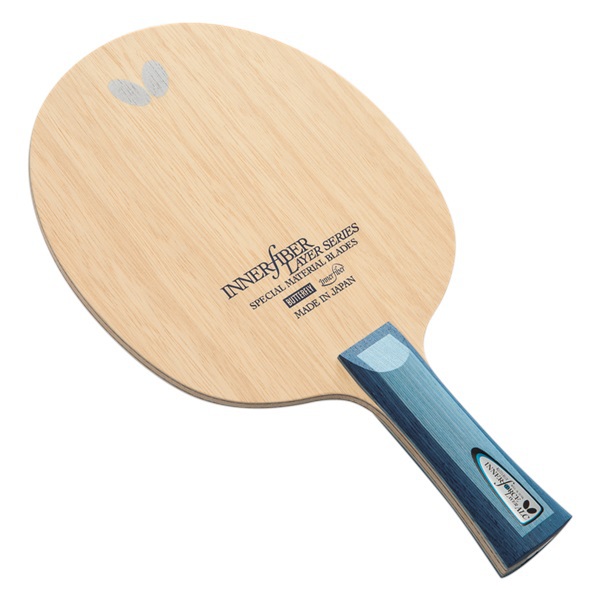
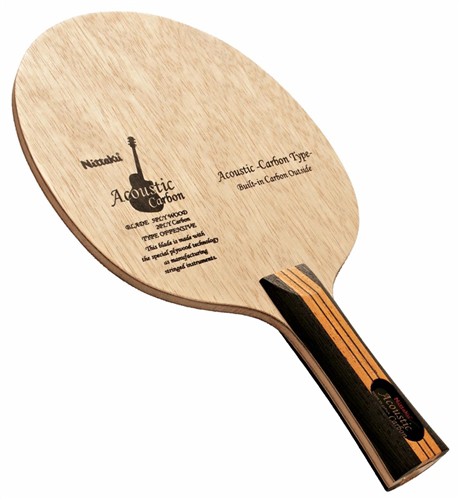
| Butterfly Innerforce Layer ALC | Nittaku Acoustic Carbon | |
|---|---|---|
| Our rating | 8.8/10 | 8.8/10 |
| feel | medium, high feel/dwell | Medium-hard outer carbon with surprising wood-like dwell and ball retention; crisp sound on contact |
| handle | FL/ST/AN | FL, ST (also Large Handle and Chinese Penhold variants available) |
| plies | 5W+2 Inner Arylate-Carbon | 7 plies — 5 wood + 2 FE carbon (Limba - FE Carbon - Limba - Tung - Limba - FE Carbon - Limba) |
| speed | OFF | OFF |
| thickness_mm | 5.9 | 5.5mm |
| weight_g | 86 | approx 90g |
We may earn a commission from links on this page. Learn more.
Same rating, same speed class, very different stiffness
Butterfly Innerforce Layer ALC and Nittaku Acoustic Carbon both rate 8.8 overall and sit within 0.1 of each other on speed (9.1 vs 9.2). On paper, indistinguishable. Underneath, the stiffness and hardness axes tell a completely different story, and that is the part an aggregate rating cannot show you.
Stiffness and hardness: the real split
Nittaku Acoustic Carbon rates 6.4 on both stiffness and hardness; Innerforce Layer ALC rates 5.0 and 5.2 respectively - deltas of -1.4 and -1.2, the two largest gaps in this comparison. That is a meaningfully stiffer, harder-feeling blade in the Nittaku, and it shows up directly in the qualitative source material: Nittaku’s own cons list warns of a “steep learning curve” where “the bounce can feel unruly until technique adapts,” while Innerforce ALC’s cons describe a gentler version of the same issue - “the first feel is bouncy and takes some time to master,” but nothing as pointed as “unruly.” If you have ever picked up a genuinely stiff carbon blade after years on all-wood, this axis predicts your first week more than any other number here.
Control and consistency both lean Butterfly
Control favors Innerforce ALC by 0.5 (9.5 vs 9.0), and consistency favors it by 0.9 (9.5 vs 8.6) - the largest “quality of experience” gap in the set after stiffness. Neither is enormous on its own, but together they paint Innerforce ALC as the more forgiving, more repeatable blade of the two, which lines up with Nittaku’s own admission that it is “less forgiving for looping far from the table, where the stiffer feel limits dwell.”
What’s actually tied
Speed is functionally identical, 9.1 vs 9.2, a 0.1-point gap that is noise. If your decision is being driven by “which one is faster,” stop - neither wins that argument. Nittaku’s own source material claims its 9.2 speed score “matches TBALC and beats Viscaria and Tenor,” which is a claim about where it sits in the broader carbon-blade market, not a claim of an edge over Innerforce ALC specifically.
Weight is the other real-world difference
Innerforce ALC weighs 86 grams; Nittaku Acoustic Carbon runs approximately 90 grams, and its own cons list flags this directly - “heavy, most units land at or around 90g, demanding careful rubber selection.” Combined with a thicker 5.9mm Innerforce ALC versus a 5.5mm Nittaku, you are choosing between a lighter, slightly thicker wood-carbon hybrid and a heavier, thinner one with a harder feel per gram.
Switching between them
If you are on Innerforce ALC and eyeing Nittaku Acoustic Carbon for “more speed,” the data does not back that up - speed is tied. The legitimate reason to switch is if you specifically want a stiffer, harder platform for tacky rubbers: Nittaku’s own pros list highlights that it “soaks up sticky and tacky rubbers like NEO Hurricane 3 without trampolining,” and its source material notes it is used by professional players including Ayane Morita. Moving the other way, from Nittaku to Innerforce ALC, makes sense if the Nittaku’s stiffness has been fighting your technique, or if you loop from mid-to-far table, where Innerforce’s larger control and consistency edge should show up as fewer unforced errors.
Who each blade actually suits
Innerforce ALC’s own bestFor description targets “allround-to-offensive shakehand players who want the feel, dwell and control of a limba all-wood blade plus the stability, sweet spot and on-demand acceleration of arylate-carbon,” pairing best with medium-hard inverted rubbers. Nittaku Acoustic Carbon’s own bestFor description is narrower: “intermediate to advanced offensive players who loop close to mid-table, want carbon speed but cannot give up the wood-like touch and short-game precision of an all-wood blade,” pairing especially well with sticky or tacky rubbers on the forehand.
Bottom line
Do not decide this one on rating or speed - both are ties. Decide on stiffness: Innerforce ALC for a softer, more forgiving, all-wood-adjacent feel with better measured consistency; Nittaku Acoustic Carbon for a stiffer, harder platform built to handle tacky Chinese rubbers without trampolining, at the cost of a steeper learning curve and roughly four extra grams.
Frequently asked questions
Is Nittaku Acoustic Carbon faster than Butterfly Innerforce Layer ALC?
Barely, and not in a way you would feel - 9.2 versus 9.1 on the speed axis, a 0.1-point gap that is well within noise. Both blades sit in the same speed class as Timo Boll ALC per Nittaku's own source material.
Which blade pairs better with tacky Chinese rubbers?
Nittaku Acoustic Carbon. Its own pros list specifically states it soaks up sticky and tacky rubbers like NEO Hurricane 3 without trampolining, and it rates 1.4 points stiffer than Innerforce Layer ALC - a stiffer platform generally suits tackier, heavier rubber setups.
Is Nittaku Acoustic Carbon too heavy?
It runs heavier than Innerforce Layer ALC - approximately 90 grams versus 86 grams - and its own cons list calls this out directly, warning it demands careful rubber selection to manage the overall racket weight.
Which blade has better control, Innerforce ALC or Nittaku Acoustic Carbon?
Innerforce Layer ALC, by 0.5 points (9.5 vs 9.0) on the control axis, and by 0.9 points on consistency (9.5 vs 8.6). It is the more forgiving of the two blades for players still developing a full stroke.