Nittaku Acoustic Carbon vs Tibhar Stratus Power Wood: Which Should You Buy?
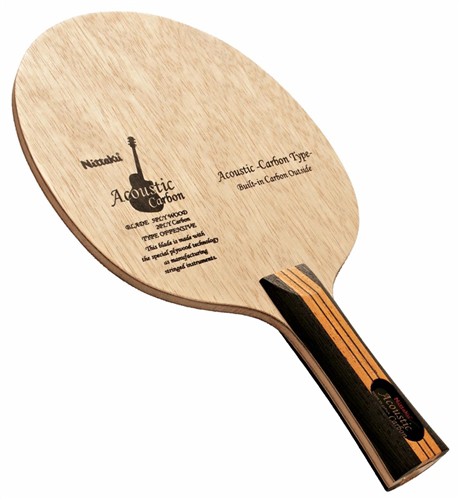
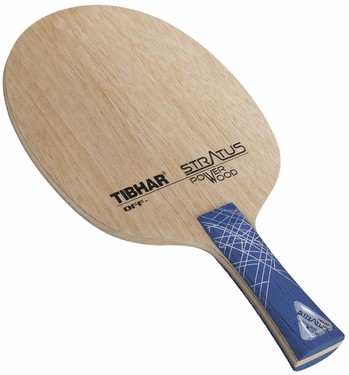
| Nittaku Acoustic Carbon | Tibhar Stratus Power Wood | |
|---|---|---|
| Our rating | 8.8/10 | 9.0/10 |
| feel | Medium-hard outer carbon with surprising wood-like dwell and ball retention; crisp sound on contact | Elastic with long dwell time, lively yet controlled, larger-than-average head and big sweet spot |
| handle | FL, ST (also Large Handle and Chinese Penhold variants available) | FL / ST / AN |
| plies | 7 plies — 5 wood + 2 FE carbon (Limba - FE Carbon - Limba - Tung - Limba - FE Carbon - Limba) | 5-ply all wood (Limba-Limba-Ayous-Limba-Limba) |
| speed | OFF | OFF- |
| thickness_mm | 5.5mm | 6.2 |
| weight_g | approx 90g | 90 |
We may earn a commission from links on this page. Learn more.
The surprise: the cheaper all-wood blade rates higher
Tibhar Stratus Power Wood earns a 9.0 overall rating, edging out the Nittaku Acoustic Carbon’s 8.8 despite being a plain 5-ply all-wood blade with no carbon layer at all. That is worth sitting with for a second: this is not a case where carbon technology simply outperforms wood. On the two axes that most directly measure attacking output, speed and control, the gap between them is close to a rounding error.
Where the axis data actually differs
Speed: 9.2 for the Acoustic Carbon versus 8.9 for the Stratus Power Wood, a delta of just 0.3. On a 10-point aggregated scale, that is not a difference a player will reliably feel rally to rally — both blades are genuinely fast. Control runs the other way, 9.0 versus 9.3, a 0.3-point edge to the Tibhar. Consistency also favors the Tibhar, 9.1 versus 8.6, a 0.5-point gap. None of these three deltas are large enough to be decision-driving on their own.
The real separation is in stiffness: 6.4 for the Acoustic Carbon versus 4.9 for the Stratus Power Wood, a 1.5-point gap, plus a 1.0-point hardness gap (6.4 vs 5.4). This is the carbon-versus-wood feel difference showing up in the numbers exactly where you would expect it — not in outright speed or control, but in how directly the blade reports impact and how much dwell time it gives the ball.
What the sources say
Megaspin’s product reviews and the Tabletennis11 blog both describe the Stratus Power Wood in almost identical language: phenomenal price-performance, frequently called the best-value 5-ply all-wood blade on the market, with a long dwell time that produces a high, long arc and heavy spin on loops. Reddit’s r/tabletennis search threads back this up with repeated recommendations for players looking for a forgiving, spin-friendly upgrade blade. On the Acoustic Carbon side, Revspin and TableTennisDaily both rate its speed at 9.2, tied with the Timo Boll ALC, and note it is trusted by professional players including Ayane Morita — a different value proposition built around carbon-plate speed rather than price.
Migration advice
If you currently play the Stratus Power Wood and are tempted by the Acoustic Carbon’s carbon-blade reputation, know what you are actually buying: a 0.3-point speed increase and a 1.5-point stiffness increase — mostly a different-feeling contact, not a dramatically faster or more controllable blade on paper. If your issue with the Stratus Power Wood is that backhand blocks reward precise timing, as its own con list states, the Acoustic Carbon’s stiffer plate will change your timing window again rather than simply widen it.
If you are on the Acoustic Carbon and finding it too heavy or too head-heavy for your extension game, the Stratus Power Wood offers a genuinely comparable speed ceiling in a lighter, more elastic package, with 0.3 more control and better consistency to boot — for considerably less money, per Megaspin and Tabletennis11’s repeated value framing.
Fit and scenario
The Acoustic Carbon suits intermediate-to-advanced players who loop close to mid-table and specifically want to pair the blade with sticky or tacky rubbers like NEO Hurricane 3 without the trampoline effect that softer wood blades can produce. The Stratus Power Wood is explicitly aimed at beginner-to-intermediate two-winged loopers who want a forgiving, spin-friendly all-wood platform with genuine attacking speed rather than a training-wheels blade — its larger head and bigger sweet spot back that up. Neither pairing is a compromise choice; they represent two different, well-validated routes to a similar ceiling of performance, and the decision should turn on feel preference and budget rather than any real gap in the speed or control numbers.
Frequently asked questions
Why does the cheaper Stratus Power Wood have a higher rating than the Acoustic Carbon?
Its control (9.3 vs 9.0) and consistency (9.1 vs 8.6) both edge out the Acoustic Carbon, while speed is nearly tied (8.9 vs 9.2), so the all-wood build isn't giving up much on paper.
Is the Nittaku Acoustic Carbon actually faster?
Only by 0.3 points on the aggregated speed axis, a gap most players won't reliably feel rally to rally.
What's the biggest real difference between these two blades?
Stiffness, at a 1.5-point gap (6.4 vs 4.9), plus a 1.0-point hardness gap. That's a carbon-plate feel versus a springier all-wood feel, not a performance gap.
Is the Stratus Power Wood good enough for competitive players?
Reviewers on Megaspin and the Tabletennis11 blog call it one of the best value 5-ply all-wood blades available, suited to beginner-to-intermediate two-winged loopers who want real attacking speed.