Butterfly Timo Boll Spirit vs Nittaku Acoustic Carbon: Which Should You Buy?
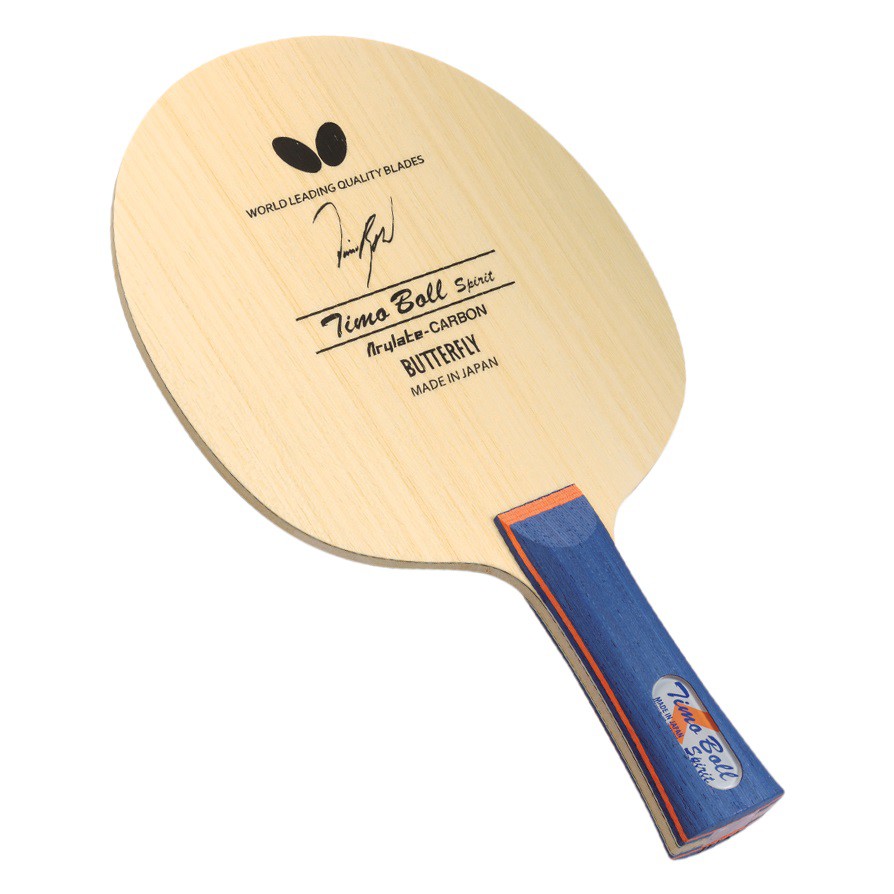
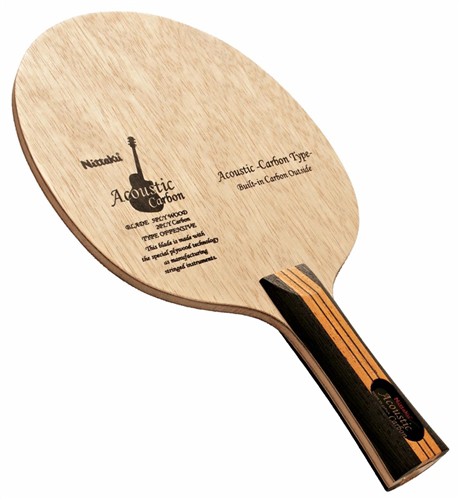
| Butterfly Timo Boll Spirit | Nittaku Acoustic Carbon | |
|---|---|---|
| Our rating | 9.0/10 | 8.8/10 |
| feel | Medium and offensive with notable flex and long dwell, crisp but forgiving for a carbon blade | Medium-hard outer carbon with surprising wood-like dwell and ball retention; crisp sound on contact |
| handle | FL / ST / AN | FL, ST (also Large Handle and Chinese Penhold variants available) |
| plies | 5 wood plies plus 2 arylate-carbon outer layers (5W and 2 ALC) | 7 plies — 5 wood + 2 FE carbon (Limba - FE Carbon - Limba - Tung - Limba - FE Carbon - Limba) |
| speed | OFF | OFF |
| thickness_mm | 5.7 | 5.5mm |
| weight_g | 87 | approx 90g |
We may earn a commission from links on this page. Learn more.
The Real Gap Is Stiffness, Not Speed
Look at the raw numbers first. Nittaku’s Acoustic Carbon edges the Timo Boll Spirit on raw pace, 9.2 versus 8.6, and on control, 9.0 versus 8.6. Neither gap is large enough to build a purchase decision around. A 0.4 to 0.6 point spread on a 10-point aggregated scale is the kind of difference you would struggle to notice blind, shot after shot, on a Tuesday night at the club.
The gap that actually matters is stiffness: 5.5 for the Spirit against 6.4 for the Acoustic Carbon, a 0.9-point swing. That is a genuinely different blade under your hand. The Spirit’s softer core plus its arylate-carbon layers give it a longer dwell time, which is exactly why reviewers on Reddit r/tabletennis and at Greg’s Table Tennis Pages keep describing it as more forgiving than stiffer carbon options. You get more time to feel the ball and adjust your angle mid-stroke, which is part of why it has stayed in Butterfly’s lineup for two decades without being retired to make room for something flashier.
The Acoustic Carbon’s higher stiffness combines with its FE carbon layers to do something unusual: Revspin’s aggregated reviews describe it as retaining a wood-like dwell despite the firmer feel, largely because of the Tung wood core sandwiched between the carbon plies. That is a harder trick to pull off than it sounds. Most stiff carbon blades feel dead and clacky in the short game. The Acoustic Carbon does not, according to reviewers at TableTennisDaily, who single out its pushes, flicks, and drops as a strength alongside its blocking.
The One Axis Where the Spirit Wins Clearly
Consistency runs the other direction: 9.4 for the Spirit versus 8.6 for the Acoustic Carbon, a 0.8-point edge for Butterfly. Translated into on-table terms, that tracks with what the cons lists say about each blade. The Acoustic Carbon’s own writeup flags a real learning curve, noting the bounce can feel unruly until technique adapts, plus a weight that typically lands around 90 grams, which forces careful rubber selection to avoid an overbuilt racket. The Spirit’s downside runs the opposite way: its cons are about the blade being too fast for underdeveloped technique, not about unpredictability once you have the technique to control it.
Sources Worth Checking Yourself
Both blades draw on real, checkable review bases rather than marketing copy. The Spirit’s reputation is built on Megaspin customer reviews, a detailed teardown at Greg’s Table Tennis Pages, ongoing discussion threads on Reddit r/tabletennis, and TableTennisDaily’s equipment reviews section. The Acoustic Carbon leans on Revspin’s aggregated blade ratings, its own TableTennisDaily thread, and the spec breakdown at TableTennisReference. Neither reputation rests on a single glowing review, which is worth knowing before spending 150 to 200 dollars on either one.
Should You Switch
If you already own a Timo Boll Spirit and are wondering whether the Acoustic Carbon is a meaningful upgrade, probably not, unless you specifically want more raw speed and are willing to trade away some forgiveness for it. The 0.6-point speed gap is real but modest, and you would be giving up the Spirit’s biggest strength, its soft and controllable dwell, for a stiffer blade that demands more precise technique, according to the Acoustic Carbon’s own reviewers.
Going the other way, from Acoustic Carbon to Spirit, makes more sense if you are finding the Nittaku’s bounce hard to tame or if you play a lot of close-to-table blocking and counter-hitting, where the Spirit’s control edge and softer feel show up most.
Fit and Setup
Both are rated OFF speed with near-identical thickness, 5.7mm versus 5.5mm, and weight, 87g versus roughly 90g, so this is not a case of one blade being objectively more blade than the other. The Spirit suits attacking shakehand players who want one blade for looping, blocking, and counterplay without a steep adjustment period. The Acoustic Carbon suits players who loop close to the table and specifically want to pair it with sticky or tacky rubber like NEO Hurricane 3 on the forehand. Its reviewers note it soaks up tacky rubber without trampolining, a combination that would overpower some other carbon blades.
Frequently asked questions
Is the Nittaku Acoustic Carbon actually faster than the Timo Boll Spirit?
Yes, but only by 0.6 points on the aggregated radar, 9.2 versus 8.6, a gap most players will not notice rally to rally. The bigger difference is stiffness, where the Acoustic Carbon is 0.9 points firmer.
Which blade is more forgiving for shot-to-shot consistency?
The Timo Boll Spirit, by 0.8 points on the consistency axis, 9.4 versus 8.6. Reviewers note the Acoustic Carbon has a real learning curve before its bounce feels predictable.
Should I switch from the Spirit to the Acoustic Carbon?
Only if you specifically want a wood-like short game with sticky or tacky forehand rubber. On pure speed and control the gap is too small to justify the switch on its own.
What rubber pairs best with the Acoustic Carbon?
Reviewers highlight sticky or tacky rubbers like NEO Hurricane 3 on the forehand, noting the blade absorbs them without trampolining.