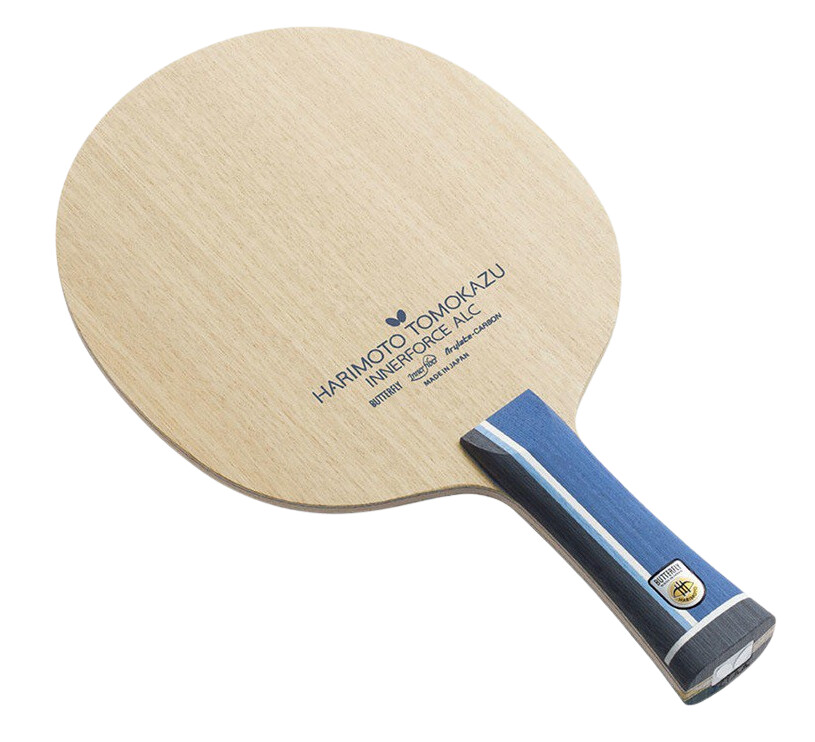
Butterfly Harimoto Innerforce ALC: Elite Spin Blade Designed for Harimoto Tomokazu
Pros
- ALC inner fiber activates on full swings while preserving all-wood touch on soft shots
- Enlarged head size (158x152mm) extends sweet spot and dwell time
- Premium Japanese manufacturing ensures consistent feel and quality
- Outstanding spin production on opening topspin and follow-up loops
- Excellent blocking and short-game control thanks to soft limba outer plies
Cons
- Measurably slower than Viscaria and outer ALC blades
- Premium price point places it out of reach for many players
- Can feel head-heavy with thick, hard rubber combinations
- Not suited to flat-hitting styles or players who prefer crisp outer ALC feedback
The Butterfly Harimoto Tomokazu Innerforce ALC is one of Butterfly’s most technically refined blades, developed with Tomokazu Harimoto, one of the world’s top-ranked players. It carries his name and his bow-and-arrow badge, and it reflects what he wants from a blade: powerful topspin attacks without losing the fine touch that elite close-to-table play needs. The Innerforce construction puts the ALC (Arylate-Carbon) fiber layers beneath two layers of wood rather than one, and the result feels, to many players, closer to pure wood than to a conventional carbon composite. At 88g with a 158x152mm head and 5.9mm thickness, it slots between its siblings: more controlled than the Viscaria, faster than the Innerforce Layer ALC, and built for spin-dominant modern play.
Performance
The whole point of this blade is the bridge it builds between two worlds: the tactile feedback of all wood and the latent power of carbon fiber. On contact the double-wood layer dampens the initial vibration, giving a soft, grippy sensation that reads clearly on every shot type, from a delicate serve to an aggressive third-ball attack.
In looping and topspin exchanges the ALC inner fiber engages by degrees. Light brushing against heavy backspin throws a steep arc with good net clearance, so opening loops come off safe and spin-loaded. Push into power loops and mid-distance drives and the carbon core stiffens, transferring energy efficiently for shots that are heavy and fast without the harshness of an outer ALC blade. Megaspin’s technical review measured a reaction rating of 10.7 and vibration rating of 9.2, both lower than Viscaria’s 11.8 and 10.3, which fits the blade’s softer, more controlled profile.
Forehand driving gives crisp, confident contact, and the enlarged head widens the sweet spot over standard Butterfly composite blades. The fifth and seventh ball are where it does its best work: the dwell time and consistent rebound make rapid exchanges feel predictable and authoritative. Backhand loops gain the same way, the carbon layer steadying the face for directional accuracy on cross-court attacks.
Blocking and passive defense come easily. The soft limba outer plies absorb incoming pace, and the carbon core steadies the face to redirect with precision. Serves and the short game pay off too: the deeper wood layer keeps the ball off the carbon a beat longer, a delicate touch that rivals many all-wood blades on short pushes and wrist-accelerated serves.
Raw power at distance is the one place it trails its faster siblings. Against the Viscaria or Timo Boll ALC, the lower reaction rating makes it weaker for power-dominant styles built on flat hitting or mid-to-far aggression. Players who want the crisp click of an outer ALC blade will find the Harimoto’s feedback muted on lighter contacts. None of that is accidental. The blade was engineered for precision, spin, and Harimoto’s own close-to-table attacking game, not for maximum pace.
What Reviewers Agree (and Disagree) On
Reviewers from Megaspin, PingPongMaster, and ButterflyOnline reach a strong consensus on the Harimoto Innerforce ALC’s core identity: it is a spin-first, control-oriented composite blade that delivers more feel and dwell than competing Butterfly ALC models while sacrificing a measurable degree of outright speed. The Megaspin technical review quantified this with a reaction score of 10.7 versus Viscaria’s 11.8, and user reviews consistently rate control and spin well above speed. PingPongMaster awarded control and dwell time scores of 4.5/5, while speed scored 4.0/5, putting the blade’s priorities in concrete numbers.
The main disagreement is over speed classification. Some advanced users describe the blade as OFF-class and adequate for power play when paired with hard rubbers like Dignics 09C or Tenergy 05 Hard; others, mostly intermediate players, find it notably slow and demanding. That split comes down to technique: the ALC layer needs a full, committed swing to activate, and players who do not generate enough racket-head speed will read the blade as sluggish. Build quality receives near-universal praise, as does the enlarged head size’s contribution to a wider effective sweet spot.
Who Should Buy It
The Butterfly Harimoto Innerforce ALC is the right choice for advanced and near-elite players who value spin, arc, and close-to-table control over maximum speed. It is ideal for two-wing topspin attackers who model their game on the modern Chinese-style forehand and disciplined backhand looping that Harimoto exemplifies. Players transitioning from the Innerforce Layer ALC will find the Harimoto version offers a slightly larger head and marginally higher reaction without a dramatic change in feel. Viscaria users looking for more touch and dwell will also find this blade a compelling alternative, accepting a speed reduction in exchange for superior spin and a softer, more natural sensation. The blade is not suited for beginners or casual players — its technique-sensitive ALC layer rewards players who consistently generate fast swing speeds and deliver full-contact strokes. Flat-hitters and players who primarily play from mid-to-far distance will find faster outer ALC or ZLC blades more rewarding.
FAQ
What is the difference between the Harimoto Innerforce ALC and the Viscaria?
The Harimoto Innerforce ALC places its ALC fiber beneath two layers of wood rather than one, producing a softer, woodier sensation and lower vibration. Measured reaction ratings confirm the Harimoto (10.7) is slower than the Viscaria (11.8), but it provides more dwell time, a higher arc, and superior touch on finesse shots. Players who prioritize spin and feel over raw speed consistently prefer the Harimoto ALC.
What rubber pairings work best with the Harimoto Innerforce ALC?
Community consensus points to hard tensor rubbers for the forehand — Dignics 09C, Dignics 05, and Tenergy 05 Hard are the most recommended choices — to compensate for the blade’s lower speed rating and activate the ALC layer on power shots. For the backhand, Tenergy 05, Tenergy 19, and Gewo ELPro 43 are popular options that balance speed and spin without overloading the softer blade construction.
Is the Harimoto Innerforce ALC suitable for intermediate players?
Technically yes, but with an important caveat: the blade’s ALC layer requires full, committed swing mechanics to activate properly. Intermediate players with developed topspin technique can use it effectively and benefit from its generous dwell time and sweet spot. However, beginners and players still building consistent strokes will find the blade unforgiving, and the premium price point makes it difficult to justify at an early stage of development.
What speed class is the Butterfly Harimoto Innerforce ALC?
Butterfly officially classifies the blade as ALL+ to OFF-. Independent reviews and technical measurements place its real-world performance squarely in the OFF- category: faster than a pure control blade but measurably slower than Viscaria and other outer ALC designs. When paired with hard rubbers like Dignics 09C, the combined setup reaches a competitive OFF level suitable for high-level tournament play.
How does the Innerforce construction differ from standard ALC blades?
Standard ALC blades such as the Viscaria place the Arylate-Carbon fiber layer directly beneath a single outer wood ply. The Innerforce construction used in the Harimoto ALC positions the ALC fiber beneath two wood plies, moving it closer to the blade’s core. This creates a softer initial contact feel, extended ball dwell time, and a higher arc on topspin strokes — at the cost of some peak speed and rebound efficiency.
Does the larger head size of the Harimoto ALC affect play?
The head size of 158x152mm is 1mm taller and 2mm wider than standard Butterfly ALC blades. This provides a wider sweet spot, more consistent feel on off-center contacts, and enhanced dwell time on opening topspin shots. The trade-off is a slight increase in overall weight with rubbers attached, which some players find makes the racket feel head-heavy — particularly when using thick or high-density rubber sheets.