Butterfly Innerforce Layer ZLC Review: Soft ZLC Feel with Outstanding Control
Pros
- Exceptional control for an OFF+ speed blade
- Soft, woody feel with genuine ZLC power on demand
- Outstanding dwell time and spin generation
- Low throw angle suits close-to-mid-distance aggressive play
- Highly consistent across all shot types
- Forgiving on off-center contact for its speed class
Cons
- Smaller sweet spot compared to the Innerforce Layer ALC
- Low throw angle clashes with Chinese tacky rubber setups
- Premium price in the 200-220 USD range
- Not suitable for beginners or intermediate players still developing technique
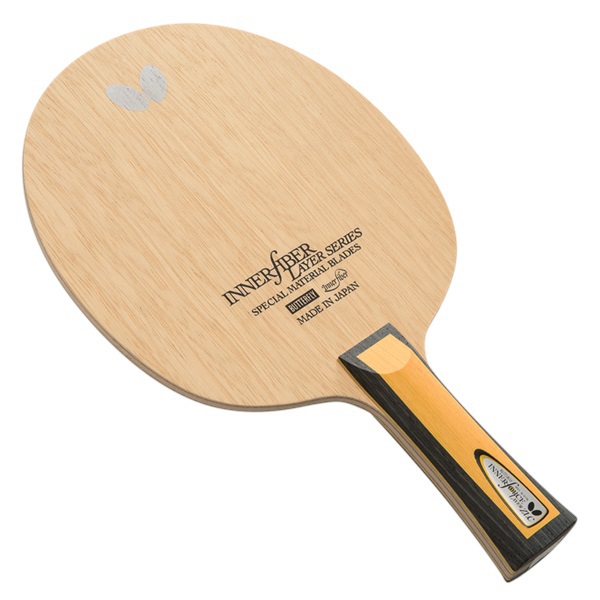
The Butterfly Innerforce Layer ZLC is a 7-ply carbon blade that changes what you expect ZLC to feel like. Outer-carbon blades put the fiber near the surface for maximum stiffness and speed; Butterfly’s Innerfiber technology sits the two ZL Carbon layers next to the central wooden core instead. You keep the lightness and power potential of ZLC but get a soft, woody playing sensation out of it. Rated OFF+ on paper, it behaves more like a controlled offensive blade in hand. Revspin, TableTennisDaily, and Reddit reviewers broadly agree on one thing: this is one of the most underrated and misunderstood blades Butterfly makes, and once you find the right rubber pairing, the spin, dwell, and placement accuracy open right up.
Performance
The Innerforce Layer ZLC is at its best close to mid-table, where the inner ZLC lets the blade dwell and load spin before releasing with controlled power. The throw angle is low and direct, which keeps the ball trajectory dangerous and penetrating. Reviewers note it handles multiple gears, from soft touches and short-game control to explosive backswing topspins and smashes once you swing hard. It is rated OFF+, but users keep reporting it feels a shade slower than Butterfly’s catalog number, and that works in its favor for advanced players who want reliability.
Control is the headline. One TableTennisDaily reviewer rated it as high as 9.8, which captures how easy it is to steer the ball to precise targets even during fast exchanges. Dwell time runs long for a carbon blade, described by one reviewer as similar to waiting for a taxi in New York City, meaning the ball hangs on the face slightly longer than you expect and gives you more time to load spin. Serving asks little for a lot of spin, blocks stay stable and predictable, looping is consistent, and the transition between close-table and mid-distance play is smooth.
It works best with medium-hard Japanese and European rubbers. Tenergy 05 on the forehand and Evolution MX-S or Rakza 7 on the backhand come up again and again. Chinese tacky rubbers fight the low throw angle, so opening against backspin gets harder unless you have adapted your technique. Weight runs from roughly 85g to 94g depending on handle type, manageable across long sessions.
What Reviewers Agree (and Disagree) On
There is strong consensus that the Innerforce Layer ZLC excels in control, consistency, and spin generation. Almost all reviewers agree it outperforms its official ratings in feel and control. The main point of disagreement is value: some players at the 200-220 USD price point feel the blade lacks the dramatic character or identity of blades like the Timo Boll ZLC or Viscaria, while others consider it worth every penny for its versatility. There is also some divergence on rubber pairing, with most preferring European or Japanese tensors and a minority attempting Chinese rubber setups with mixed results. Speed perception also varies, with some finding it comfortably OFF+ and others feeling it is closer to OFF in real game conditions.
Who Should Buy It
The Innerforce Layer ZLC is best suited for advanced offensive players who have outgrown all-wood blades but find outer-carbon blades too stiff or unforgiving. It is particularly well matched to players who rely on close-to-mid-table looping, heavy spin serves, and precise ball placement over pure speed. Players who have used all-wood blades like the Violin or Nittaku Acoustic and want to step up with minimal disruption to their stroke mechanics will find the transition smoother than with most carbon blades. It is not recommended for beginners, intermediate players still building technique, or power hitters who want maximum explosive speed from their equipment.
FAQ
How does the Innerforce Layer ZLC compare to the Innerforce Layer ALC?
The ZLC version uses ZL Carbon fiber, lighter and more flexible than Arylate Carbon, which gives it more speed and a slightly stiffer feel than the ALC. The inner placement keeps both fairly soft, though. The ZLC has a smaller sweet spot but more power and spin potential for advanced players. Most players find the ALC more forgiving and accessible.
What rubbers pair best with the Innerforce Layer ZLC?
Medium-hard Japanese and European tensor rubbers work best. Tenergy 05 or Dignics 09C on the forehand and Evolution MX-S, Rakza 7, or Tenergy 80 FX on the backhand are popular combinations. Chinese tacky rubbers can be difficult due to the low throw angle and may result in inconsistent opening loops against heavy backspin.
Is the Innerforce Layer ZLC suitable for beginners?
No. Multiple reviewers explicitly state this blade is not for beginners. The speed and sensitivity of ZLC carbon demand well-developed stroke mechanics. Players at intermediate level and above who can already loop consistently will benefit most from this blade.
How heavy is the Innerforce Layer ZLC?
Reported weights range from approximately 85g to 94g depending on handle type and individual piece variation. Flared handle versions tend to be toward the heavier end around 94g, while straight handle versions can be around 85-90g.
Is this blade good for mid-distance play?
Yes, it performs very well at mid-distance. Reviewers praise its consistency and dwell time for looping from mid-distance, though some note it is primarily optimized for close-table play. Far from the table, other blades with outer carbon constructions may have more speed and consistency.
Why do some reviewers say the blade feels slower than its OFF+ rating?
The inner placement of ZLC fiber creates a softer, more cushioned feel compared to outer-carbon blades rated at the same speed level. The blade absorbs more energy on contact, giving players more control but also making it feel slower than equivalent outer-carbon OFF+ blades. Pairing with harder rubber sponges can help unlock its full speed potential.