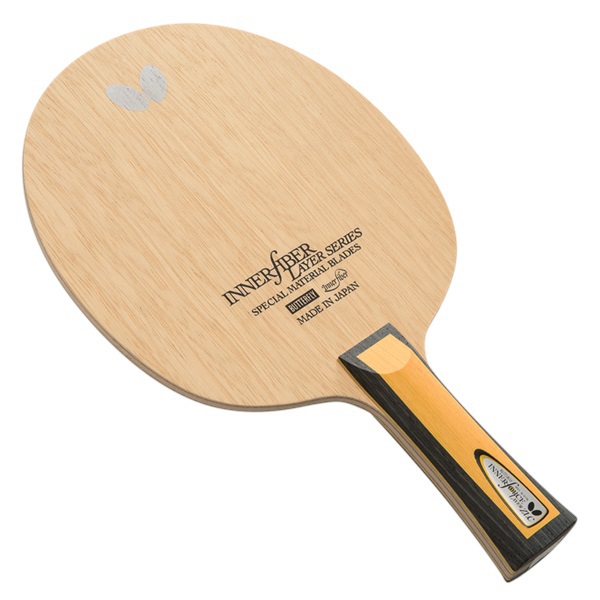
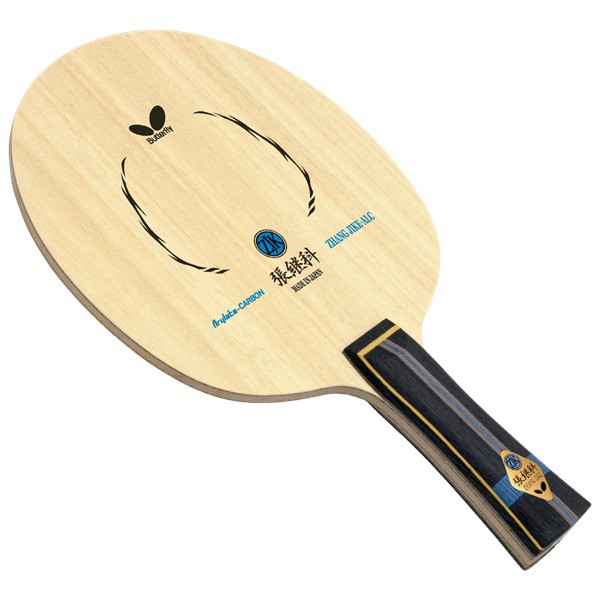
Butterfly Innerforce Layer ZLC vs Butterfly Zhang Jike ALC: Which Should You Buy?
| Butterfly Innerforce Layer ZLC | Butterfly Zhang Jike ALC | |
|---|---|---|
| Our rating | 8.7/10 | 8.7/10 |
| feel | Soft ZLC feel, woody touch, excellent dwell time | medium-hard but flexible, crisp carbon with long dwell |
| handle | FL / ST / AN / CS | FL/ST/AN |
| plies | 7-ply, 5 wood + 2 ZL carbon (inner) | 5W+2 Arylate-Carbon (5 wood plies with 2 Arylate-Carbon layers) |
| speed | OFF+ | OFF |
| thickness_mm | 5.7 | 5.8 |
| weight_g | 85-94 | 88 |
We may earn a commission from links on this page. Learn more.
Same brand, same rating, opposite carbon feel
Butterfly Innerforce Layer ZLC and Butterfly Zhang Jike ALC both rate 8.7 overall, and both are covered by the same three sources - Revspin, TableTennisDaily and Reddit’s r/tabletennis - as premium Butterfly offensive blades in the same tier. The rating tie makes this look like a coin flip. The stiffness and hardness axes say otherwise, by the widest margins on any Butterfly-versus-Butterfly pairing: stiffness differs by 2.6 points and hardness by 1.9, both among the largest deltas in this entire batch of comparisons.
Stiffness and hardness: this is where the choice actually lives
ZLC rates 2.7 on stiffness and 3.3 on hardness, genuinely soft numbers, among the lowest in the batch. Zhang Jike ALC rates 5.3 and 5.2 on the same two axes, roughly double ZLC’s stiffness reading. Both blades describe themselves in similar language - ZLC as having a “soft, woody feel with genuine ZLC power on demand,” Zhang Jike ALC as “soft, flexible, non-stiff carbon feel” - but the axis numbers make clear these are relative descriptions within different carbon families. ZLC (Zylon-carbon) is Butterfly’s softer composite technology; ALC (Arylate-carbon) is stiffer and more direct. If you have played both carbon types before, this axis pairing is effectively the entire decision; if you have not, know that ZLC will feel closer to an all-wood blade with a late kick, while Zhang Jike ALC will feel more immediately reactive throughout the stroke.
Speed class differs even though the numbers are close
The measured speed axis is close, 8.8 for ZLC versus 9.0 for Zhang Jike ALC, a 0.2-point gap, but the manufacturer speed classification is not: ZLC is rated OFF+, a full class above Zhang Jike ALC’s OFF. That is a case where the coarse classification and the fine-grained axis data disagree slightly, and the axis data is the more useful number here - treat these two as close in raw pace, with ZLC’s OFF+ label reflecting how the blade plays at full extension rather than a proportionally faster measured speed.
Control and consistency: close, with a slight ALC edge
Control favors Zhang Jike ALC by 0.4 (9.3 vs 8.9), and consistency is nearly identical, 9.6 vs 9.7, a 0.1-point gap that is a rounding error rather than a real difference. Both are among the highest consistency scores anywhere in this dataset, reflecting that both are mature, well-reviewed blades rather than one clearly beating the other.
A cross-reference worth knowing: sweet spot
ZLC’s own cons list states its sweet spot is smaller compared to Butterfly’s plain Innerforce Layer ALC model (a separate blade, not covered here); Zhang Jike ALC’s own cons list says its sweet spot is smaller than Butterfly’s ZLC and Super ZLC blades. Read together, that is Butterfly’s own source material placing Zhang Jike ALC’s sweet spot below ZLC’s - worth knowing if off-center contact on mishits is a bigger practical concern for you than raw stiffness preference.
The practical factor: availability
Zhang Jike ALC’s own cons list flags that it “has been heading toward discontinuation, affecting availability.” That is not a performance consideration, but it is a real one if you are deciding what to commit to for the next several years of rubber changes - ZLC carries no such warning in its own source material.
Switching between them
Moving from Zhang Jike ALC to ZLC trades some control and a touch of consistency for a markedly softer, more forgiving-at-the-core feel better suited to close-to-mid-table placement play, matching ZLC’s own bestFor description of advanced players prioritizing precision over raw explosive speed. Moving the other way gets a stiffer, more classically carbon feel, a slight control edge, and, for now, easier availability, at the cost of the extra sweet-spot margin ZLC offers.
Who each blade actually suits
ZLC’s own bestFor description names “advanced players seeking a high-control, high-spin offensive blade with a soft ZLC feel,” ideal for “close-to-mid-distance loopers who value placement precision and consistency over raw explosive speed.” Zhang Jike ALC’s own bestFor description targets “intermediate to advanced offensive loopers who want a fast but spin-friendly Arylate-Carbon blade with plenty of dwell and control,” and who value handle choice across FL, ST and AN shapes plus the option to pair either tensor or tacky Chinese rubber.
Bottom line
Rating and consistency will not separate these two, they are statistically tied on both. Stiffness and hardness will: pick ZLC for a genuinely softer, ZLC-family feel built for precision looping; pick Zhang Jike ALC for a firmer ALC-family feel with a slight control edge, keeping in mind it may become harder to find over time.
Frequently asked questions
What's the difference between ZLC and ALC carbon in Butterfly blades?
In this pairing, ZLC (Zylon-carbon, used in Innerforce Layer ZLC) is markedly softer, rating 2.7 on stiffness versus Zhang Jike ALC's (Arylate-carbon) 5.3 - roughly double. ZLC plays closer to an all-wood blade with a late kick; ALC feels more immediately reactive throughout the stroke.
Is Butterfly Zhang Jike ALC being discontinued?
Its own cons list states it has been heading toward discontinuation, which affects availability. That is a practical purchasing consideration independent of the performance comparison - Innerforce Layer ZLC carries no such warning.
Which blade has a bigger sweet spot, ZLC or Zhang Jike ALC?
Based on their own cons lists, ZLC's sweet spot is described as smaller than Butterfly's plain Innerforce Layer ALC, while Zhang Jike ALC's is described as smaller than both ZLC and Super ZLC. Read together, ZLC comes out ahead of Zhang Jike ALC specifically on this point.
Is Innerforce Layer ZLC actually faster than Zhang Jike ALC despite being OFF+ rated?
Not really - the measured speed axis has ZLC at 8.8 and Zhang Jike ALC at 9.0, a 0.2-point gap in the ALC's favor even though ZLC carries the higher OFF+ classification. Treat the two as close in raw pace regardless of the class label.