Nittaku Acoustic vs Nittaku Acoustic Carbon: Which Should You Buy?
| Nittaku Acoustic | Nittaku Acoustic Carbon | |
|---|---|---|
| Our rating | 8.7/10 | 8.8/10 |
| feel | Crisp all-wood feel with a large sweet spot, long dwell and a signature acoustic sound | Medium-hard outer carbon with surprising wood-like dwell and ball retention; crisp sound on contact |
| handle | FL/ST | FL, ST (also Large Handle and Chinese Penhold variants available) |
| plies | 5-ply all wood (Limba outer veneers over a tung and ayous core) | 7 plies — 5 wood + 2 FE carbon (Limba - FE Carbon - Limba - Tung - Limba - FE Carbon - Limba) |
| speed | OFF- | OFF |
| thickness_mm | 5.7 | 5.5mm |
| weight_g | 88 | approx 90g |
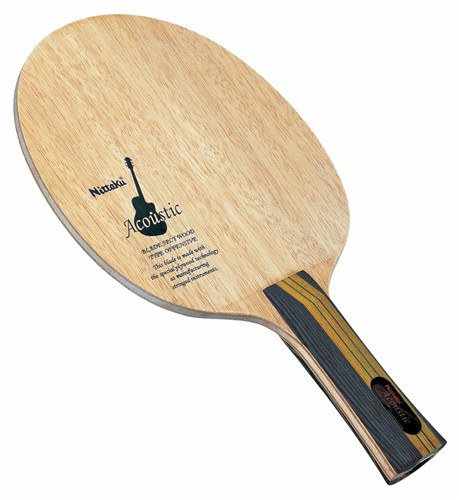
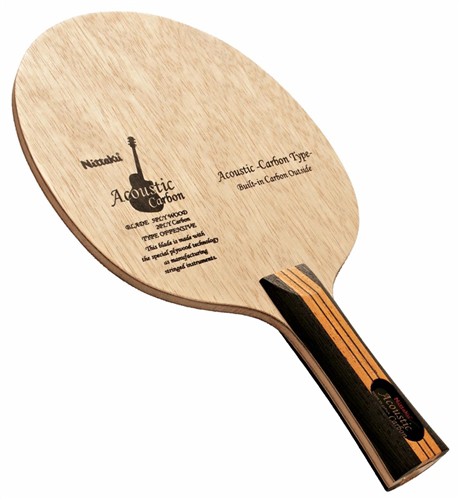
We may earn a commission from links on this page. Learn more.
Same family, different generation of feel
These are siblings by name and lineage, and that makes the axis deltas unusually informative: this is Nittaku’s own all-wood flagship against its carbon-reinforced sibling, so every gap here is attributable almost entirely to the two FE Carbon plies, not to a different manufacturer’s design philosophy.
The two axes that actually decide this
Stiffness is the story: 4.3 for the all-wood Acoustic versus 6.4 for the Acoustic Carbon, a 2.1-point gap — the largest delta anywhere in this batch of comparisons. That is the carbon plies doing exactly what they are designed to do: convert a soft, absorbing wood flex into a stiffer, faster-rebounding plate. Consistency moves the opposite direction and by nearly as much: 9.5 for the wood Acoustic versus 8.6 for the Carbon version, a 0.9-point gap, and hardness adds another 1.5-point separation (4.9 vs 6.4). Put together, the wood Acoustic is the more forgiving, more predictable blade stroke to stroke, while the Carbon version is the stiffer, harder-hitting one — and the size of these gaps tells you the difference in feel is not subtle.
Speed moves by 0.6 points (8.6 vs 9.2) in the Carbon’s favor — real, and noticeable on flat hits, but not the dominant story here; the pure wood Acoustic is still rated OFF- and has enough speed, per its own review summary, to finish points without a carbon plate. Control is nearly a wash, 9.3 versus 9.0, a 0.3-point edge to the wood version — not enough to be a deciding factor by itself.
What the sources say
Revspin’s aggregate for the plain Acoustic emphasizes class-leading control and feedback for an all-wood blade, language echoed by Table Tennis Spot’s dedicated review and by threads across r/tabletennis. Megaspin’s product review page for the standard Acoustic backs the same theme: a large sweet spot and long dwell that make looping, pushing, and blocking forgiving. For the Carbon version, Revspin, TableTennisDaily, and TableTennisReference all converge on a different vocabulary — speed matched with the Timo Boll ALC, ahead of Viscaria and Tenor, plus a note that it is used by professional players including Ayane Morita. These aren’t contradictory reviews; they are describing genuinely different tools built from a shared design lineage.
The upgrade question, answered honestly
If you own the plain Acoustic and are wondering whether the Carbon version is worth the money: the honest answer depends on what you are missing. If your limitation is top-end speed on flat, committed hits, the 0.6-point speed gain plus the 2.1-point stiffness increase will genuinely deliver more pop. But you will give up a meaningful chunk of the wood Acoustic’s signature trait — its 9.5 consistency score and forgiving dwell — and the Carbon version’s own con list warns of a steep learning curve with a bounce that can feel unruly until technique adapts. If your current complaint is that the wood Acoustic feels underpowered against long pips or heavy loopers, this upgrade addresses that directly. If your complaint is inconsistent timing or a small margin for error, upgrading to the stiffer blade will very likely make that worse, not better.
Going the other direction, from Carbon to plain wood, makes sense for players who find the Carbon’s head-heavy balance and medium throw angle demanding, per its own con list, and who value the short game and touch shots the wood Acoustic’s higher consistency score supports.
Fit and scenario
Both blades target intermediate-to-advanced offensive players, but the plain Acoustic leans toward mid-distance loopers who prioritize control and feel, while the Carbon version is built for players looping close to the table who want carbon speed but refuse to give up wood-like touch entirely. Handle range differs too: the wood Acoustic comes mainly in FL and ST, with LG and G-Revision options for larger hands, while the Carbon version adds a Large Handle and Chinese Penhold variant. Given the 2.1-point stiffness gap, this comparison is really a question of how much rebound you want your blade to add to your own swing versus how much you want it to simply relay what you put into it.
Frequently asked questions
Is the Acoustic Carbon just a faster version of the plain Acoustic?
Partly. Speed rises 0.6 points (8.6 to 9.2), but the bigger changes are stiffness, up 2.1 points, and consistency, down 0.9 points.
Should I upgrade from the plain Acoustic to the Acoustic Carbon?
Only if you're missing top-end speed on flat hits. If your issue is timing or consistency, the Carbon version's stiffer, less forgiving feel will likely make that worse.
Is the control difference between them significant?
No. Control differs by just 0.3 points (9.3 vs 9.0), essentially a tie.
Which version has the more forgiving sweet spot?
The plain wood Acoustic, with a 9.5 consistency score, the highest of any blade in this dataset, versus 8.6 for the Carbon version.