Butterfly Ovtcharov Innerforce ALC vs Nittaku Acoustic Carbon: Which Should You Buy?
| Butterfly Ovtcharov Innerforce ALC | Nittaku Acoustic Carbon | |
|---|---|---|
| Our rating | 8.8/10 | 8.8/10 |
| feel | crisp and firm with controlled dwell | Medium-hard outer carbon with surprising wood-like dwell and ball retention; crisp sound on contact |
| handle | FL / ST / AN | FL, ST (also Large Handle and Chinese Penhold variants available) |
| head_size_mm | 158 x 152 | — |
| plies | 5 wood plies with 2 inner ALC (Arylate Carbon) layers, 7-ply total construction | 7 plies — 5 wood + 2 FE carbon (Limba - FE Carbon - Limba - Tung - Limba - FE Carbon - Limba) |
| reaction | 117 | — |
| speed | OFF+ | OFF |
| thickness_mm | 6.2 | 5.5mm |
| vibration | 105 | — |
| weight_g | 91 | approx 90g |
We may earn a commission from links on this page. Learn more.
The Closest Match In This Entire Comparison Set
Start with the numbers, because they tell you something unusual: speed is tied exactly (9.2 vs 9.2), hardness is tied exactly (6.4 vs 6.4), and control, stiffness, and consistency all differ by 0.5 points or less — control by 0.3 (9.3 vs 9.0), stiffness by 0.5 (5.9 vs 6.4), consistency by 0.3 (8.9 vs 8.6). None of these gaps are large enough to be a real deciding factor; they sit within the noise you would expect from aggregated user ratings on two well-reviewed carbon blades. If you are choosing between these two based purely on the radar chart, you are choosing between statistical twins.
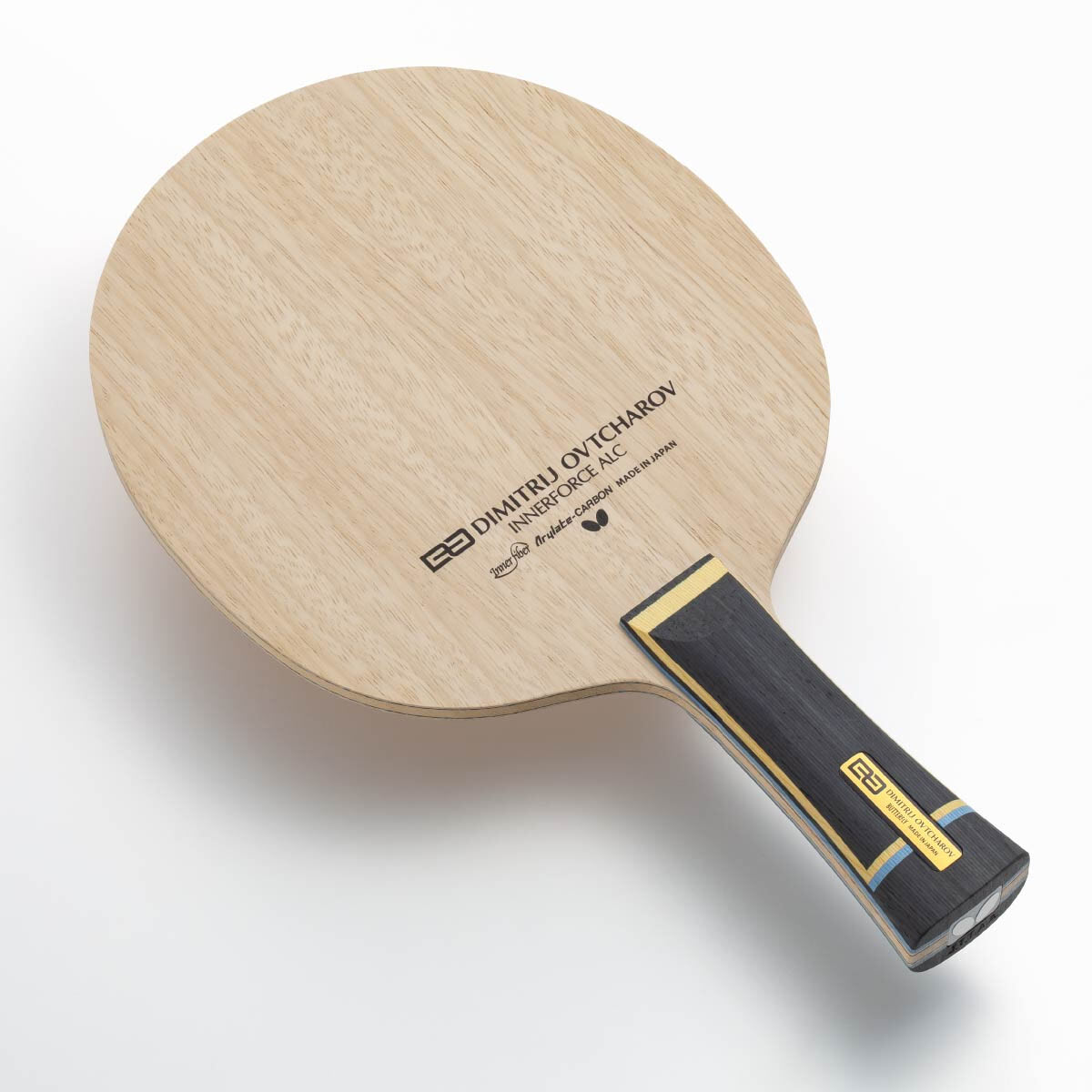
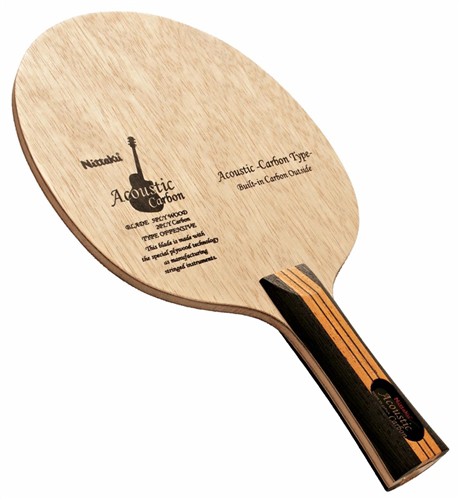
What makes that genuinely interesting is that the two blades get there through opposite engineering approaches. The Ovtcharov Innerforce ALC sandwiches its arylate-carbon layers inside the wood, an inner-ALC construction that per TTGearLab’s lab testing gives it an elasticity score (Ep) of 2.02 and a vibration profile noticeably softer than Viscaria. The Nittaku Acoustic Carbon puts its FE carbon on the outside, 5 wood plies plus 2 outer FE carbon layers, a construction that usually produces a harder, more direct-feeling blade — yet per Revspin and TableTennisDaily reviews it keeps wood-like dwell and feel despite the outer FE carbon layers. Two different structural philosophies, nearly identical outcomes on paper.
Where They Actually Differ
Since the axis numbers will not decide this for you, look at the qualitative differences instead. Price is one real gap: the Acoustic Carbon’s own pros note it is priced below comparable Butterfly carbon blades, while the Innerforce ALC’s cons openly state its premium price reflects flagship positioning. If budget matters and the performance is this close, that is a legitimate tiebreaker.
Rubber compatibility is another. The Acoustic Carbon’s pros specifically call out that it soaks up sticky and tacky rubbers like NEO Hurricane 3 without trampolining, a claim aimed squarely at players using Chinese tacky sponge. The Innerforce ALC’s bestFor description, by contrast, targets European-style power attackers and players switching from Viscaria, suggesting a rubber ecosystem more oriented toward European and Japanese tensor rubbers like Tenergy.
Technique demand differs too, even with near-identical control scores. The Innerforce ALC’s own cons state it requires advanced technique and beginners will struggle to control it, while the Acoustic Carbon’s bestFor description reaches slightly wider, to intermediate to advanced offensive players. The Acoustic Carbon’s cons do warn of a steep learning curve of their own, so neither is a beginner blade, but the Innerforce ALC sets the bar marginally higher.
Handle and Head Differences
The Innerforce ALC has a documented larger head (158 x 152mm) and thicker build (6.2mm) versus the Acoustic Carbon’s thinner 5.5mm profile, despite similar weight (91g vs approximately 90g). The Acoustic Carbon also offers a Large Handle and Chinese Penhold variant that the Innerforce ALC’s FL/ST/AN lineup does not list.
Should You Switch Between Them?
Given how close the performance numbers are, switching from one to the other purely for better numbers is not a good reason — you will not feel a 0.3-point control difference in a match. The better reasons to switch are structural: move to the Acoustic Carbon if you play with tacky Chinese rubber and want to save money over a comparable Butterfly carbon blade; move to the Innerforce ALC if you are already invested in European tensor rubber and want Butterfly’s specific inner-ALC dwell character, and your technique is advanced enough to handle it.
Bottom Line
These are two of the most evenly matched blades in this dataset. Do not decide on speed, control, or hardness — they are tied or nearly tied. Decide on price, rubber ecosystem, and how advanced your technique actually is.
Frequently asked questions
Which blade has better raw performance numbers?
Neither -- speed and hardness are exactly tied, and control, stiffness and consistency all differ by 0.5 points or less, making these the closest-matched blades in this comparison set.
Is the Nittaku Acoustic Carbon cheaper than the Butterfly Ovtcharov Innerforce ALC?
Its own pros describe it as priced below comparable Butterfly carbon blades, while the Innerforce ALC's cons cite a premium price for its flagship positioning.
Which blade suits tacky Chinese rubber better?
The Acoustic Carbon, whose pros specifically note it soaks up sticky and tacky rubbers like NEO Hurricane 3 without trampolining.
Is one of these blades easier to control for less advanced players?
The Acoustic Carbon's bestFor reaches slightly wider, to intermediate-to-advanced players, while the Innerforce ALC's own cons say beginners will struggle to control it.