Nittaku Acoustic Carbon vs Yasaka Ma Lin Carbon: Which Should You Buy?
| Nittaku Acoustic Carbon | Yasaka Ma Lin Carbon | |
|---|---|---|
| Our rating | 8.8/10 | 8.4/10 |
| feel | Medium-hard outer carbon with surprising wood-like dwell and ball retention; crisp sound on contact | medium-hard carbon, controllable, excellent value |
| handle | FL, ST (also Large Handle and Chinese Penhold variants available) | FL |
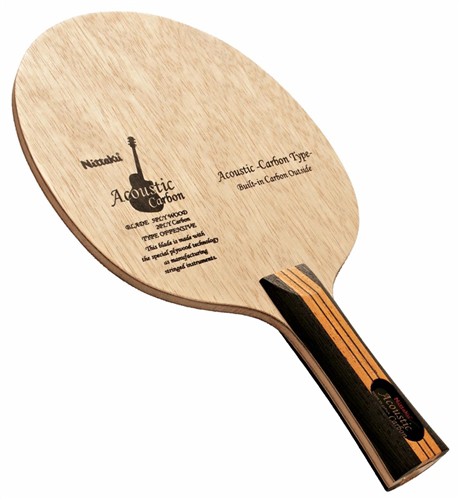
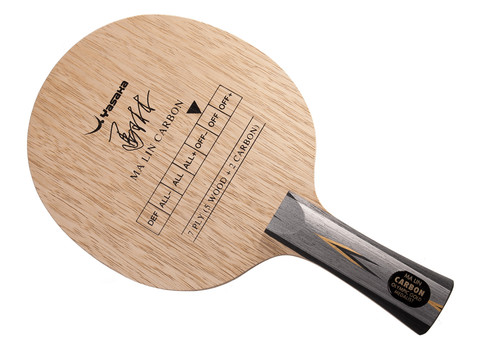
| plies | 7 plies — 5 wood + 2 FE carbon (Limba - FE Carbon - Limba - Tung - Limba - FE Carbon - Limba) | 5 ply wood + 2 ply Carbon (limba/ayous with a carbon layer) |
| speed | OFF | OFF- |
| thickness_mm | 5.5mm | 6 |
| weight_g | approx 90g | 88 |
We may earn a commission from links on this page. Learn more.
Two carbon blades, closer than the price gap suggests
Nittaku Acoustic Carbon and Yasaka Ma Lin Carbon are both offensive carbon blades, and unlike some other pairs in this category, every axis delta between them is modest. Speed: 9.2 vs 8.6, delta 0.6. Control: 9.0 vs 8.4, delta 0.6. Stiffness: 6.4 vs 5.5, delta 0.9 — the largest gap on the sheet, and still not a dramatic one. Hardness: 6.4 vs 6.2, delta 0.2, essentially identical. Consistency: 8.6 vs 8.5, delta 0.1 — a rounding error. If you are choosing between these two purely on performance numbers, the honest answer is that there isn’t much to choose.
Where the real difference actually lives
The story here isn’t the radar chart, it’s everything around it. Yasaka’s own review aggregate flags that unit-to-unit weight varies widely, from about 81g to 91g, while the Acoustic Carbon is far more consistent, landing at or around 90g across units. If you buy the Ma Lin Carbon expecting a specific feel, you may not get the same blade your friend has. TTGearLab’s lab test report and Megaspin’s product reviews both note handle quality complaints too — a rough or thin, flat grip and fragile side wood on some units — a manufacturing consistency issue that simply doesn’t show up in an axis-by-axis comparison but matters in practice.
Price is the other real differentiator. Reviewers describe the Ma Lin Carbon as very cheap for its class, sometimes found in the 20-to-55 USD range, while the Acoustic Carbon is priced as a premium option, still positioned below comparable Butterfly carbon blades but well above Yasaka’s budget entry.
What the sources say
Revspin’s aggregated user data underlies both radar profiles here. On the Yasaka side, Reddit’s r/tabletennis search threads and TTGearLab’s dedicated lab report both converge on the same verdict: excellent control, a large and forgiving sweet spot, but a blade that is not fast at light impact — you must supply your own power with a full swing. That’s an important nuance the raw speed number doesn’t capture: an 8.6 speed score built on hard-swing pop, not free speed off a light touch. The Acoustic Carbon, by contrast, is praised across Revspin, TableTennisDaily, and TableTennisReference for a large sweet spot that balances speed and control more passively, needing less commitment to access its speed ceiling.
Migration advice
If you already own the Ma Lin Carbon and are considering the upgrade, the 0.6-point speed and control gaps are real but not transformative — you are not switching to escape a limitation, you are switching for consistency, both in build quality and in stroke-to-stroke feel, and for the extra 0.4 points of stiffness that gives slightly crisper feedback on your hardest hits. If your Ma Lin Carbon unit happens to be on the lighter end of its 81-91g range and feels underpowered, that is a units-variance problem the Acoustic Carbon’s tighter manufacturing tolerance solves more reliably than any spec on this page.
Going the other direction, from Acoustic Carbon to Ma Lin Carbon, makes sense mainly on budget grounds. You give up a modest amount of stiffness and consistency but gain a genuinely cheap, well-regarded carbon blade with a large, forgiving sweet spot for short play, blocks, and touch shots.
Fit and scenario
Both blades target improving-to-advanced attacking players, and both work best when the player supplies committed power rather than relying on free rebound. The Acoustic Carbon slightly favors mid-table loopers with sticky forehand rubber and multiple handle options, including Large Handle and Chinese Penhold variants. The Ma Lin Carbon is a stronger fit for all-round attackers and penholders on a tighter budget who are willing to accept some unit-to-unit variance in exchange for real value, and who plan to drive the ball with a full stroke rather than lean on borrowed pace.
Frequently asked questions
How different are these two carbon blades in actual performance?
Not very. Every axis delta is under 1 point except stiffness (0.9), including a near-identical 8.6 vs 8.5 consistency score.
Why does the Ma Lin Carbon cost so much less?
Reviewers note it is priced well below the Acoustic Carbon, sometimes found for 20 to 55 USD, though unit weight varies more widely (81 to 91g) than the more consistent Acoustic Carbon.
Does the Ma Lin Carbon feel slow?
Reviews say it's not fast at light impact and needs a full committed swing to access its speed, unlike the Acoustic Carbon's more passive speed delivery.
Which handle options does each blade offer?
The Acoustic Carbon comes in FL, ST, Large Handle, and Chinese Penhold. The Ma Lin Carbon is offered mainly in FL.