Stiga Intensity NCT Carbon Blade Review: Value Carbon with Big Sweet Spot
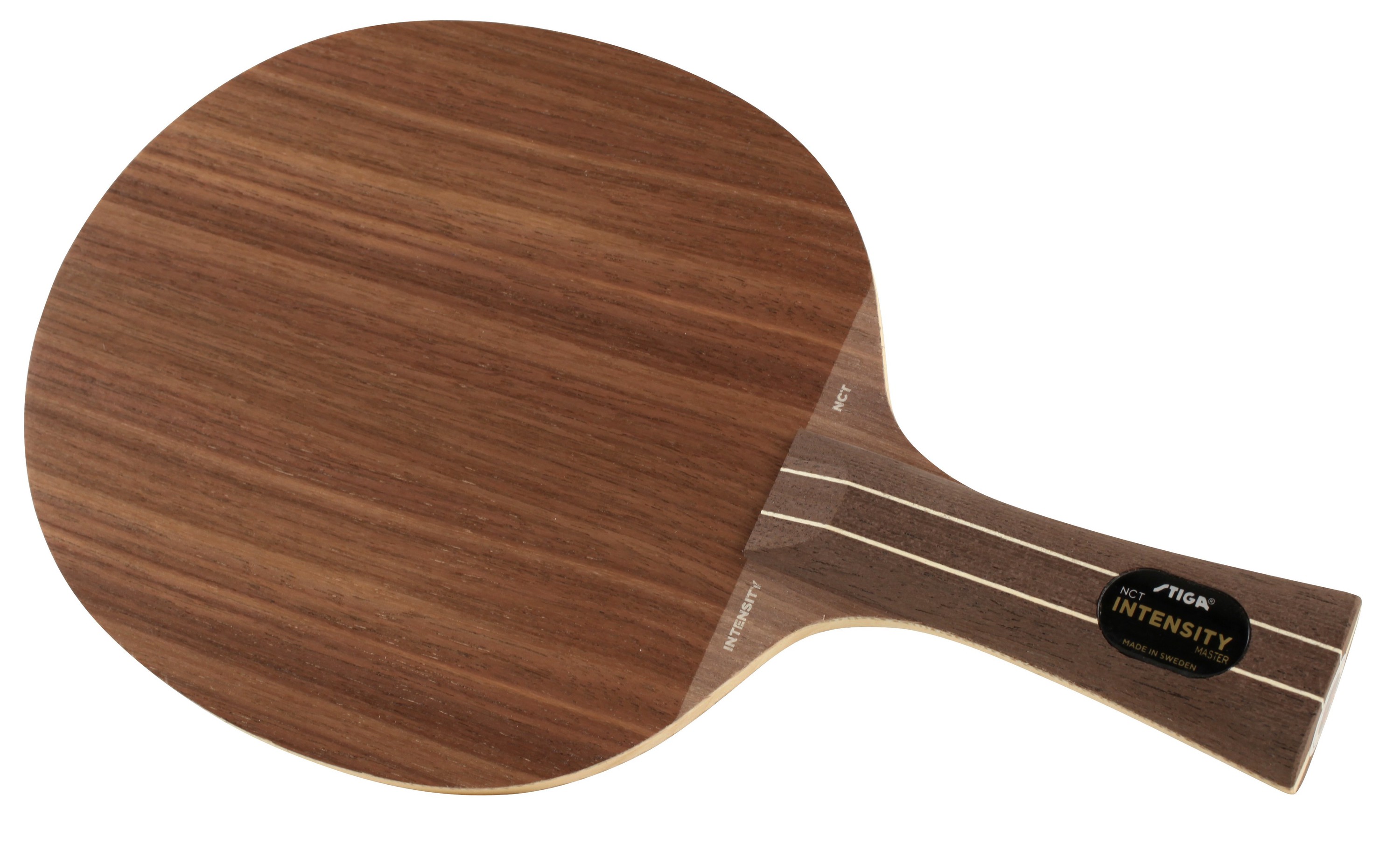
Pros
- Large sweet spot turns off-center contact into a usable ball, not a mishit
- Long dwell loads heavy topspin on forehand loops
- Light 80-82 gram build keeps the arm quick through mid-distance rallies
- Sticky Chinese-style rubbers pair cleanly on both wings
- Trajectory stays consistent and predictable looping at OFF-
- Undercuts harder carbon blades on price in its class
Cons
- Blocks and power smashes feel underpowered against stiffer alternatives
- Sharp edges where face meets handle can dig into a shakehand player's middle finger
- Built for offense, not defensive or all-round play
- Demands solid fundamentals, so beginners should skip it
The Stiga Intensity NCT Carbon extends the popular Intensity line by slotting two ultra-thin Nano Carbon Technology layers into the 5-ply wood core. It keeps the soft, dwell-rich feel of the original all-wood Intensity and adds stability plus a clear bump in elasticity. The speed class is OFF-, aimed at players who want carbon’s precision without the unforgiving pace of a full OFF+ setup. Loop-style players have built a loyal following around it as a reliable, lightweight carbon blade at a mid-range price.
Performance
The forehand is where the Intensity NCT Carbon earns its reputation, specifically in topspin exchanges. The extended dwell holds the ball on the rubber long enough to load heavy rotation, and the loops come off with a sharp, penetrating trajectory that carries deep into the opponent’s court. The sweet spot is large, so off-center contact still gives you a reliable ball instead of a mishit — a help if you’re still building consistency. Speed sits at OFF-: fast enough for competitive play, still controllable through multi-ball rallies and cross-court exchanges. The carbon layers stiffen it up against the all-wood Intensity, improving power transfer on forehand drives without tipping into the wild territory of stiffer OFF+ composites.
Mid-distance is the blade’s best zone. The trajectory fits the looping exchanges that define the modern game, and the light build — usually around 80 to 82 grams — keeps the arm quick without wearing it out. Sticky rubbers pair well here; the NCT construction handles the feedback demands of Chinese-style rubber on both wings. On the backhand, attacking exchanges are solid, but the blade’s lower stiffness next to harder carbon frames means backhand blocks need more deliberate technique to hold depth.
Passive blocks and power smashes are where it runs out of road. Reviewers across sources agree blocking feels underpowered against harder, stiffer alternatives. The close-to-table short game takes adjustment time too, and if you’re coming off a softer blade, give it several sessions before the carbon’s effect on push and flick contact starts to feel natural. One build note: on some units the edges where the face meets the handle are sharp enough to dig into a shakehand player’s middle finger during long sessions. A light sanding of that transition zone fixes it. The picture holds across every source — an offensive looper’s blade that pays back technique and a commitment to spin.
What Reviewers Agree (and Disagree) On
Reviewers across Revspin, Megaspin, Bladerubber.net, and Tabletennis-reference converge on the same core findings: the Intensity NCT Carbon is excellent for looping and has an unusually large sweet spot for a carbon composite, but it falls short for blocking and smashing. The main area of disagreement is around who qualifies as a suitable player. Some sources recommend it broadly for intermediate players stepping up from all-wood equipment, while others caution that its demanding feedback makes it better reserved for advanced players with solid technique already established.
Who Should Buy It
This blade suits offensive players at the intermediate-to-advanced level who have moved past all-wood equipment and want their first or second quality carbon blade without the pace penalties of an aggressive OFF+ setup. It is especially well-matched for loop-dominant players who use sticky rubbers and prioritize spin and consistency over raw smashing power. Players who rely on heavy blocking, passive defense, or serve-and-block tactics should look elsewhere for a stiffer or more control-oriented setup.
FAQ
What is the speed class of the Stiga Intensity NCT Carbon?
The blade is classified at OFF- speed, which is offensive but slightly below a full OFF rating. It is faster than all-round blades but more controllable than aggressive OFF+ composites.
How does the NCT Carbon differ from the standard Intensity NCT?
The NCT Carbon adds two ultra-thin Nano Carbon Technology layers to the 5-ply wood core of the all-wood Intensity NCT. This increases elasticity and stability, boosting power on loops and drives while maintaining the dwell time the Intensity family is known for.
Is it suitable for beginners?
No. Multiple reviewers agree the blade demands solid technical fundamentals. Beginners and casual players will likely find it too demanding and would benefit more from a control-oriented all-round blade while developing their strokes.
What rubbers pair best with this blade?
Sticky Chinese-style rubbers pair particularly well due to the blade’s carbon-enhanced stability and feedback. European tensor rubbers in the medium hardness range also work well for players wanting a spin-speed balance on both sides.
Is the handle comfortable for shakehand players?
Generally yes, but some units have sharp edges where the blade face transitions into the handle, which can irritate the middle finger during long sessions. A light pass with fine sandpaper at the transition area resolves this issue on affected units.