Butterfly Hadraw SR Review: Premium 7-Ply All-Wood Offensive Blade
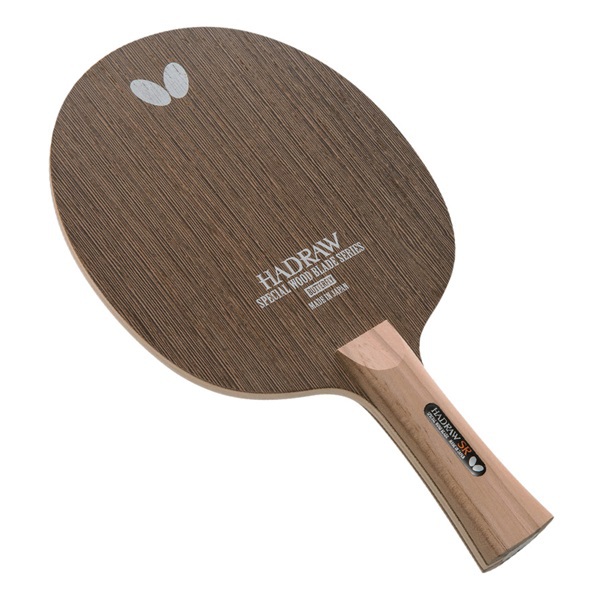
Pros
- True OFF+ speed from 100% all-wood construction — no carbon or synthetic layers
- Wenge outer veneers deliver a satisfying pop with more dwell than carbon blades at similar speeds
- Made in Japan to exacting quality standards
- Comfortable woody resonance that feels lively in the hand across multiple rubber types
- Distinctive aesthetic with beautiful wenge grain and color
- Professional pedigree — used by Jon Persson and HU Melek
Cons
- Rubber pairing is critical — hard or thick rubbers cause the ball to fly before spin develops
- Discontinued, so availability is limited to secondary market
- Players transitioning from carbon blades may find the dwell unfamiliar at first
- Polarizing community reception — some players find it stiff and unforgiving
A 7-ply all-wood blade rated OFF+ is rare. That speed normally belongs to carbon or composite builds, yet the Hadraw SR reaches it with nothing but wood. Introduced in 2015 and made in Japan, it was part of Butterfly’s Hadraw series, a lineup built on pure natural wood and premium timber selection, no synthetic fiber anywhere. The outer veneers are wenge, a tropical hardwood that woodworkers value, and now blade engineers do too, for its hardness paired with surprising elasticity. The result feels fast and powerful at contact but keeps the dwell that sets wood apart from carbon-layered blades. The SR sits at the fast end of the Hadraw family, made for attackers who want more speed without losing wood feedback.
Performance
In play it backs up the high-speed billing. Flat hitting feels firm and crisp: the wenge outer veneers move energy into the ball efficiently and produce a pop players usually link to carbon, not pure wood. But the all-wood build keeps the ball on the surface a touch longer than a composite at the same speed rating, opening a window to brush topspin that faster carbon blades can close on you.
Looping is where players split. Match it with softer rubbers, around Tenergy 05-FX or similar medium-soft sheets, and you get strong spin and a ball that sits on the rubber long enough to load the stroke. Mount hard rubber or extra-thick sponge and the story flips: the stiff wenge veneers and hard rubber together fling the ball off before spin develops, and the contact turns floaty and uncontrolled. That rubber dependency is the single most important caveat before you buy.
Paired right, directional control earns good marks. The firm center core, three equally thick wood plies, gives a stable, predictable platform that sends the ball where you aim. Several reviewers say that despite the speed they placed the ball well and trusted the accuracy. Blocking and counter-driving ride the same stability, with no vibration coming through the handle during fast exchanges.
At the table the short game holds up well for an OFF+ blade. The wood build keeps some of the touch and sensitivity carbon tends to strip away, so flicks and drop shots come easier than they would on an equally fast composite. Coming from a 5-ply or softer blade, you’ll need an adjustment period, since the 7-ply stiffness cuts your margin for error on delicate shots.
What Reviewers Agree (and Disagree) On
Across Revspin, Tabletennis Reference, and the wider community, the Hadraw SR averages around 7.3 to 8.0 out of 10, a positive but not adored reception. The praise lands on the same things: the mix of wood feel and high speed, the Japanese build quality, and the look of the wenge grain. The fight is over rubber compatibility. Players who found the right pairing, usually medium-soft, rate it highly; those who tried it with harder or thicker rubbers ran into control problems and scored it much lower. A smaller group just found the 7-ply too firm and went back to the softer arc of a 5-ply. The pro link to Jon Persson and HU Melek vouches for the quality ceiling, even if everyday players find it harder to unlock.
Who Should Buy It
The Hadraw SR is best suited to advanced or intermediate-advanced players who already have experience with fast, stiff blades and understand how to select rubber pairings that complement blade characteristics. Players who grew up on all-wood blades and want to push into OFF+ territory without moving to carbon will find the Hadraw SR the most natural progression. Loopers who generate their own spin and prefer to feel the ball on the blade will appreciate the dwell the all-wood construction retains even at this speed. Conversely, beginners, intermediate players still developing technique, and anyone who prefers a soft, forgiving setup should look at something slower and more flexible. Players who already rely on hard rubber sheets would need to reconsider their rubber choice before purchasing this blade.
FAQ
Is the Butterfly Hadraw SR a carbon blade?
No. The Hadraw SR is a 7-ply all-wood blade with no carbon, arylate, or any synthetic fiber layers. All seven plies are natural wood, with wenge species used for the outer veneers.
What speed class is the Hadraw SR?
The Hadraw SR is rated at OFF+ speed by most reviewers and retailers. Tabletennis Reference assigns it a speed rating of 10.8 on their scale, placing it firmly in the offensive-plus category.
What rubbers work best with the Hadraw SR?
Soft to medium-soft tensor or tacky rubbers work best. Multiple reviewers specifically warn against hard or extra-thick sponge rubbers, which cause the ball to fly away before spin develops. Sheets like Tenergy 05-FX or medium-hardness variants of Tenergy are frequently recommended.
Is the Hadraw SR still in production?
No. The Hadraw SR is discontinued by Butterfly and is no longer listed as a current product. It can still be found through secondary-market sellers and specialty table tennis retailers who carry remaining stock.
How thick is the Hadraw SR?
The blade measures 6.6 mm thick and weighs approximately 91 g, which is in the normal range for a 7-ply all-wood offensive blade.
Who are the professional players associated with the Hadraw SR?
The blade has been associated with Jon Persson, the Swedish international, and HU Melek, both of whom have been linked to the Hadraw SR in Butterfly promotional and retail materials.