Sanwei T5000 Carbon Blade Review: Best Budget Offensive Carbon Under $20
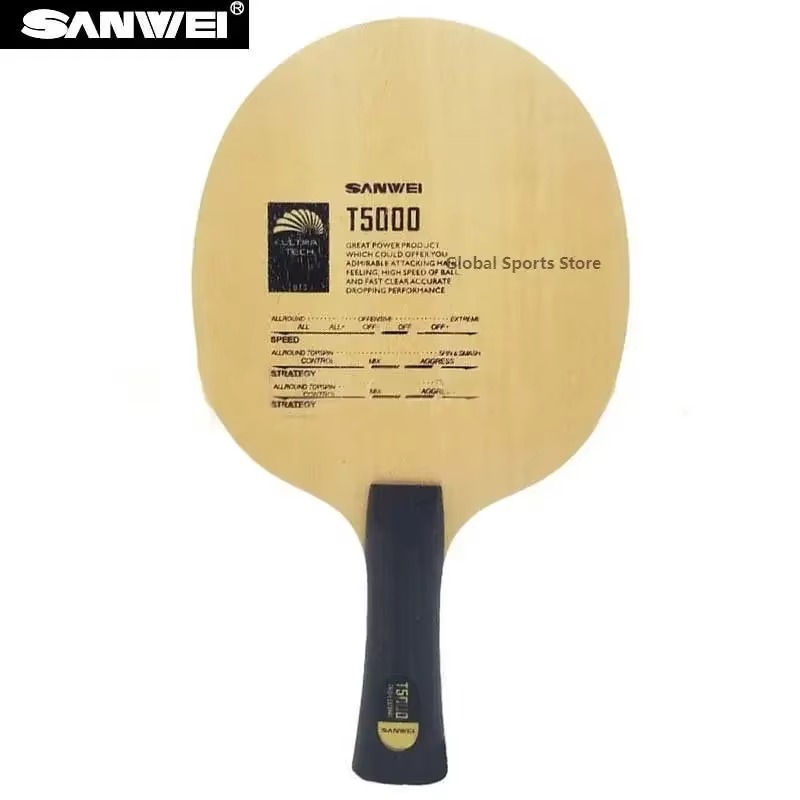
Pros
- Exceptional value for money at under 15 USD
- 5+2 carbon construction provides stiff, high-rebound feel
- Strong sweet spot consistency across the entire hitting surface
- Good looping ability with a noticeable catapult effect
- Works well with a wide range of rubbers including high-end options like Tenergy 05
- Koto outer ply gives useful vibration feedback
Cons
- Inner vs outer carbon version ambiguity makes ordering uncertain
- Slightly slower looping than comparable inner-carbon blades from DHS or Yinhe
- Sound on ball contact is not universally liked
- Build quality does not match premium blades in finish and feel
The Sanwei T5000 has worked its way into nearly every budget-blade conversation. At roughly 10 to 15 USD, it puts a 5-ply wood plus 2-ply carbon (7 total plies) construction in your hand, the kind of build you normally see on blades costing three to five times as much. The pitch is for the offensive player who wants real carbon-blade speed and trampoline without paying premium. Communities from Revspin to TableTennisDaily have marked it well, which makes it a real value pick in the carbon category.
Performance
The T5000 is built on a 5+2 carbon architecture: five wood plies around two carbon fiber layers. That makes a stiff, high-rebound profile tuned for fast attack and loop play. The trampoline is pronounced, so flat hits and topspin drives leave the blade with clearly more pace than a comparable all-wood option. Revspin user data puts speed at 7.9 and control at 8.4 out of 10, a split that says the blade keeps its touch instead of trading it all for pace. The Koto outer ply feeds back vibration that helps you sense contact and time loops.
Close to the table the short game holds up, and several reviewers had no trouble with backhand pushes or defensive returns. Mid-distance looping is a strength too; the carbon gives the stiffness you need to throw long, low-bouncing topspin arcs. Players have run it with demanding rubbers like Tenergy 05, Donic BlueFire M2, and Chinese tackies like Hurricane 3. One TableTennisDaily user who played it for two months put it on par with a Primorac Carbon, a far pricier blade.
The main limit is a small drop in dwell compared with inner-carbon blades from DHS or Yinhe. If you loop with soft, long ball contact, the T5000 reads a touch quicker and more linear than you’d expect. The stiffness also punishes a mistake a little harder than a flexible all-wood blade would. Weight sits around 86g, heavy for a budget blade but normal for a 7-ply carbon build.
What Reviewers Agree (and Disagree) On
Two points draw near-universal agreement: the T5000 is outstanding value, and its control ratings run higher than you’d expect from a carbon blade in this bracket. Most reviewers also agree it plays well for looping and offensive close-table exchanges. The real argument is over whether a given unit is inner or outer carbon, since Sanwei seems to have sold both under the same name with inconsistent labeling. TableTennisDaily users ordered outer carbon and got inner. Revspin lists it as Inner Carbon in the manufacturer details. The mix-up doesn’t seem to change how the blade plays, but it’s a real quality-control worry. A smaller dispute is over speed: some find it fast enough for club-level offense, while players coming off premium inner-carbon blades feel it lag a little when they loop at full power.
Who Should Buy It
The Sanwei T5000 is the right blade for an offensive player who wants to experience carbon-blade performance without a large financial commitment. It is ideal for beginners who have outgrown their first all-wood blade, intermediate club players building an offensive style, and anyone who wants a reliable backup racket. Players who prioritize maximum loop dwell time or use a European-style power game at advanced levels may want to step up to a mid-range inner carbon from a larger brand. But for anyone under approximately 1800 USATT or equivalent, the T5000 offers a level of performance-to-cost ratio that is very hard to beat in the carbon blade market.
FAQ
Is the Sanwei T5000 an inner carbon or outer carbon blade?
Both versions appear to exist and Sanwei has sold the T5000 under the same name with inconsistent labeling across sellers. Revspin lists it as Inner Carbon with 7 plies (5 wood plus 2 carbon) at 6.5mm thickness. TableTennisDaily users have reported receiving inner carbon when ordering outer carbon. If the carbon variant matters for your game, confirm with the seller before purchasing and check product photos carefully.
What rubbers work best with the Sanwei T5000?
Players report good results with medium-hard tacky Chinese rubbers like Hurricane 3 Neo and Sanwei T88-III, as well as European tensor rubbers like Tenergy 05, Donic BlueFire M2, and Fastarc C-1. The stiff carbon construction pairs well with rubbers that have their own spin and speed, letting the blade handle energy transfer efficiently.
Is the Sanwei T5000 good for beginners?
Yes, for a beginner who wants to learn offensive technique it is a solid choice. The high control rating (8.4 on Revspin) and consistent sweet spot mean fewer mishits during learning. However, true beginners who need maximum forgiveness and slow speed may prefer an all-wood blade first and upgrade to the T5000 once they have basic strokes down.
How does the Sanwei T5000 compare to the Butterfly Innerforce Layer ALC or similar blades?
The T5000 is far cheaper (around 10-15 USD vs 100+ USD for the Innerforce ALC) but significantly slower and less refined. The Innerforce ALC delivers more dwell time, better loop quality, and more consistent feel. The T5000 is the right choice if budget is the primary constraint; players who have the budget for premium blades will feel a clear performance difference.
What is the speed rating of the Sanwei T5000?
Revspin community ratings average 7.9 out of 10 for speed, placing it in the OFF category. It is fast enough for aggressive looping and flat attacking at club level, but not at the upper end of the OFF+ range. The stiff 5+2 carbon construction creates a trampoline effect that boosts raw ball speed beyond what an all-wood blade produces.
How long does the Sanwei T5000 blade last?
At its price point the durability is reported as good. One retailer noted no warping or delamination after 30 hours of play. Community reviewers who have used it for two or more months report no degradation in performance. The low price also means replacement is not a major financial concern if the blade does eventually wear.