Butterfly Viscaria vs Sanwei T5000: Which Should You Buy?
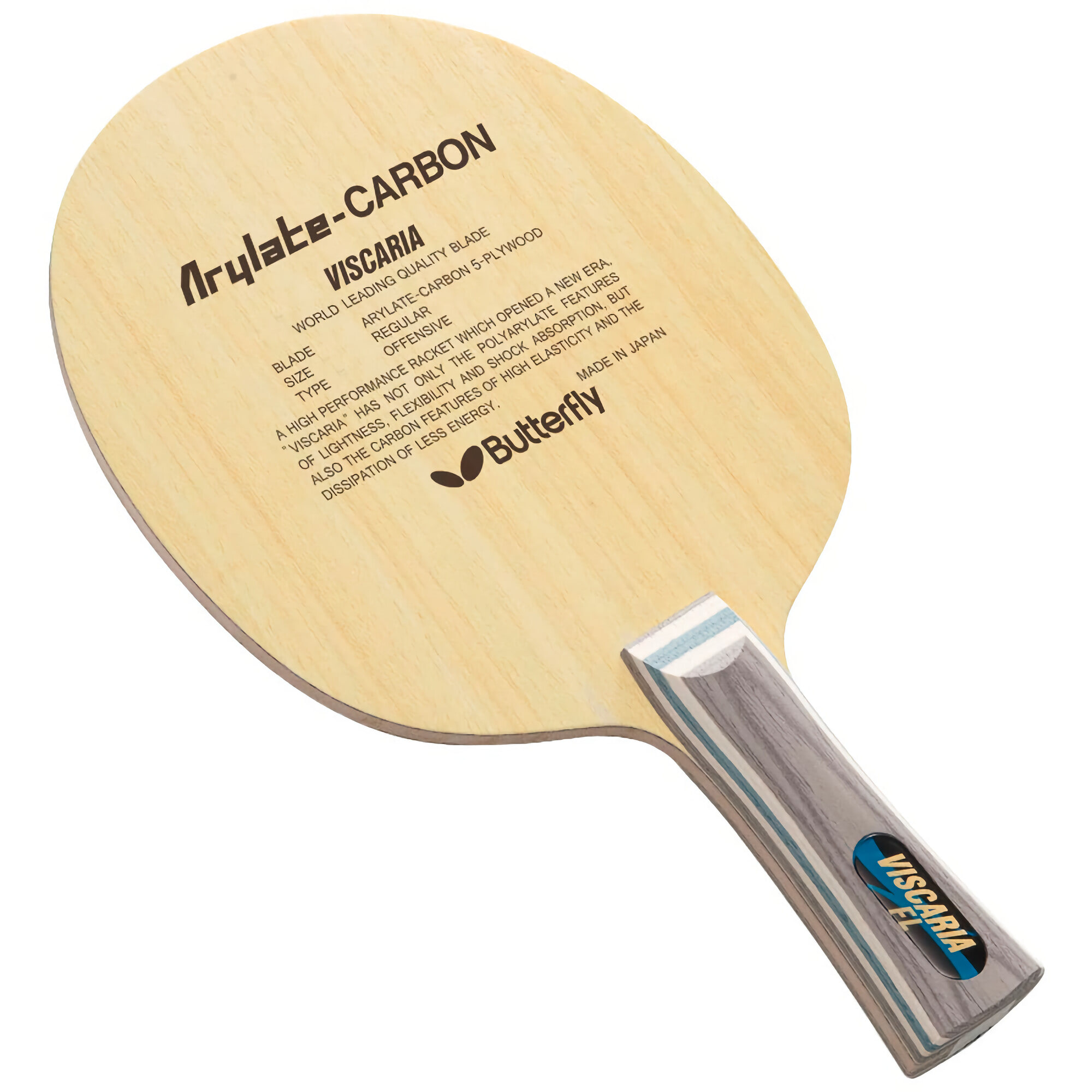
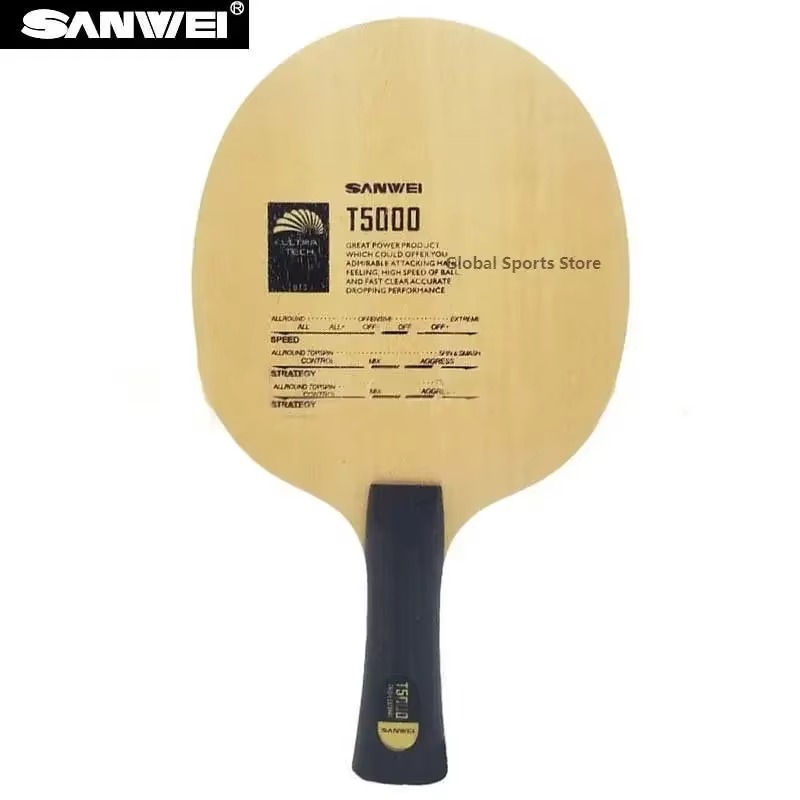
| Butterfly Viscaria | Sanwei T5000 | |
|---|---|---|
| Our rating | 9.0/10 | 8.1/10 |
| feel | medium-hard | Stiff with crisp carbon feedback; solid rebound and good sweet spot consistency |
| handle | FL/ST/AN | Flared (FL) |
| plies | 5W+2 Arylate-Carbon | 5 wood + 2 carbon (7 total) |
| speed | OFF | OFF |
| thickness_mm | 5.8 | 6.5 |
| weight_g | 87 | 86 |
We may earn a commission from links on this page. Learn more.
The real question: is Viscaria worth 10x the price?
Butterfly Viscaria and Sanwei T5000 are both attacking carbon blades built the same way on paper — five wood plies plus two carbon-fiber layers, a koto outer veneer, and an OFF speed rating — but they sit at opposite ends of the price spectrum. The Viscaria runs well over a thousand RMB domestically and sits at a premium tier internationally; the T5000 costs under 15 USD. That price gap is the entire reason this comparison exists, so let’s see what the radar numbers actually say about what you get for the extra money.
Where the gap is real: speed and hardness
The clearest separation in the axis data is speed: 9.0 for the Viscaria versus 7.9 for the T5000, a 1.1-point gap on this radar scale. That is not a marginal difference — it is the kind of gap you feel as extra ball flight time you have to compensate for on your backswing when you first switch blades. Hardness runs the same direction, 5.7 versus 4.8, a 0.9-point gap: the Viscaria’s arylate-carbon build gives a firmer, snappier response off contact, which is part of why owners describe its release as quick and crisp and why it demands an active, committed stroke rather than a passive block-and-poke game.
Where the gap is not real: consistency and stiffness
Here is the finding that should reassure T5000 owners: on the consistency axis, the T5000 actually scores higher than the Viscaria — a perfect 10 versus 9.2. Revspin and TableTennisDaily reviewers describe the T5000’s sweet spot as remarkably even across the whole blade face, and Sanwei backs that up by noting it holds up well even paired with a premium rubber like Tenergy 05. Stiffness likewise runs 5.9 for the T5000 against 5.2 for the Viscaria — the cheaper blade is actually the stiffer, higher-rebound feeling one of the two, according to its own build description. If you assumed expensive automatically means stiffer and more consistent, these two numbers say otherwise. Control sits close too, 8.8 versus 8.4, a 0.4-point gap that most intermediate players will not notice rally to rally.
What the sources actually say
Megaspin’s product-review page for the Viscaria and the community reviews aggregated by Revspin for the T5000 tell two different but consistent stories: the Viscaria’s write-ups keep circling back to power and forgiveness for players with a complete looping stroke, while T5000 reviews on TableTennisDaily’s forum thread and TokSpin’s listing keep circling back to one word — value. Nobody claims the T5000 punches at Viscaria’s speed ceiling; nobody claims the Viscaria is a beginner blade either.
Should you switch?
If you already own a Viscaria, downgrading to a T5000 to save money doesn’t make sense unless you specifically want a cheap travel or backup blade — you’d be giving up 1.1 points of speed and 0.9 points of hardness for a small consistency gain you’re unlikely to need. If you own a T5000 and are wondering whether the Viscaria justifies the price jump, the honest answer depends on your stroke: the Viscaria’s cons list is explicit that passive or borrowed-pace players won’t unlock its deep power, so if you’re still developing a full loop-driving swing, that extra 1.1 points of speed will sit unused and you’ll just be paying for potential you can’t cash in yet.
Bottom line by player type
Beginners and budget-conscious intermediates upgrading from all-wood: take the T5000. Its build spec — 5+2 carbon, 6.5mm thick, 86g — plus its perfect consistency score make it a low-risk entry into carbon-blade speed, and Sanwei explicitly pitches it as a club-player backup too. Advanced shakehand attackers with a mature loop game who want the extra speed and hardness and can absorb the cost: the Viscaria remains the higher-ceiling tool, backed by its elite pedigree through Fan Zhendong’s early ALC-blade career and consistent praise across Mogu Liao Pingpang, Heima Liao Pingpang and Megaspin for handling looping, blocking, flat hitting and the short game in one blade.
Frequently asked questions
Is the Sanwei T5000 basically a cheap clone of the Viscaria?
No. Sources describe the Viscaria as an ALC (arylate carbon) blade built to unlock power for a complete looping stroke, while the T5000 is a wood-plus-carbon budget blade praised mainly for value and sweet-spot consistency — it actually scores 10 out of 10 on consistency versus the Viscaria's 9.2. The price gap points to a different tier of materials and finish, not an identical blade at a discount.
Will I feel the 1.1-point speed difference?
Yes — a gap that size on this radar scale is generally noticeable in ball flight and dwell time, especially on faster loops and counter-hits.
Should I upgrade from the T5000 to the Viscaria?
Only if you already have a complete, active loop-driving stroke. The Viscaria's own listed con is that passive or borrowed-pace players cannot unlock its power, so the upgrade only pays off once your technique demands more speed than the T5000 gives.
Is the T5000 good enough to pair with Tenergy-level rubber?
According to its sourced pros, yes — reviewers note it holds up well with high-end rubbers like Tenergy 05, though it plays somewhat slower on the loop than comparable inner-carbon blades from DHS or Yinhe.