TIBHAR Darko Jorgic Infinity Carbon Review: Two Carbon Positions, One Blade
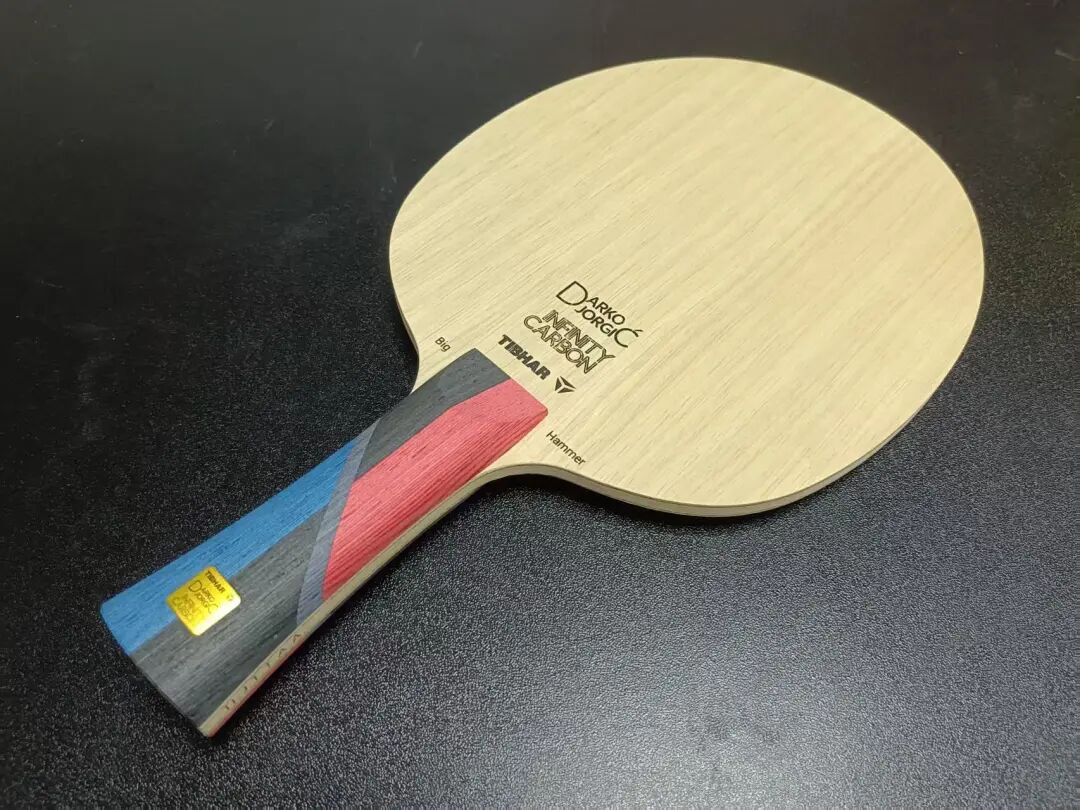
Pros
- Distinct inner- and outer-carbon faces offer two response profiles
- Inner face favors placement and spin-oriented opening play
- Outer face favors quicker, more direct backhand attacks
- The tested sample remained manageable at 87.9 g
Cons
- The asymmetric feel will not suit players who want the same response on both wings
- A single detailed field report cannot establish how much the difference varies by rubber or blade sample
- Specialist design gives fewer reasons to buy if both wings use similar strokes
The design question
TIBHAR describes the Infinity Carbon as a 5+2 offensive blade with an inner-carbon construction on one face and an outer-carbon construction on the other. Its published weight is 85 g ± 5 g. The carbon position is intended to offer more dwell and placement on one side and a crisper, faster release on the other. It is an unusual solution to a real fitting problem: some players want a patient, spin-led forehand and an immediately dangerous backhand from the same racket.
The detailed performance evidence available to us is one August field report by Heima Liao Pingpang, alongside TIBHAR’s specifications. A separate English page repeats that report closely and is not treated as an independent test here. The 8.1/10 score is an editorial assessment with limited evidence, not a measured advantage over conventional blades.
Build and sample measurements
The field report’s sample measured 87.9 g, about 5.75 mm thick, with a head near 158 × 151 mm. Those are measurements of one blade. They sit within TIBHAR’s weight range, but buyers should expect normal sample variation. The handle was reported as fairly slim and the balance slightly toward the head. Both outer faces are wood; the difference is where the composite layer sits below them.
What the two faces change
On the inner-carbon face, the tester found a more settled response in touch play and a longer sense of contact when opening with topspin. The outer-carbon face released the ball sooner and felt firmer on direct attacks. The tester also tried reversing the usual forehand-inner, backhand-outer arrangement and found the outer face still capable of producing a usable loop. This makes the orientation a fitting choice, not a rule printed into the blade.
TIBHAR’s own positioning is consistent with that report: one face for placement and spin, the other for speed. Yet the magnitude of the difference has not been established by controlled, side-by-side testing with identical rubbers. Rubber choice and player technique may be as important as the carbon position. Anyone expecting two entirely separate rackets in one handle may be disappointed.
Who should choose it
The clearest case is a player whose forehand uses longer, spin-heavy strokes while the backhand emphasizes early contact, punches, and quick counters. That is where the reported inner/outer contrast has a purpose. If you want the same predictable response on both wings, a conventional inner-carbon blade such as the Butterfly Innerforce Layer ALC is a simpler comparison to test first.
The Infinity Carbon is distinctive and plausibly useful, but the evidence base is narrower than for long-established blades. Buy for its specific two-wing design, not for an assumption that asymmetry automatically makes every stroke better.
FAQ
Which face is for the forehand?
TIBHAR presents the inner-carbon face as the controlled, spin-oriented side and the outer-carbon face as the faster, more direct side. You can reverse the racket if your forehand and backhand needs are opposite.
How much does it weigh?
TIBHAR lists 85 g ± 5 g. The field report’s individual sample weighed 87.9 g; that is not a guarantee for every blade.
Does it replace two different blades?
It offers two layer positions on one blade, but we have not found controlled evidence that each face reproduces the feel of a dedicated inner- or outer-carbon model exactly. Treat it as a specialist compromise to test with your own rubbers.