Stiga Cybershape Wood Blade Review: Control-Oriented Offensive with Iconic Hexagonal Shape
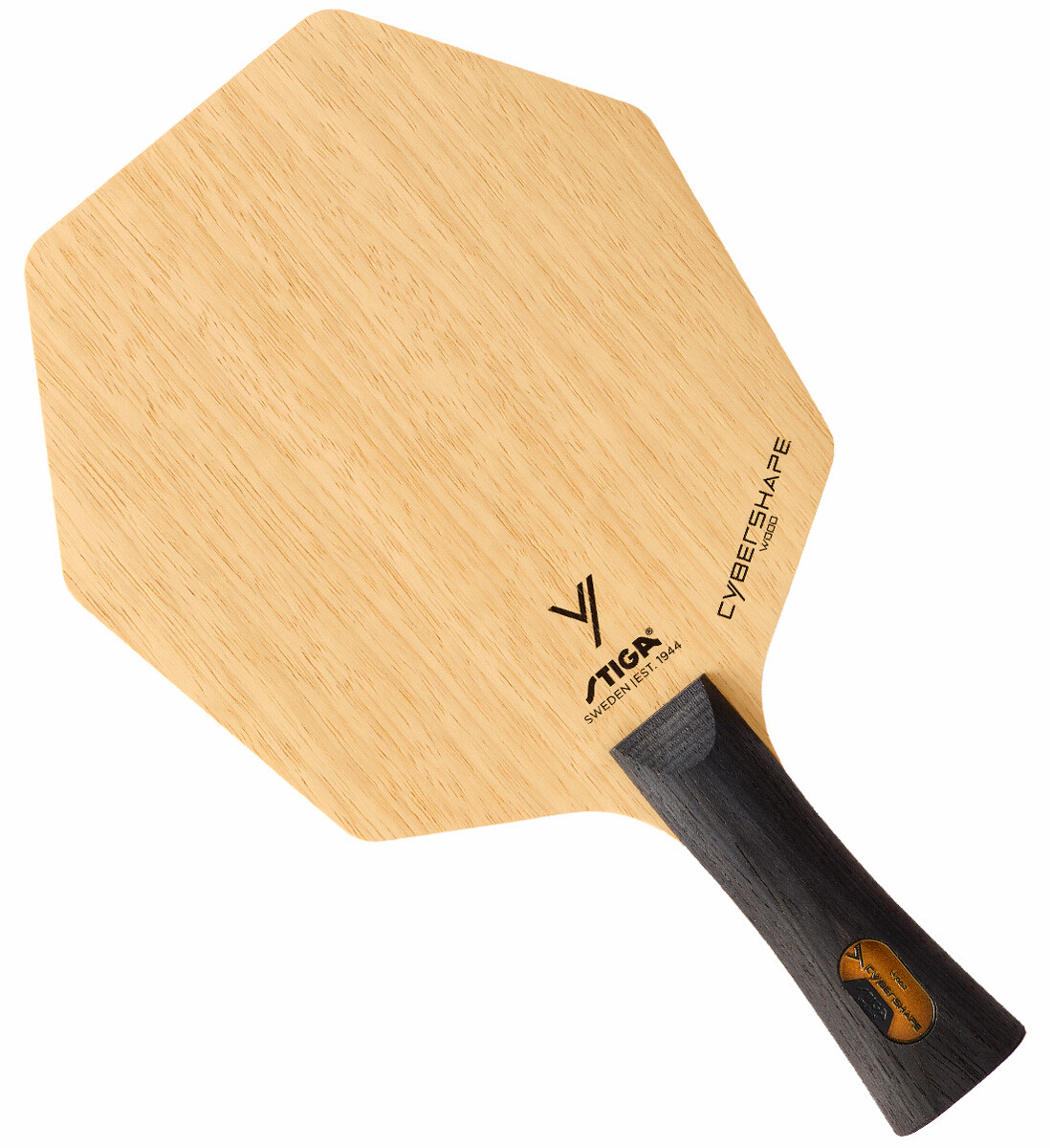
Pros
- Enlarged hexagonal sweet spot placed higher on the blade helps off-centre contacts
- Linear, predictable feedback across all shot types and speeds
- Excellent dwell time supports heavy topspin and spin variation in service
- Optional CWT magnetic weights allow fine-tuning of total racket balance
- Top-quality Italian wood handle provides secure, non-slip grip
- Pairs well with a wide variety of tensor and European rubbers
Cons
- Base speed is modest - fast rubbers are needed to stay competitive offensively
- Straight grip variant feels thin and rounded for players with larger hands
- Premium price point relative to similarly rated 5-ply all-wood alternatives
You notice the shape before anything else. The Cybershape Wood is built around Stiga’s patent-pending hexagonal head, the one that made headlines when Truls Moregard carried it to the 2021 World Cup final. Where the Cybershape Carbon stacks in fiber layers, this version drops them entirely for a pure all-wood build, and you get the dwell and touch that seasoned players know from traditional wooden blades. It lands at the OFF- classification: quick enough for competitive attack, controlled enough for precise placement and spin-heavy rallies. The CWT variant adds the optional Custom Weight Technology, letting you clip 3, 6, or 9-gram magnetic weights onto the handle to dial in the balance.
Performance
The Cybershape Wood is more forgiving than oval blades of the same speed. That comes down to the head: the hexagonal shape widens the upper third of the hitting surface, and measurements done with KTH Royal Institute of Technology put the sweet spot higher up the face. You feel the payoff when a ball comes in fast or your feet arrive a beat late. Community testers cluster speed at 8.1 to 8.4 out of 10, square in the OFF- bracket, with spin hitting 9.2 and control near 9.5. Those numbers tell the story: this is a feel-and-consistency blade, not a pace blade. Serves draw the most praise, both the short touch variety and long power serves with spin variation. Blocks sit secure, the short game stays easy to read, and topspin from mid-distance comes off with a high, rotating arc, helped along by the soft-ish Italian limba top layer that holds the ball a fraction longer than harder blends. Come down from a carbon or fast-fiber blade and it will feel slow at first, until your technique and rubber catch up. Mount high-tension tensor rubbers in 2.0 mm or thicker and that complaint mostly disappears, opening up what the blade can do on attack. As for the CWT weights, they shift the balance point and change how the blade loads on heavy forehand loops; testers tend to settle on the 6-gram as the middle ground.
What Reviewers Agree (and Disagree) On
Revspin, Reddit, and the retailers line up on the basics: this is a top control blade that turns offensive once you bolt on faster rubbers. The enlarged sweet spot and linear feedback win everyone over. Where opinion splits is the handle. Several players call the straight grip too thin and rounded; others shrug and report no issue. A smaller camp insists the blade is too slow for high-level play without premium tensors backing it up, while club and regional players find the speed fine as is. The CWT system pulls the widest range of reactions, landing somewhere between a clever, useful innovation and a marketing add-on people clip on once and forget.
Who Should Buy It
Club players rated roughly 1000 to 1800 ELO are the target here: people ready to leave an entry all-round blade behind but not ready for a stiff carbon setup. It fits players building a topspin game, counter-topspinners who read spin and redirect with precision, and coaches who want a training blade that rewards clean technique. If you already run a fast carbon blade and like the speed, this will feel slow. Defenders and passive blockers will want something slower and more neutral. But for the ambitious attacker in the middle, the one who lives on dwell, spin, and confident short play, little else competes at the price.
FAQ
Is the Stiga Cybershape Wood a good blade for beginners?
It leans toward intermediate players. A complete beginner will struggle to justify the price, but anyone who has the basic strokes down and wants to build spin technique gets a lot from the forgiving sweet spot and the feedback it sends back.
What rubbers pair best with the Cybershape Wood?
Go for high-tension tensors in the medium to hard sponge range. Reviewers keep naming Stiga DNA Platinum and Butterfly Dignics 09C on the forehand, the kind of sheets that add the speed the blade itself holds back on.
What is the difference between the Cybershape Wood and the Cybershape Wood CWT?
The CWT version adds Custom Weight Technology: three magnetic weights of 3, 6, and 9 grams that clip onto the base of the handle so you can tune overall racket weight and balance. The blade underneath is identical.
How does the hexagonal shape actually affect play?
Stiga and independent KTH measurements both put it the same way: the hexagonal head enlarges the upper third of the hitting area and pushes the sweet spot higher on the blade. Off-centre contacts in the top half come back more consistently than they would on a standard oval shape.
Is the Cybershape Wood fast enough for competitive table tennis?
At club and regional level, yes. Community testers rate its speed around 8.1 to 8.4 out of 10, solidly OFF-. Bolt on fast tensors and it handles aggressive looping and counter-attacking fine. Push up to the top national or professional tier and players reach for faster blades.
Does the Cybershape Wood contain any carbon or fibre layers?
No. The Cybershape Wood is pure all-wood, with no carbon or synthetic fibre layers. That is what separates it from the Cybershape Carbon, which slots in inner carbon layers for more speed and a stiffer, crisper feel.