Stiga Carbonado 45 Review: The Carbon Blade That Thinks Like Wood
Pros
- Wood-like feel with clearly felt, informative vibrations
- Wide sweet spot and excellent stability in blocking
- High throw angle aids heavy topspin loops
- Outstanding short game, drop shots, and serve control
- Well-balanced at around 85-91g, nimble for FH-BH transitions
- Endorsed by top Chinese women's national team players
Cons
- Slower than most carbon blades; smashes lack pace
- Requires extra physical effort for power shots from mid-distance
- Outer limba ply can be fragile with aggressive glues
- Not ideal for power-first or far-from-table game styles
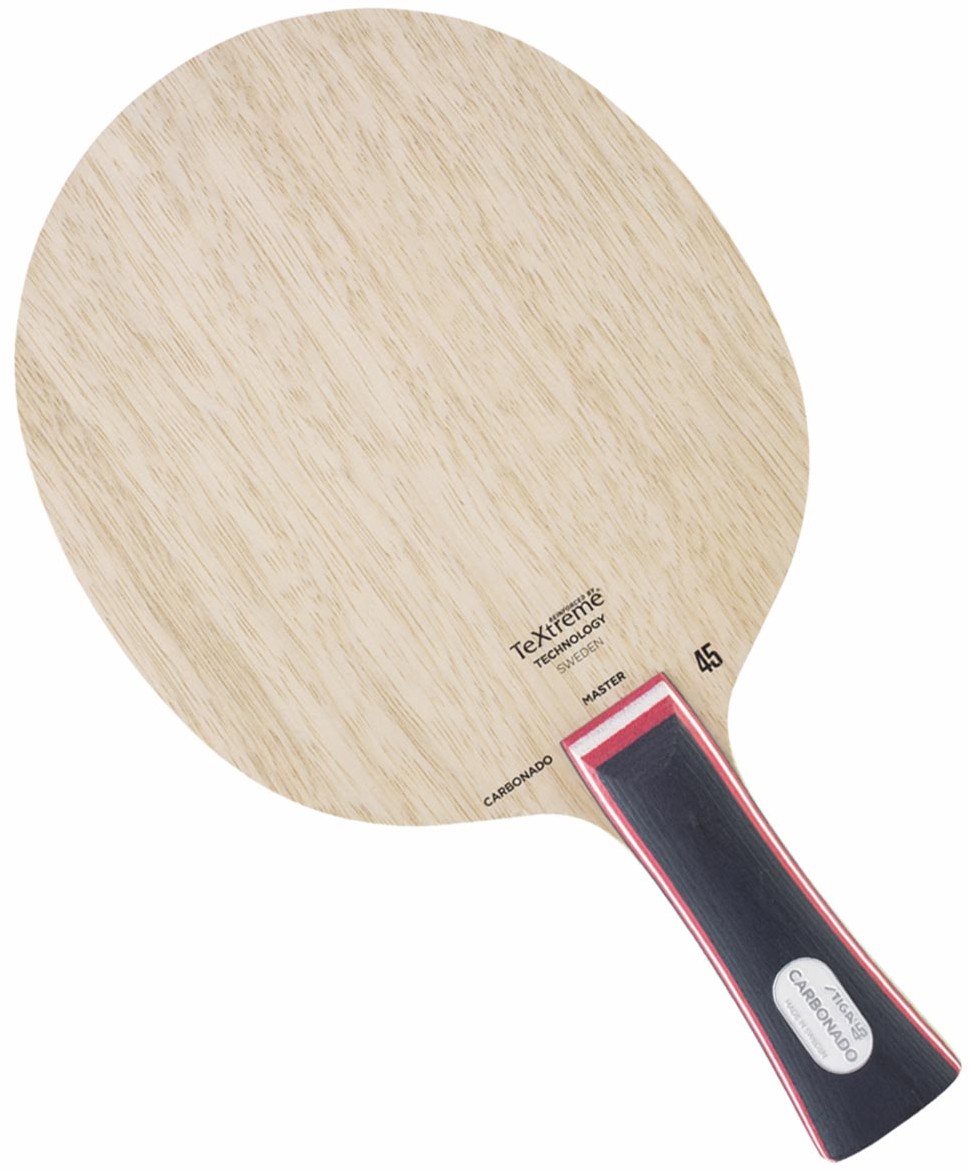
Most carbon blades give up wood feel to buy speed and stiffness. The Carbonado 45 refuses the trade. It runs an exceptionally thin TeXtreme carbon layer (64 g/m2) laid at a 45-degree angle, which keeps torsional flexibility and a high arc that players usually only get from premium all-wood. The build is 7-ply: 5 wood plies with an ayous core and limba outer, plus 2 TeXtreme carbon layers, 5.7mm thick, 85-91g, OFF- on speed. Stiga sells it as the entry to the Carbonado family, and Chinese women’s team stars Zhu Yuling and Chen Meng compete with it, which tells you it has the ceiling for elite technical play.
Performance
Speed sits at the bottom of the OFF range, well under the Carbonado 145 and nowhere near the 290. Read that as a design choice that pays off elsewhere. FH and BH drives send back deep reverberating vibrations that tell you exactly where and how the ball hit, which gives skilled players instant feedback and confidence. FH loops against heavy backspin come off consistent and spinny on a high arc, safe over the net while still threatening depth and kick on the bounce. The flip side: the moderate speed makes you supply your own pace, and flat hits or smashes land mid-table instead of near the endline. Power-first players should look elsewhere.
Close to the table is where it earns its keep. Blocking is outstanding — the blade soaks up incoming loop energy and hands it back as controlled, consistent returns. The short game is the real strength. Drop shots, short pushes, and touch-heavy serve receives all feed off the moderate speed and long dwell. Serves load heavy spin, the crisp but forgiving contact letting you keep them short and rotating. FH flicks work, though the timing window is tighter than on a faster blade. Testers ran it happily with both non-tacky European and Japanese rubbers, such as Dignics 09c or Stiga DNA Pro Hard, and traditional tacky Chinese sheets, and the high arc pairs especially well with spin-heavy forehand rubbers.
What Reviewers Agree (and Disagree) On
Every source agrees on the same picture: an unusually wood-like carbon blade with excellent control, a wide sweet spot, and a high throw. They also line up on the speed, calling it slower than most carbon and treating that as a deliberate feature for the players it targets, not a fault. The split is over the exact number. Some peg it alongside the Viscaria and other mid-range carbon blades around 8.5 out of 10; a penhold player who has tested more than 30 blades put it nearer 8.2. The deeper argument is whether the lower speed helps or hurts, and that comes down to your style and how far back you stand.
Who Should Buy It
The Carbonado 45 is built for loop-dominant, spin-offensive players at advanced or club level who stay close to the table. It is a natural step for anyone coming off all-wood who wants a bigger sweet spot and a modest carbon lift without losing the feel they trust. Tacky Chinese rubbers on the forehand or high-tension non-tacky sheets on both wings both click with it. Stay away if you finish points with flat drives and smashes, or if you play mostly from mid-to-far distance and need a blade that supplies pace without maximum effort from you.
FAQ
How does the Carbonado 45 compare to the Carbonado 145?
The Carbonado 45 is noticeably slower and more flexible than the 145, sitting in the low OFF- range versus the 145’s low OFF range. The 45 has a higher arc and more wood-like dwell, while the 145 is more linear and direct. The 45 is better for spin-heavy close-to-table play; the 145 suits a more direct, power-oriented game.
Is the Carbonado 45 suitable for penhold players?
Yes. Several penhold players have reviewed it positively, noting that its flexibility and control work well for blocking and looping. However, penhold players who rely on smashing may find the blade lacks pace for finishing points.
What rubbers pair best with the Carbonado 45?
Faster non-tacky European or Japanese rubbers like Stiga DNA Pro Hard, Dignics 09c, or Tenergy 05 hard work excellently on the forehand, letting the blade’s high arc and dwell complement the rubber’s speed. Tacky Chinese rubbers are also a natural fit for spin-heavy forehand play.
Is the Carbonado 45 durable?
The playing surface holds up well, but the outer limba ply can chip or peel if you use aggressive solvent-based glues. Long-term owners often recommend a thin protective lacquer coat around the edges.
Who are the professional players who use the Carbonado 45?
Stiga lists Chinese national team members Zhu Yuling and Chen Meng as users of the Carbonado 45. It has also reportedly been a favorite of Chinese coaches for players who emphasize spin and control in their game.