Stiga Cybershape Carbon Review: Larger Sweet Spot, Serious Offensive Power
Pros
- Exceptionally large sweet spot positioned higher on the blade, verified by KTH lab tests
- Outstanding blocking comfort on both forehand and backhand
- Head-heavy balance adds natural acceleration to backhand and forehand drives
- CCF inner carbon preserves a woody feel while adding stiffness and speed
- Speed rating of 9 out of 10 — comparable to Butterfly Koto-ALC class blades
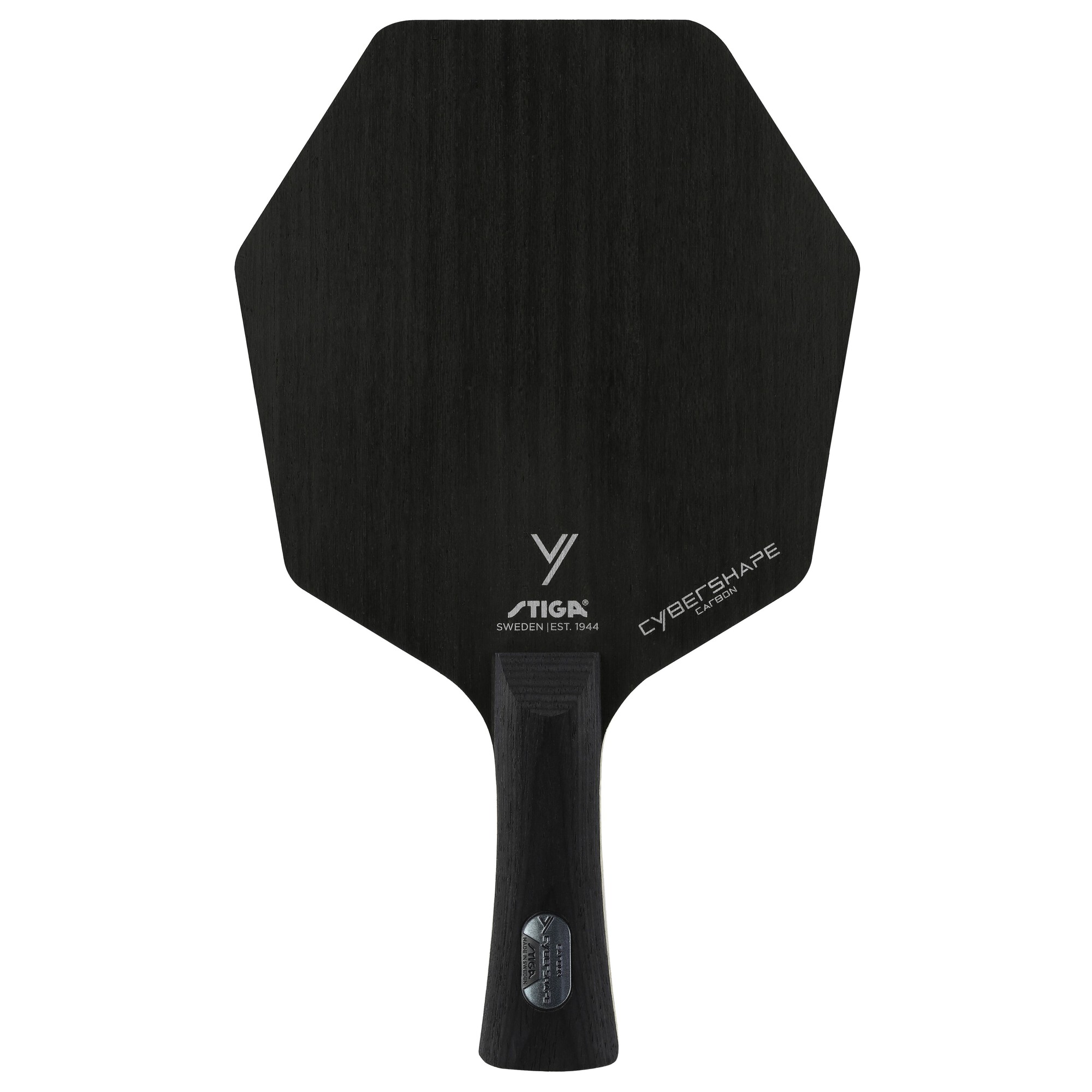
- Distinctive hexagonal shape aids serve angles and bat angle awareness
- ITTF competition approved
Cons
- Short dwell time is challenging for heavy topspin or looping styles
- Service feel is noticeably different from oval blades and takes adaptation
- Demanding for intermediate or developing players — technique must be compact to avoid overhitting
- Premium price point around 220 EUR makes it one of the more expensive options in its class
The Stiga Cybershape Carbon arrived as one of the most visually striking blades in modern table tennis when it launched. Its patent-pending heptagonal (seven-sided) head shape is not a gimmick — it was engineered in collaboration with KTH Royal Institute of Technology in Stockholm to shift the sweet spot higher and further from the handle, giving players more consistent contact across a wider hitting area. The blade is built on Stiga’s CCF (Close Core Fibre) technology, placing the carbon fibre layer directly on top of the wood core rather than near the outer surface. This keeps the feel closer to an all-wood blade while still delivering the stiffness and speed benefits of carbon construction. When Truls Moregardh adopted the Cybershape Carbon and used it to compete at the highest international level, global interest in the design exploded. It is available in multiple handle options including Classic Flared and Master Concave, and is approved for all ITTF competition formats.
Performance
Pick it up and it plays nothing like a conventional oval-headed inner-carbon blade. The backhand is the headline. Reviewers on Revspin and Megaspin keep reporting backhand attacks that come faster, more precise, and easier to start, and one player who switched from Viscaria and ZJ ZLC called the backhand jump the most incredible he had ever felt. The trick is the head-heavy balance: piling material at the top of the blade instead of spreading it evenly gives a hammer-like swing weight that adds acceleration for free.
The forehand keeps pace with high-end ALC blades. Megaspin’s ratings and user comparisons put it around Butterfly Koto-ALC territory, solidly OFF, and one experienced user confirmed the speed matches Koto-ALC blades while the CCF construction holds onto a little woody feel. Blocking draws the strongest praise across sources. The angular corners and the higher sweet spot make it easier to tilt the bat for placement, and the carbon stiffness keeps short blocks and punch-blocks consistent. Stiga’s KTH data shows a more linear frequency response than a standard blade, so the vibrations spread out and the feel stays uniform across the face rather than bunching at the centre. Those same corners hand servers six distinct edge angles to work with, which experienced servers put to use.
The costs are clear. Dwell runs shorter than all-wood or softer carbon, and that is the one complaint every source shares. If you generate heavy topspin or brush-style loops off prolonged contact, the Cybershape fights you in a way the Stiga Infinity or softer wood designs do not. Serving is the other sore point — the shape and the balance shift make familiar service motions feel off at first, and dialing them back in takes deliberate practice. Lighter copies in the 81-82g range come across as hollow and less stable than the 87-88g pieces, so weight selection matters at purchase.
What Reviewers Agree (and Disagree) On
There is strong consensus across Revspin, Megaspin, and Reddit that the Cybershape Carbon is best suited to advanced offensive players. All three source groups agree that blocking is a standout strength, that the head-heavy balance distinguishes it from standard blades, and that backhand performance is surprisingly good. The main point of disagreement is about control for less experienced players: some intermediates found the stiffness and low dwell punishing, leading to many errors into the net, while advanced players found the control excellent once technique was adapted. Reviewers also split on the short dwell time: all-out attackers read it as neutral or positive, while topspin-heavy players call it a clear limitation. Everyone flags the price as steep, and most still call it fair given the engineering behind it and where the brand sits.
Who Should Buy It
The Stiga Cybershape Carbon is the right choice for competitive offensive players at the advanced or semi-professional level who want an inner-carbon blade with a scientifically verified larger sweet spot and a head-heavy feel that rewards aggressive play. It is particularly well suited to players who want to strengthen their backhand game and blocking consistency. Players who generate most of their points through looping or heavy topspin should look at softer or more dwell-oriented alternatives. Beginners and intermediate developing players should wait until their technique is compact and consistent before committing to this blade.
FAQ
What is the Stiga Cybershape Carbon’s blade construction?
It is a 5+2 ply blade using CCF (Close Core Fibre) technology, meaning two carbon fibre layers are positioned directly on top of the wood core rather than near the outer surface. The outer layer is Black Koto. Total thickness is approximately 5 mm and typical weight is 85g plus or minus 5g.
Is the hexagonal shape approved for official competition?
Yes. The Cybershape Carbon is approved for all types of ITTF competition. The blade’s angular polygon shape is unique but fully legal under current table tennis regulations.
How does the Cybershape Carbon compare to the Butterfly Viscaria?
Both are inner-carbon blades in the OFF category. The Cybershape Carbon is head-heavy from its angular shape, which makes it hit harder on backhand drives and blocks. The Viscaria is more balanced and better for pure forehand topspin with longer dwell. Players coming from a Viscaria report a noticeably more dynamic Cybershape backhand, while the forehand loop feels close to what they left behind.
What rubbers pair well with the Cybershape Carbon?
Players consistently recommend medium to hard tensor rubbers that complement the blade’s stiffness and speed. Popular pairings reported by reviewers include Stiga DNA Platinum H, Dignics 09C, Tenergy 05, and Rakza 9. Softer rubbers can compensate for the short dwell if you prefer more topspin, while harder high-performance rubbers fully unlock the blade’s speed and counter-attack potential.
Is the Stiga Cybershape Carbon suitable for intermediate players?
Not the usual pick for intermediates. The stiffness, the short dwell, and the head-heavy balance all demand compact, well-timed technique. Reviewers report intermediate players overhitting or dumping shots into the net until their strokes tightened up. Advanced players, by contrast, find the control and consistency excellent.
Does the head-heavy balance affect serves and short game?
Yes — the shifted balance point takes noticeable adjustment for serves. Most reviewers reported that their serve felt uncomfortable or imprecise for the first few sessions, requiring deliberate adaptation. Short pushes and drop shots are manageable once accustomed to the balance, but players used to head-light or balanced blades should expect a learning curve in the touch game.