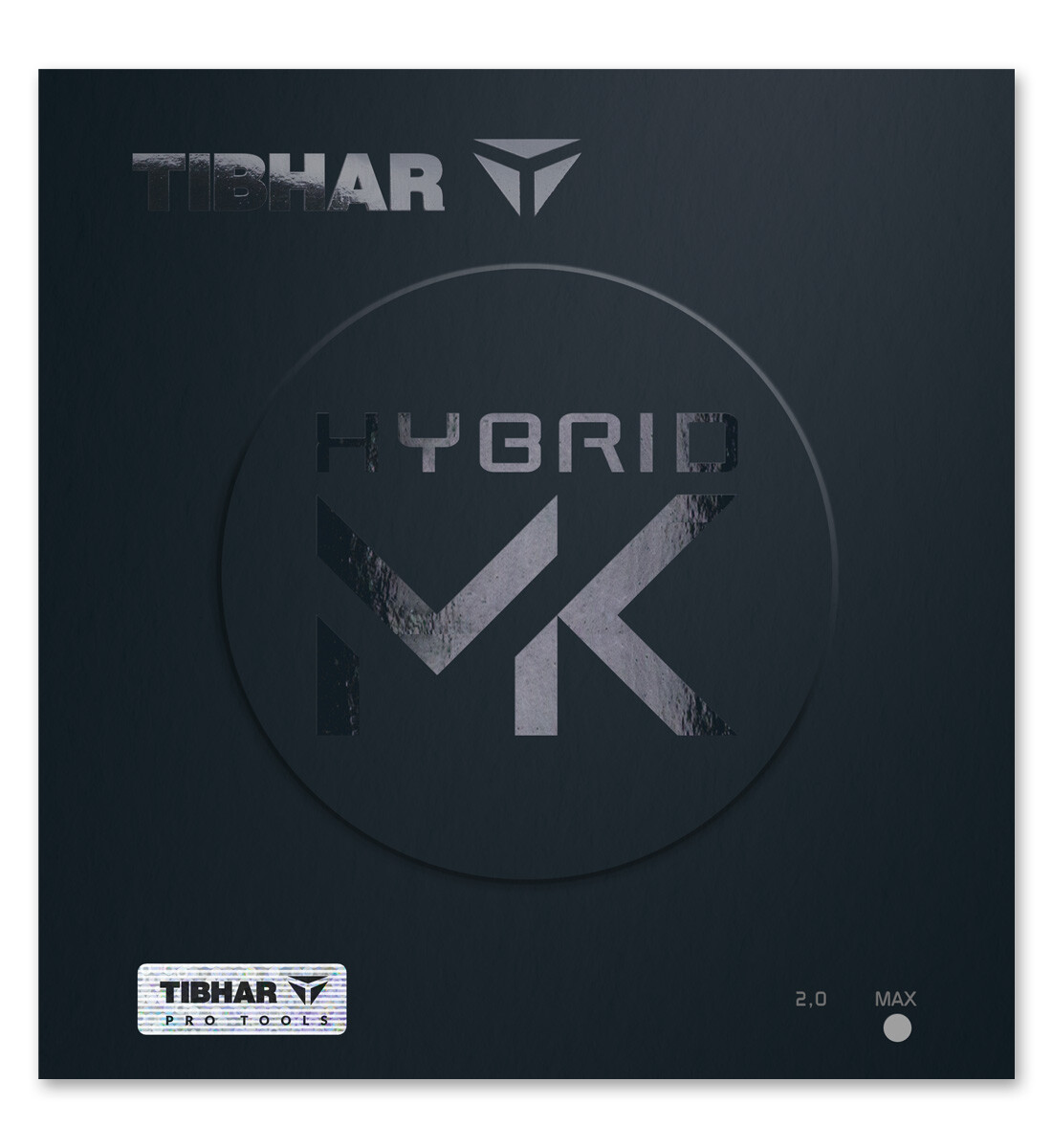
Tibhar Hybrid MK Review: High-Control Hybrid Rubber for Offensive Players
Pros
- Exceptional control — community average of 9.33/10
- Low spin sensitivity makes blocking and receiving very reliable
- Grippy topsheet generates heavy topspin with minimal effort
- Forgiving feel despite 48° sponge rating; plays softer than spec
- Strong short game: pushes, flicks, and serves all excel
Cons
- Power drops at mid-to-long range distances from the table
- Durability is modest — typically 3 months with regular training
- High throw angle requires deliberate technique adaptation
- Not suited for stiff carbon blades; needs softer all-wood or inner carbon
Tibhar built the Hybrid MK with Japanese top player Kenta Matsudaira, which is why it lands where European tensor engineering meets an Asian playing philosophy. The sponge is 48°, mid-OFF territory, firm enough for decisive topspin but soft enough to pay back players who play placement and consistency. It sits between the more aggressive MK Pro (51°) and the beginner-friendly end, the all-rounder of Tibhar’s Hybrid MK lineup. The ratings of 125/125/110 for Speed/Spin/Control say it plainly: this is a rubber for players who win on precision, not raw power.
Performance
The MK barely reacts to incoming spin, and that’s its calling card. Defending a heavy topspin loop or reading a tricky backspin push, the soft, grippy topsheet soaks up the spin and sends the ball back on a trajectory you can manage. Blocks stay stable. Reviewers across Megaspin and TableTennis-Reference kept noting the rubber neutralizes incoming spin instead of amplifying it, which buys you time to reset and respond.
On offense, the MK is at its best in the short game and in mid-distance topspin exchanges. Opening against backspin is easy: the sponge compresses readily and the grippy surface bites the ball into a high, heavy arc. Loop-to-loop consistency holds up, and the rubber rewards committed technique over anyone trying to muscle the ball through.
Some reviewers flag a throw angle higher than comparable German tensors, so anyone coming off a rubber like Fastarc G1 has to close the blade angle a little when driving or looping flat. It’s a small adjustment, not a real drawback, but worth keeping in mind through the break-in period.
The limit shows up in mid-to-long-range power exchanges. Several long-term reviewers, several of them on Megaspin, reported the catapult energy dropping off after two to three months of regular training, the rubber losing bite past four meters from the table. Close to the table, in an all-round game, none of that matters. Step back to trade powerful drives and the power ceiling starts to box you in. The TableTennis11 editorial review reads the same: competent close to the table, at its best at mid-distance, rewarding the player who commits to controlled topspin sequences.
What Reviewers Agree (and Disagree) On
All three sources praise the same two things: the control and the spin insensitivity. The 9.33/10 community average for control on TableTennis-Reference ranks among the highest in the hybrid category, and Megaspin reviewers back it up, returning over and over to how forgiving the rubber is on off-center hits and heavy-spin returns. The real disagreement is blade pairing. Testers who put the MK on stiff carbon reported poor results, one Megaspin reviewer calling it uncomfortable on a carbon blade, while those on medium all-wood or inner-fiber rated it highly. Durability is the smaller fight: some players get 65-plus hours of solid use with proper maintenance, others see it fall off after three months of four-times-weekly training.
Who Should Buy It
The MK is for intermediate and advanced players whose game runs on topspin consistency, placement, and point construction rather than flat power. It fits all-round offensive players who want a rubber that handles attack and defense competently, and penhold players who need precise short-game control next to credible topspin. Coming over from Japanese or Chinese tacky rubbers to European hybrids, you’ll find the MK’s slightly sticky topsheet familiar, no jarring jump straight to a full German tensor. Put it on a medium-speed all-wood or inner-carbon blade. If you live on flat drives and mid-range power, or train more than four times a week, the speed ceiling and durability will hem you in, and the stiffer MK Pro is the better call.
FAQ
How does the Tibhar Hybrid MK compare to the MK Pro?
The MK and MK Pro share the same topsheet, but the MK uses a 48° sponge while the MK Pro uses a 51° sponge. The MK is more forgiving, with a higher throw angle and softer feel — better for control-focused players. The MK Pro is more linear and stable at pace, better suited to players who need more power transfer and a flatter trajectory.
What blade pairs best with the Tibhar Hybrid MK?
Medium-speed all-wood or inner-fiber blades are the recommended pairing. The MK’s soft sponge benefits from a blade that adds some pace without sacrificing dwell time. Stiff outer-carbon blades create a harsh, overly bouncy feel that negates the rubber’s control strengths. Blades in the OFF-minus to OFF range are ideal.
Is the Tibhar Hybrid MK good for beginners?
Not ideally. The MK is designed for intermediate to advanced players who already have consistent topspin mechanics. Beginners may struggle with its high throw angle and the technique-dependent nature of its sponge compression. Players with one to two years of regular training will get much more out of its capabilities.
How durable is the Tibhar Hybrid MK?
Durability is the MK’s most debated characteristic. Players training three to four times per week typically report three months of peak performance before the sponge loses its catapult effect. With proper care — wiping the topsheet after each session and using a protective film — some players report 65-plus hours of consistent use. Heavy trainers may want to budget for replacement more frequently.
Can the Tibhar Hybrid MK be used on both forehand and backhand?
Yes. The MK was designed as a versatile rubber and receives strong marks on both sides. On the forehand, its spin generation and arc height reward patient topspin play. On the backhand, its low spin sensitivity and easy block stability make it particularly effective. Players using it on both sides should factor in the higher throw angle when adjusting to each side.
Is the Tibhar Hybrid MK tacky or grippy?
The MK topsheet is best described as slightly tacky and very grippy — it is not as sticky as a traditional Chinese tacky rubber, but it has more surface grip than a typical European tensor. The pimples are short and wide, creating strong contact with the ball without the heavy spin-sensitivity that fully tacky rubbers produce.