DHS Hurricane 8 Review: A Faster, Easier-Driving Tacky Forehand Rubber
Pros
- Faster and easier to drive than the Hurricane 3 family
- Excellent spin and tack on serves, serve receive and short pushes
- Capable of fast, low-arc loopdrives, loopkills and counterloops
- Strong control and feel, rated better than H3 Neo by many reviewers
- Good durability and works fine unboosted for some players
- Responds very well to boosting if you want more speed and arc
Cons
- Heavy, often 50 grams or more cut, demanding stronger technique
- Tackiness is inconsistent between sheets and fades after about two weeks
- Weak in the passive and flat game
- Not recommended as a backhand rubber for most players
- Demands proper footwork and a committed swing to play well
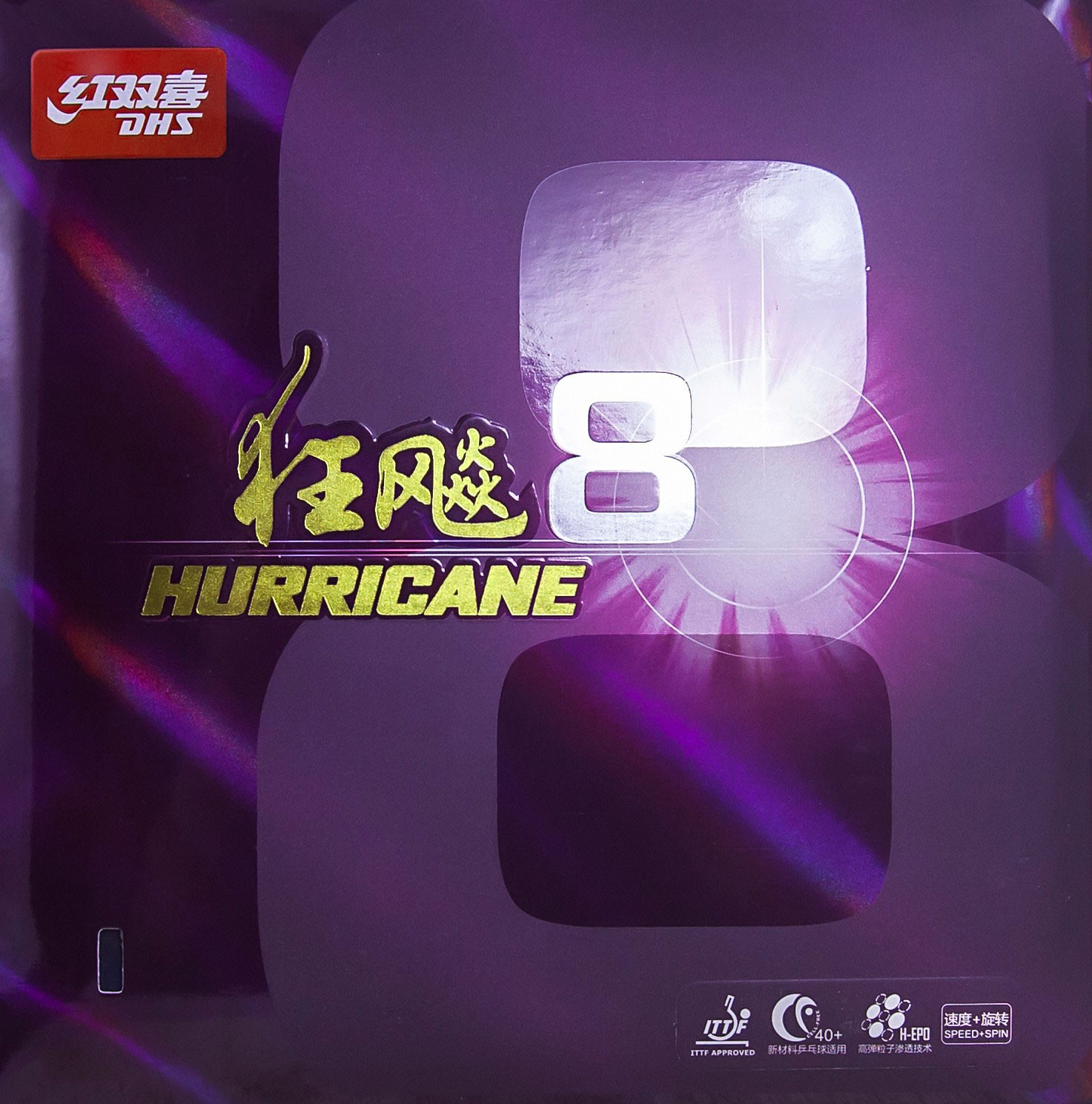
The Hurricane 8 occupies an interesting spot in DHS’s crowded lineup. It is a hybrid tacky-tensor rubber that keeps the grippy, spin-loaded top sheet Chinese rubbers are known for, while adding more speed and elasticity than the long-dominant Hurricane 3 and Hurricane 3 Neo. As the standard commercial version rather than a national or provincial sheet, it is everywhere, often shipped as the factory forehand rubber on DHS prebuilt rackets, and priced to be reachable. This review pulls hands-on impressions from four independent sources: long-form user reviews on Revspin, a detailed comparison thread on TableTennisDaily that accompanies the site’s video review, Reddit’s r/tabletennis, and customer reviews on Megaspin. They agree closely on both what the Hurricane 8 does well and where it asks more of the player.
Performance
Serves and the short game are where the Hurricane 8 makes its case. Revspin users point to controlled, deadly short pushes, easy forehand flicks and a relative insensitivity to incoming spin on low-gear touches, all riding on the tacky top sheet. Megaspin buyers go further, calling it one of the spinniest and tackiest rubbers they have used. A 54-year veteran rates it among the spinniest he has tried, and one reviewer called the short game shockingly good.
Tackiness is the most divisive trait, though. Several Revspin and Megaspin reviewers warn the tack varies from sheet to sheet and fades noticeably after roughly two weeks of play, and the most analytical TableTennisDaily poster rates the H8 as only mildly tacky, well below H3 Neo, which in his hands meant a weaker short game and less spin on brushy serves.
Driving and looping speed is where the Hurricane 8 pulls away from the H3 family. Reviewers describe it as more elastic, so the ball sinks into the sponge more easily and the trajectory comes out flatter and more linear. A TableTennisDaily member running the national 39-degree version said it plays like H3 but much faster, and found driving and passive blocking easier precisely because it is less tacky than H3 Neo. Revspin’s most detailed reviewer saves his highest praise for loopdriving, reporting very fast shots with good spin and a dangerously low arc once the rubber breaks in. He is honest about the cost: opening loops are good but not great, the rubber is poor on passive play and weak in the flat game, and the best shots demand proper footwork, weight transfer and a whip-like swing.
Speed reads differently elsewhere, with some Megaspin buyers finding it fast unboosted and others rating it slower than H3 Neo out of the package. The consensus: the medium-hard 39 to 40 degree sponge feels slow at first, and booster lifts both speed and arc, with several reviewers calling a boosted H8 a real alternative to a boosted H3. Control runs as a quiet strength throughout, rated better than H3 Neo with good feel, strong counter-attack and reliable counterloops. Weight is the recurring practical downside: Megaspin reviewers call it very heavy, often 50 grams or more once cut, which adds to the physical demand of playing it well.
What Reviewers Agree (and Disagree) On
All four sources agree on the core identity: a tacky, spin-heavy, control-rich forehand rubber that is faster and easier to drive than the Hurricane 3 family, and that rewards committed, technical play. They agree on the main weaknesses too, a weak flat and passive game, real weight, and tackiness that fades. The disagreements are about degree and direction. Reviewers split on how tacky and how fast it is out of the box, some calling it fast and very tacky while a careful TableTennisDaily tester calls it only mildly tacky and not a clear upgrade over H3 Neo. Boosting divides them as well: some players insist it only sings once boosted, while a Reddit user runs it unboosted and finds it fine. Side preference is the clearest fault line. Most Revspin and Megaspin reviewers call it definitely not a backhand rubber, yet a TableTennisDaily member found it awesome on the backhand, and Reddit keeps recommending the softer H8-80 spin-off for that side.
Who Should Buy It
The Hurricane 8 fits a developing to intermediate, forehand-dominant attacker who wants the spin, tack and feel of a Chinese rubber but with more speed and easier driving than a boosted Hurricane 3 Neo. With decent footwork, weight transfer into your loops and tolerance for a heavy rubber, it gives strong serves, excellent short-game control and fast, low-arc loopdrives at a reachable price, boosted or not. It is a weaker pick if you rely on a passive, flat or blocking game, if you want a dedicated backhand rubber, where the softer H8-80 is the better call, or if you are a committed H3 Neo user who may not see it as a real upgrade. Pure beginners should know it punishes loose technique.
FAQ
Is the DHS Hurricane 8 good for the backhand?
For most reviewers, no. Revspin and Megaspin users keep calling it definitely not a backhand rubber, though one TableTennisDaily member enjoyed it there, and Reddit players point to the softer H8-80 variant as the better backhand choice in this family.
Does the Hurricane 8 need boosting?
No, it does not require it. A Revspin reviewer says it needs no boosting once broken in, and a Reddit user runs it unboosted and finds it fine. Many Megaspin buyers, on the other hand, say boosting raises speed and arc and turns it into a real weapon, so it comes down to how much speed you want.
How does the Hurricane 8 compare to the Hurricane 3 Neo?
Most reviewers find the Hurricane 8 faster, more elastic and easier to drive, with a lower, flatter arc and better control. The catch is that some find it less tacky than H3 Neo, and one careful tester noted that at full swing the H3 Neo is faster and spinnier.
Is the Hurricane 8 heavy?
Yes. Megaspin reviewers call it very heavy, often 50 to 56 grams once cut in 2.2mm, which adds to the physical demand of playing it and is one of the most common complaints.
How long does the tackiness last?
Not long. Several Revspin and Megaspin reviewers report the tackiness fading noticeably after about two weeks of play, and it varies from sheet to sheet, so the tack you start with may not hold up over the long run.