Nittaku Acoustic Carbon Inner Review: Woody Feel Meets Inner Carbon Power
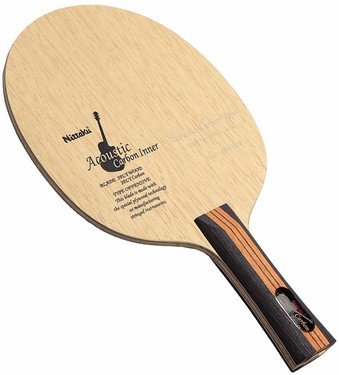
Pros
- Outstanding control and spin performance validated across dozens of reviews
- Inner FE carbon adds power on drives without stiffening the feel
- Retains a natural, woody ball sensation unique in the carbon blade category
- Generous sweet spot, especially on the G-Revision variant
- Excellent short-game touch and delicate push control
- Broad rubber compatibility from tacky Chinese sheets to high-tension European
- Professionally endorsed - famously used by Mima Ito in her early career
Cons
- Noticeably slower than outer-carbon alternatives - not ideal for all-out attackers
- Original version handle is narrow and may feel cramped for medium to large hands
- Higher price point around USD 180 places it in the premium segment
- Amplifies rubber catapult effect - requires careful rubber pairing
- Backcourt power output is moderate compared to stiffer carbon blades
Nittaku released the Acoustic Carbon Inner on May 1, 2014, as part of its Instrument series, a line drawing on the wood lamination used to build stringed musical instruments. It is the inner-fiber answer to the Acoustic Carbon, which puts carbon nearer the surface for a faster, stiffer hit. The Inner version instead buries FE Carbon between the Tung center and Limba middle layers, so the carbon stays quiet during touch play and only wakes up on full strokes. The blade got its international profile through Mima Ito, who played it during her formative competitive years and helped cement its reputation as a high-performance but controllable offensive tool.
Performance
On service and receive, the Acoustic Carbon Inner is hard to tell apart from a quality all-wood blade. The Tung wood center, a denser cousin of Kiri, eats a little more of the ball’s energy than Ayous-centered builds, so contact feels softer and dwell runs longer. That is the blade’s signature. The ball hangs on the face a fraction longer than you expect, which lets you load heavy topspin onto a controlled arc. In close-to-table looping, the inner carbon steadies the head and kills the vibration that aggressive shots can bring out of pure wood. The numbers back it up: a 66/100 control rating on Megaspin keeps it in manageable territory, while a 90/100 speed is brisk enough to attack with.
Blocking heavy incoming topspin is a real strength. The inner carbon absorbs the ball’s energy and hands back a consistent, slightly arc-heavy ball that opponents find hard to read. Aggressive forehand drives land satisfying power without overwhelming it; players coming off outer carbon blades will notice the missing pace at first. The backhand gains from the blade’s stability, looping both backspin and topspin with consistency. Flat hitting holds up too, and several reviewers single out flat stroke performance as a highlight.
Serving is where the long dwell pays off most, opening up heavy short serves and deceptive no-spin balls. The sweet spot is generous for a carbon blade, so off-center contact forgives far more than stiffer rivals. Lab measurements from TTGearLab put the parallel velocity at 1.08, lower than typical inner carbon blades, a number that traces straight back to the energy-absorbing Tung center.
What Reviewers Agree (and Disagree) On
Megaspin, Tabletennis-Reference, TTGearLab, and Reddit all land in the same place: the Acoustic Carbon Inner fills a rare niche, a carbon blade that feels like wood. Reviewers rate spin and control high and admit the speed ceiling is moderate. Rubber pairing is where they split. Some find high-tension sheets like Butterfly Rozena too catapulty here, while others run Dignics 05 on the forehand without complaint. Handle size is the most persistent gripe, with original-version owners wishing for a slightly wider grip. The G-Revision is widely treated as the fix.
Who Should Buy It
This blade is for intermediate to advanced players with solid technique who want inner carbon stability without jumping to a hard, fast outer-carbon blade. It rewards players who loop consistently from both wings at close-to-mid distance, run a disciplined short game, and put touch and spin ahead of pure speed. All-wood players curious about carbon should try this one before committing to anything faster. Skip it if you lean on the blade to make power, or if you want a rigid, direct contact.
FAQ
How does the Acoustic Carbon Inner compare to the outer Acoustic Carbon?
The inner version is softer, slower, and more wood-like. The outer Acoustic Carbon sets the carbon closer to the surface, which makes it stiffer and faster with a crisper hit. The inner version puts control, dwell, and natural ball feel ahead of pace. If you are coming off all-wood, start with the inner version.
What rubbers pair best with the Nittaku Acoustic Carbon Inner?
Linear, moderately fast rubbers work best. Yasaka Rakza Z, Yasaka Rakza 7, and the Tibhar Evolution series come up often. High-tension rubbers with strong built-in catapult, like Butterfly Rozena, turn too bouncy on it. Tacky Chinese rubbers pair well too, since the blade’s long dwell suits the friction-based spin of Chinese sheets.
Should I buy the standard version or the G-Revision?
For most players, the G-Revision. It carries a better handle, a more comfortable shape with a slightly wider grip than the narrow original, and the sweet spot is reportedly larger. Speed and overall feel match the original. New buyers should head straight for the G-Revision unless they want the slimmer handle or catch the original on a steep discount.