Donic Bluefire M1 Review: Hardest and Fastest of the Bluefire Series
Pros
- Hardest and fastest of the Bluefire M-series, a clear step up from the M2 in speed
- High throw angle produces heavy, dipping topspin loops
- Matches premium rubbers like Tenergy 05 in speed at a lower price
- Long durability with good grip when kept clean
- Strong close-to-table control for pushes and flicks
Cons
- Very unforgiving, demanding advanced technique and proper arm acceleration
- Performance fades after one to two months as factory boost expires
- Falls off at far distance and on the backhand
- Too fast and hard for players under 1400 USATT or equivalent
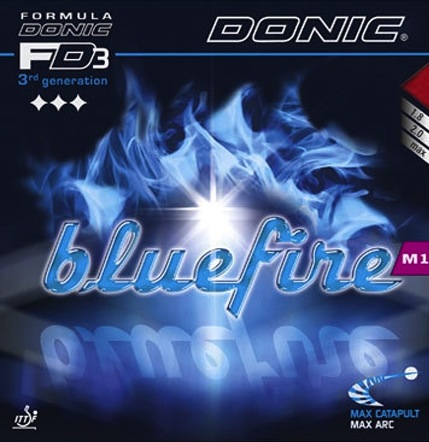
The Donic Bluefire M1 is the hardest and fastest of Donic’s popular Bluefire M-series. A 47.5-degree blue sponge sits under a narrow, long-pimple topsheet, and the pair puts out explosive speed and heavy topspin. The softer M2 is the balanced pick; the M1 is the specialist’s tool, built for high-level forehand attackers who want the absolute ceiling of speed and spin from a European tensor.
Performance
Speed is what the Bluefire M1 is about. Reviewers peg it at 9.7 out of 10, level with or a shade past Butterfly Tenergy 05. At 47.5 degrees the sponge runs firmer than the M2 at 45 degrees and well above the M3, so it needs real arm-speed acceleration to switch on. Once it does, the high throw angle sends topspin loops out on a steep, dipping arc that is hard to block or counter.
Forehand looping from close to mid range is its home ground. Sources line up on this: drives and third-ball attacks come out powerful and consistent when your technique holds. The close-table short game, the pushes, flicks, and quick exchanges, gains from the rubber’s grip and catapult. Far-distance looping is the weak spot. Out there the stiffness cuts dwell time and timing gets harder.
Against the M2, the M1 gives up some control and spin consistency for more outright speed and a higher spin ceiling. The M2 suits a wider band of skill levels; the M1 pays back players whose mechanics are already grooved. Against the M3, the M1 is faster and harder across the board, and the feel gap is wide enough that players moving from M3 to M1 often need a blade change to keep things in hand.
Durability runs above average for a tensor. Cleaned regularly, the topsheet keeps its grip, and users report 250-plus hours of steady performance. The factory boost is the catch: it fades after one to two months, and performance sags until you re-boost, the familiar trait of pre-boosted European tensors.
What Reviewers Agree (and Disagree) On
Across Revspin, Megaspin, and the forums, reviewers agree the Bluefire M1 is a high-performance forehand rubber for advanced players and that it runs faster and harder than the M2. They agree too that it demands advanced technique and does not suit players below around 1400 USATT. Control is where the argument starts: some call it a real weakness, others find close-table control quite good once they settle into the speed. Far-distance play splits opinion less, with nearly everyone agreeing it falls off at long range against close or mid range.
Who Should Buy It
The Donic Bluefire M1 is for advanced offensive players, roughly 1500-plus USATT or national-level club players, who attack mainly with the forehand and play close to mid range. If you want the fastest, most spin-capable rubber in the Bluefire series, this is the one. If you want more margin for error, or a rubber that holds up on the backhand, take the M2 instead. Beginners and intermediate players should stay off the M1 until their technique is fully built.
FAQ
How does the Bluefire M1 differ from the Bluefire M2?
The M1 runs a harder sponge, 47.5 degrees against the M2’s 45, which buys more speed and a higher spin ceiling at the cost of much less control and margin for error. The M2 is softer, more forgiving, and better balanced across a wider range of players. The M1 is a specialist forehand rubber for advanced attackers, nothing else.
Is the Donic Bluefire M1 comparable to Butterfly Tenergy 05?
Yes. Reviewers put the M1 at roughly the same speed as Tenergy 05, and some call it marginally faster. Spin is close, a shade lower. The M1 costs noticeably less, which makes it a smart buy for players chasing Tenergy-class performance.
Can beginners or intermediate players use the Bluefire M1?
No. Coaches and reviewers both warn that the M1 needs solid technique and arm-speed acceleration to control. Below around 1400 USATT or equivalent, you will find it too fast and too hard to use consistently. The Bluefire M2 or M3 are the better starting points for a developing player.
How long does the Bluefire M1 last before it degrades?
The topsheet stays grippy for around 250 hours of play when you keep it clean. The factory boost fades after about one to two months, and speed and catapult drop off with it. Re-boosting brings back close to original performance. Clean it regularly to stretch topsheet life.
Is the Bluefire M1 better on forehand or backhand?
Forehand. The high speed, hard sponge, and high throw angle suit forehand topspin loops but make backhand strokes hard to control for most players. Most users who try it on the backhand end up switching to a softer rubber for that side.
What blade pairs well with the Donic Bluefire M1?
The M1 sits well on all-wood and carbon blades alike, but a very fast carbon blade can push the combination past controllable. Many players bolt it to medium-speed all-wood or inner-carbon blades to keep the setup in hand while still cashing in on the rubber’s speed and spin.