Butterfly Dignics 09C vs Donic Bluefire M1: Which Should You Buy?
| Butterfly Dignics 09C | Donic Bluefire M1 | |
|---|---|---|
| Our rating | 8.7/10 | 8.4/10 |
| best_side | forehand | Forehand |
| control | medium-high | 9.1 / 10 |
| speed | high (when looping with full swing) | 9.7 / 10 |
| spin | extreme | 9.0 / 10 |
| sponge_hardness | 44 degrees (Butterfly scale; plays around 50-52 ESN) | 47.5 degrees (medium-hard) |
| type | hybrid tacky tensor (Spring Sponge X) | Inverted / Tensor |
| weight_uncut_g | 70 | approx 49 g |

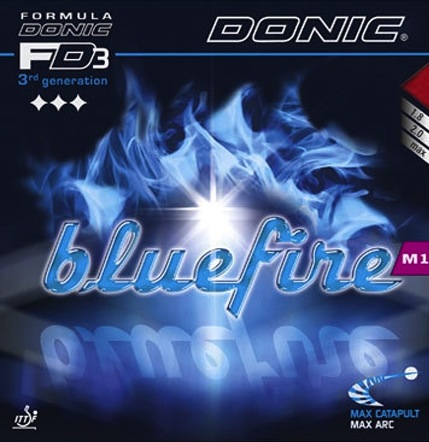
We may earn a commission from links on this page. Learn more.
Two different characters wearing similar ratings
Butterfly Dignics 09C rates 8.7 overall, Donic Bluefire M1 rates 8.4 — close on paper, but the axis breakdown shows these are not twins competing on the same terms. M1 is faster (9.3 versus 8.8, a 0.5-point edge) while Dignics 09C wins on control (9.0 versus 8.4, a 0.6-point gap) and spin (9.5 versus 9.2, a smaller 0.3-point edge). None of those three is huge, but together they sketch two different rubbers: M1 prioritizes raw pace, Dignics 09C prioritizes precision and grip.
The two gaps that actually matter: throw and tackiness
The real story is throw and tackiness, where the gaps are large enough to change how a shot behaves, not just how it rates. Throw runs 8.2 for Dignics 09C versus 6.3 for M1, a 1.9-point gap — one of the widest in this whole dataset. Tackiness runs 5.5 versus 2.7, a 2.8-point gap. Together these describe a fundamentally different ball-and-racket interaction. Dignics 09C’s grippy topsheet and extreme throw are what let it “load serves and short pushes with heavy spin” and produce a safe, high arc, per its own pros list — the hybrid tacky-tensor construction behaves closer to a Chinese-style rubber than a typical European tensor. M1 is a much more conventional low-tack tensor: lower throw, flatter trajectory, and a game built around close-to-table pushes and flicks rather than heavy spin loading.
Durability: closer than the cons suggest
Durability scores are close, 7.8 for Dignics 09C versus 7.3 for M1, only a half-point gap. But M1’s own cons flag something the raw number understates: “performance fades after one to two months as factory boost expires.” Dignics 09C’s cons make no equivalent complaint, and its pros specifically note “no ball slippage after months of use.” So while the season-long durability score is similar, the shape of the decline is different — M1 likely feels noticeably fresher-then-flatter, while Dignics 09C degrades more gradually.
What the sources say
Dignics 09C’s profile is backed by RacketInsight, Revspin, and Reddit discussion. Bluefire M1 draws on Revspin, Megaspin user reviews, Reddit, and a dedicated TableTennisSpot review, all of which flag its unforgiving nature and its need for proper arm acceleration to perform.
Migration and fit
These two are not really interchangeable on a single blade. Dignics 09C is heavy and, per its cons, “several users say hurts backhand play and flicks” — it wants an OFF-or-faster outer-composite blade and a swing built around active looping rather than light touch. M1’s bestFor is explicit about needing 1500-plus USATT-level technique and warns it is “too fast and hard for players under 1400 USATT.” Neither is a stepping-stone rubber; both assume an already-developed offensive game. If you are choosing between them for a single forehand slot, the deciding question is which trajectory you want: 09C’s high, safe, spin-loaded arc, or M1’s flatter, faster, close-to-table game. Players who open against backspin often and rely on heavy topspin margin should lean toward 09C. Players whose game is built on close-to-table pushes, flicks, and a hard first-ball attack should lean toward M1, accepting that it needs replacing sooner to stay sharp.
Weight and backhand considerations
09C’s cons specifically call out its weight hurting backhand play and flicks. M1 is markedly lighter at roughly 49 grams uncut versus 09C’s 70 grams, per the spec data, which is part of why some players find M1 more manageable on the backhand despite its own cons noting it “falls off at far distance and on the backhand.” Neither rubber is a strong backhand pick in absolute terms; the difference is in degree, not direction.
Bottom line
The overall ratings are close, but throw and tackiness reveal two rubbers built for different shot shapes. This is a playstyle decision more than a quality decision.
Frequently asked questions
Which is faster, Dignics 09C or Donic Bluefire M1?
Bluefire M1, by 0.5 points (9.3 versus 8.8). Dignics 09C answers back with a 0.6-point control edge and a much higher throw angle.
Does Donic Bluefire M1 really fade quickly?
Its own reported cons say performance fades after one to two months as the factory boost expires, even though its overall durability score (7.3) is only 0.5 points behind Dignics 09C's 7.8. The decline is described as faster and more noticeable, not just numerically shorter-lived.
Is Dignics 09C or Bluefire M1 better for the backhand?
Neither is a strong backhand rubber outright. Dignics 09C's cons flag that its weight hurts backhand play and flicks; M1's cons say it falls off at distance and on the backhand. M1 is the lighter of the two at roughly 49 grams versus 70 grams uncut, which some players find easier to manage there.
Is Dignics 09C worth the extra price over Bluefire M1?
It depends on whether you need the extreme throw and tackiness for a high-arc, spin-loaded game against backspin. If your game is closer to the table with pushes, flicks, and flat hitting, M1's flatter, faster character may suit you better despite the shorter effective lifespan.