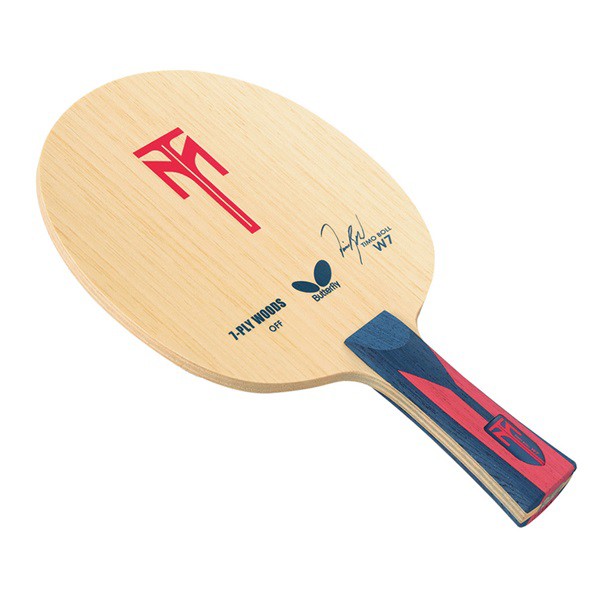
Butterfly Timo Boll W7 Review: The Ultimate 7-Ply All-Wood Offensive Blade
Pros
- Near-carbon OFF speed from a pure all-wood construction
- Huge sweet spot and stable trajectory for a seven-ply blade
- Satisfying Limba outer ply feel with crisp, direct ball feedback
- Relatively light at around 94g for its ply count
- Excellent for flat drives, smashes, and flicks
Cons
- Loop-against-backspin spin is lower than composite alternatives
- Very stiff feel; not suited to beginners or intermediate players
- Discontinued — harder to source at fair prices
- High hardness can cause hand vibration over long sessions
The Butterfly Timo Boll W7 is the lone pure-wood blade in Butterfly’s Timo Boll family, a lineup otherwise built on arylate-carbon and ZL-carbon composites. Seven plies of selected Limba, Ayous, and Kiri set out to answer one question: can an all-wood blade keep up with modern composites on pace while holding onto the tactile richness and dwell that wood purists want? At 6.7mm thick and around 94 grams, it is a compact, moderately weighted offensive tool with a hard, direct personality. Butterfly rates it speed 86 and control 74, numbers that drop it firmly in the OFF category, which is unusual for all-wood.
Performance
In practice the W7 makes good on its promise of carbon-like pace from a wood platform. Flat driving and smashing are its best work. The stiff Limba outer ply transfers energy with little loss, kicking out fast, penetrating trajectories that catch out opponents braced for the softer response of typical all-wood. The sweet spot is large for a blade this stiff, so mishits near the edge still come back as usable shots. Flicking is easy here, with the direct feel and quick response suiting the compact stroke the table demands.
Looping is more complicated. Against topspin or mid-pace balls the W7 loops fine, and the dwell, though shorter than a softer all-wood blade, still runs perceptibly longer than most carbon composites, which gives experienced players time to brush the ball for spin. Heavy backspin is where it falls down: the stiffness fights the longer, slower stroke that rotation needs, and spin output lags well behind the Timo Boll Spirit or ALC. Community scores put spin at roughly 5.2 out of 10 against 7.9 for speed, which spells out the imbalance. Control is the other wall. At 4.56 out of 10 in community ratings, the W7 punishes technical imprecision hard. Serves that miss the sweet spot lose placement, and backspin defence needs careful adjustment. Softer rubbers such as Tenergy 64 or Vega Europe make it much more manageable; harder rubbers deepen the control problem, so skip them. At 6.7mm and a stiffness rating of 7.1, the blade also passes through more vibration than softer all-wood builds, which some players feel over a long session.
What Reviewers Agree (and Disagree) On
Reviewers across Tabletennis Reference, Revspin, and community forums agree on two things: the W7 is exceptionally powerful and direct for a pure-wood blade, and it demands advanced technique to control. They split on how much weight to give those qualities. Some advanced players rate it 8 out of 10 because the pace and sweet spot suit their flat-drive game. Others find the hard, vibrating feel uncomfortable and rate it 6 out of 10, especially the heavy-topspin crowd. Dwell draws a smaller disagreement: some reviewers find it surprising for seven plies, while others compare it unfavourably to five-ply all-wood blades or slower alternatives.
Who Should Buy It
The W7 suits advanced or elite offensive players who lean on flat drives, powerful smashes, and quick flicks near the table, and who want pure all-wood feel instead of composite performance. It pays off for players who have already mastered looping technique and want a blade that answers directly to stroke quality. If your game runs on heavy topspin against backspin, or you are a beginner or intermediate player after forgiveness, look elsewhere. The Butterfly Timo Boll ALC matches the speed with better spin leverage, and a five-ply all-wood blade hands developing players far more control.
FAQ
Is the Butterfly Timo Boll W7 a carbon blade?
No. The W7 is a pure seven-ply all-wood blade built from Limba, Ayous, and Kiri. There is no carbon, arylate, or ZL fibre layer in it. It hits OFF-class speed through wood selection and stiffness, not composite materials.
How does the W7 compare to the Timo Boll ALC?
The ALC is faster and puts on much more spin, especially on loops against backspin, because its arylate-carbon layers add a catapult effect and more dwell for brushing strokes. The W7 has a softer, more tactile feel and more dwell than the ALC, but a lower speed ceiling and less spin. Pick the W7 if you want pure wood; reach for the ALC if you want maximum performance.
What rubbers pair best with the Timo Boll W7?
Most reviewers point to softer tensor rubbers to offset the blade’s stiffness. Tenergy 64, Vega Europe, and Sriver EL come up often. Keep very hard rubbers like Tenergy 80 or Dignics 09C off this blade; they only deepen the control trouble.
Is the Timo Boll W7 still in production?
No. Butterfly has discontinued the W7. You can still find it on secondary marketplaces and at a few specialty retailers sitting on old stock, but availability is limited.
What skill level is the W7 suitable for?
Advanced and elite players only. The stiffness (rated 7.1), hardness (7.5), and OFF speed class make it unforgiving for developing players. Reviewers keep recommending it only for those with polished stroke technique who can control a fast, hard blade.
Is the Timo Boll W7 good for a penhold grip?
The W7 comes in FL and ST handle styles, both standard shakehand grips. Butterfly never made it in a Chinese penhold or Japanese penhold configuration, so penhold players would have to modify one or pick a different blade.