Butterfly SK Carbon Review: The Ideal First Carbon Blade for Transitioning Players
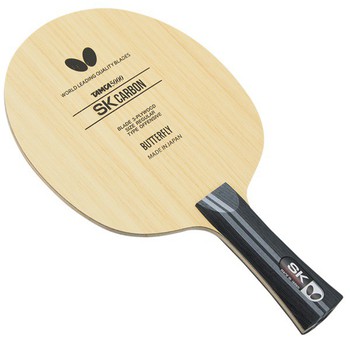
Pros
- Lightweight at approximately 78g for fast swing speed
- Thin 5.2mm profile retains wood-like feel despite carbon layers
- Strong community ratings averaging 8.69 out of 10
- 'Excellent close-to-table control for blocking, flicking, and looping'
- High spin potential for an offensive carbon blade
- Takes both tacky Chinese rubbers and high-tension tensors
- Made in Japan with consistent quality
Cons
- Not powerful enough for sustained back-court attacking play
- Lighter ball output can be a disadvantage against heavy-hitting opponents
- Limited handle options compared to other Butterfly blades
- Requires careful rubber matching to maximize its performance
The Butterfly SK Carbon plays in a crowded but important corner of the market: the beginner-to-intermediate carbon blade. It sells for USD 99.99, comes out of Japan, and uses a 3+2 construction with TAMCA 5000 outer carbon to make an offensive blade that weighs just 78g. At 5.2mm it is clearly slimmer than the stiffer ALC blades, and that thinness is exactly why it feels softer and woodier at contact. Butterfly pitches it as a stepping stone off all-wood setups, and the community data backs the pitch up: 74 reviews on tabletennis-reference.com average 8.69 out of 10, one of the strongest aggregate scores in its price class.
Performance
Speed sits at a controlled OFF level. It does not fling the ball off the face the way a Viscaria or ALC blade will, but the dwell at the TAMCA 5000 carbon interface produces a lot of spin. On Megaspin, mbrader2 wrote that it ‘produces an extreme amount of spin giving strong ball curve which allows you to hit harder and keep control,’ and rated it above the Viscaria and Timo Boll Spirit for his game style.
Up close is where the blade does its best work. Blocks come back crisp and easy to redirect, flicks snap off the face, and the short-game touch survives the carbon. On Megaspin, lorne praised its ‘excellent blocking and flicking’ with T05fx and Hurricane 3 Neo. The tabletennis-reference.com community scored control at 8.51 and spin at 8.31, both above average for a carbon blade. Because it is light you swing faster, and that arm speed makes up some of the moderate built-in pace. The backhand can run a little lively with high-tension rubbers, so some reviewers drop to a softer sheet on that side to keep the arc down.
Push back from the table and the picture changes. Mid-distance looping works, but only on a committed, full-arm stroke. At three to four meters the blade starts to feel underpowered against aggressive opponents, and anyone who lives in back-court exchanges should look for something faster. Rubber pairing decides a lot here: the blade rewards tensors like Tenergy 05 or Rasanter R37 and gets along with tacky Chinese rubbers like Hurricane 3 Neo. Stack it with a very stiff, high-throw rubber and the trajectory climbs too high; bolt on something very slow and the spin goes flat.
What Reviewers Agree (and Disagree) On
Megaspin and tabletennis-reference.com agree on the core: the SK Carbon is a light, spin-friendly offensive blade built for close-to-table play and players in transition. The disagreement is power at distance. Advanced reviewers found it underpowered for sustained baseline looping; intermediate players praised that same moderated speed for giving them better consistency. Rubber matching draws a smaller split. Most reviewers go tensor or tacky, but one got good results with hard Chinese rubbers and another flagged its value with anti-spin setups. The negative outliers on Megaspin complain about inconsistency and poor control, which reads as rubber mismatch or style clash rather than a fault in the blade.
Who Should Buy It
Buy the Butterfly SK Carbon if you have spent one to three years on an all-wood blade and want to add speed and spin without giving up the feel of wood. It fits the modern short-game style built on close-to-table looping, banana flicks, and compact blocking. Players on tacky rubbers like Hurricane 3 Neo or medium-soft tensors like Tenergy 05 FX or Rasanter R37 will get the most from it. Skip it if you play most points from mid-distance or beyond, or if you need the raw launch of an ALC or ZLC build for flat hitting and power looping.
FAQ
Is the Butterfly SK Carbon good for beginners?
It can work for advanced beginners who already have consistent stroke mechanics, but it leans intermediate. True beginners are better off on a pure all-wood blade first to build feel and control before adding carbon-assisted speed.
What rubbers pair best with the SK Carbon?
It pairs well with medium-soft tensors such as Tenergy 05, Tenergy 05 FX, and Rasanter R37, plus tacky Chinese rubbers like Hurricane 3 Neo. Steer clear of very stiff, high-throw rubbers, which push the trajectory too high and cost you control.
How does the SK Carbon compare to the Butterfly Primorac Carbon?
The Primorac Carbon hits harder and feels stiffer; the SK Carbon is lighter and gives you more control and feel. If you want an easier step up from wood, take the SK Carbon. If you want more outright speed, take the Primorac Carbon.