Butterfly Garaydia ALC Review: A Low-Throw Arylate-Carbon Blade Built for Control-First Attackers
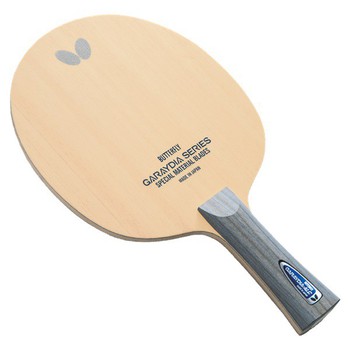
Pros
- Genuine outer arylate-carbon construction with a soft hinoki surface ply
- Very low throw arc that excels at blocking, flicking and counter-topspins
- Crisp, stiff, almost vibration-free direct feel
- Outstanding stability and control near the table, often compared to Viscaria
- Manageable weight around 83 grams with a comfortable, thick handle
- Pairs well with Tenergy 05 and other medium-hard tensor rubbers
Cons
- Low arc requires precise technique to reach maximum speed
- Can feel weak away from the table without strong footwork and form
- So damped that you feel little ball feedback, which some players dislike
- Poorly matched to tacky hard Chinese rubbers because of the low throw
- Discontinued, so new copies are hard to source
The Garaydia ALC landed in 2015 alongside the faster ZLC and T5000 versions, all built for the plastic poly ball era. It belongs to Butterfly’s arylate-carbon family, the same composite line as the Viscaria and Timo Boll ALC, but it carries its own character: a low throw and a crisp, controlled feel. The build is 5-ply, three wood veneers finished with two arylate-carbon fibers and a Japanese hinoki surface layer over the carbon, pairing the touch of hinoki with the stability of an outer-carbon layout. Butterfly sold it under the line ‘Consistency and Power Combined with Arylate-Carbon,’ aiming it at spin-based attackers who want placement and control over raw catapult. Retailer copy, RevSpin reviews, TableTennisDaily’s filmed series review, and Reddit threads all paint the same picture: an OFF-class offensive blade that plays like a precision instrument rather than a rocket launcher. Butterfly has since discontinued it, which turned the Garaydia ALC into a cult board that owners hold onto and replacement-hunters chase, so knowing exactly who it suits matters more than ever.
Performance
The low throw arc defines this blade. Reviewers keep coming back to it. TableTennisDaily calls it a low-throw blade, excellent for blocking and at its best for flicking and counter-topspins close to the table, and a RevSpin owner notes the throw angle runs much lower than Butterfly’s SZLC blades, which helps blocks and short play without hurting topspins. That low arc cuts both ways. It makes wristing short underspin balls and varying block pace easy and keeps balls from sailing long, but it demands clean technique: TableTennisDaily testers found three-point forehands at maximum pace needed real precision because of the low arc, and only after adjusting could they pull out a lot of speed.
Speed lands firmly in OFF without going extreme. A RevSpin reviewer who owns both versions reports the ALC is a touch slower and slightly less stiff than the ZLC, yet still fairly hard and stiff, while TableTennisDaily found it felt slightly faster than a Timo Boll ALC. Read together, this is a fast blade you can trust, not one that runs away from your strokes. The feel is crisp, stiff, and direct with essentially no vibration. Those two arylate-carbon fibers mean you don’t feel much of the ball, a clean, damped contact that some love for its consistency and others find too muted. Stability is a strength, with one reviewer rating it as stable as a Viscaria but with an even crisper touch, ideal for blocking hard attacks with a slightly closed racket face.
Control is what earns the blade its name. It is widely regarded as the most controllable in the Garaydia line, built for a hybrid block-and-drive game rather than stepping well back to power-loop. Weight stays friendly, with owners reporting copies around 82 to 83 grams, so total setup weight stays reasonable even after two rubbers, though a few note it can run light enough that combined weight drops lower than expected with certain rubbers. Rubber matching matters. Testers and forum users agree it shines with medium-hard European and Japanese tensors, pairing perfectly with Tenergy 05 and similar sheets, while tacky hard Chinese rubbers turn awkward because the medium-to-low throw forces a flatter contact. The handle draws praise too, thick, catchy, and comfortable, especially for larger hands. The one recurring knock concerns play away from the table, where a couple of reviewers say it feels weaker than dedicated power blades if your footwork and body form go lazy, though with correct form and good wrist use it still produces powerful shots.
What Reviewers Agree (and Disagree) On
Every source agrees on the core read: a control-oriented, low-throw arylate-carbon blade at its best close to the table for blocking, flicking, and counter-topspin, stable and crisp with almost no vibration. Reviewers agree it pairs well with medium-hard tensors like Tenergy 05 and that it suits advanced players over beginners. The sharpest splits are over ball feedback and back-from-the-table power. TableTennisDaily and some owners prize the heavily damped, vibration-free contact; others find that feeling little of the ball makes the blade muted and would rather have something flexier. On power, the camp that calls it weak away from the table with lazy form runs up against the camp that insists correct technique still produces plenty of speed. There’s a minor split on relative speed too, since one RevSpin owner rates it slower than the ZLC while TableTennisDaily rates it slightly faster than a Timo Boll ALC, and both hold up because they’re measuring against different blades. One practical snag turns up on Reddit, where an owner reported a Rakza XX rubber peeling off repeatedly with water-based glue, a setup problem rather than a blade flaw, but worth knowing.
Who Should Buy It
Buy the Garaydia ALC if you are an advanced or strong intermediate topspin attacker who plays close to and at mid distance, leans on blocking, flicking, and counter-topspin, and wants a stiff, crisp, low-throw arylate-carbon blade with class-leading control instead of a springy catapult. It rewards clean technique, players who can use the low arc to keep attacks fast and flat, and anyone who likes a thick, comfortable handle. Pair it with a medium-hard European or Japanese tensor such as Tenergy 05 to get the intended feel. Skip it if you are a beginner, if you step back to power-loop from distance, if you run tacky hard Chinese forehand rubbers, or if you want a flexier blade with rich, vibrating feedback. Defenders and choppers should avoid it as well, since reviewers agree it handles everything except chopping. And one practical caveat: Butterfly discontinued it, so you may have to track down remaining stock or used copies. If you want a current blade that’s easy to replace, weigh that against everything it does well.
FAQ
How many plies does the Butterfly Garaydia ALC have?
Five. It runs 3 wood veneers plus 2 arylate-carbon (ALC) fibers, listed by retailers as 3W+2ALC, with a Japanese hinoki surface ply over an outer-carbon layout. The arylate-carbon layers bring the stiffness, stability, and crisp, low-vibration feel.
What are the Garaydia ALC’s weight and thickness?
Butterfly and retailers list it at about 83 grams and 6.9mm thick, and owners commonly report copies in the 82 to 83 gram range. For an OFF-class arylate-carbon blade, that keeps total weight manageable once two rubbers are on.
Is the Garaydia ALC faster than a Timo Boll ALC or Viscaria?
TableTennisDaily testers found it felt slightly faster than a Timo Boll ALC, and RevSpin reviewers rate its stability against a Viscaria while crediting it with an even crisper touch. The bigger difference is the throw: the Garaydia ALC’s arc runs noticeably lower, which favors blocking and close-table play.
What rubbers pair best with the Garaydia ALC?
Reviewers point to medium-hard European and Japanese tensors, with Tenergy 05 named as a perfect match. Tacky hard Chinese rubbers turn awkward on the forehand because the blade’s medium-to-low throw forces a flatter contact.
Is the Garaydia ALC good for beginners?
No. RevSpin and TableTennisDaily agree it targets advanced and upper-intermediate topspin attackers. The OFF speed, stiff feel, and low throw arc all demand solid technique, so newer players should start on a slower, more forgiving all-round or offensive-minus blade.
Is the Garaydia ALC still available?
Butterfly has discontinued it, so new stock keeps getting harder to find and some retailers list it as no longer available. Buyers tend to hunt down remaining inventory or used copies, or fall back on a similar low-throw arylate-carbon blade.