Butterfly Freitas ALC Review: Controlled Power for the Euro Looper
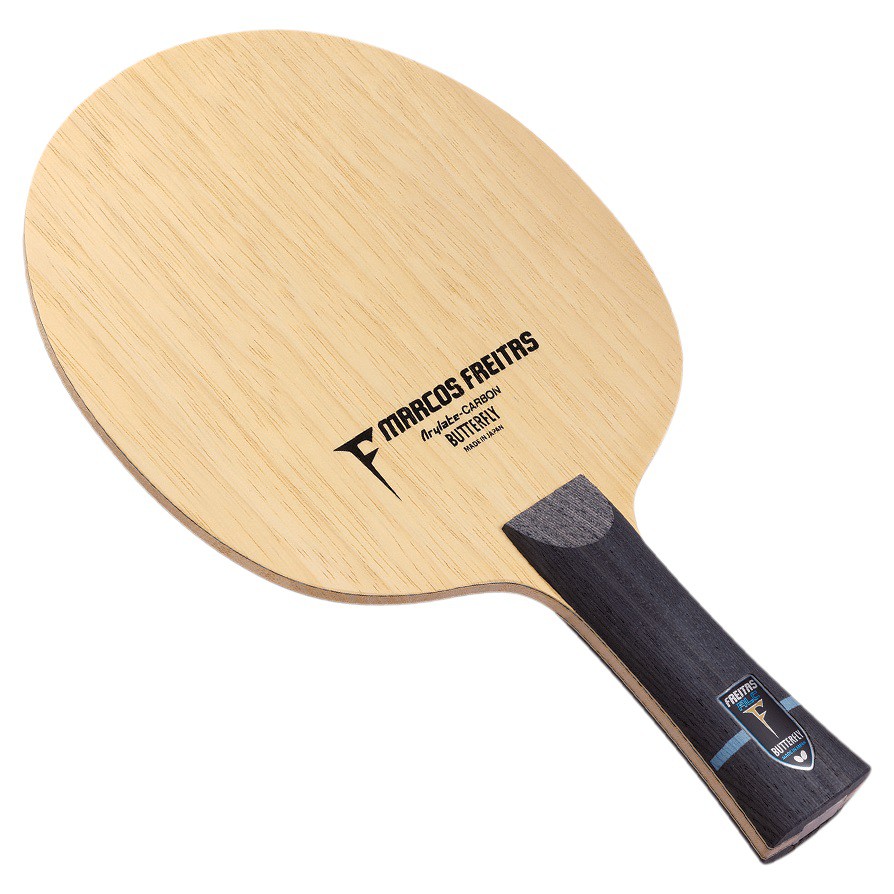
Pros
- Outstanding dwell time and soft feel for an outer-carbon blade
- Excellent control and consistency for an OFF-rated blade
- Great looping performance — topspin is rewarded with spin and placement
- Blocking is comfortable and precise
- Works well with a wide range of tension rubbers
- Natural step-up from all-wood blades for developing players
Cons
- Slower than Michael Maze ALC or Timo Boll ALC — some players find it underwhelming at pace
- Low throw trajectory makes short game and flicks tricky
- Weight variation between units can exceed 90 grams
- Not suited to heavy-brush Asian technique or Chinese-style power looping
- Premium price challenged by some reviewers
The Butterfly Freitas ALC is an outer arylate-carbon blade shaped around the game of Portuguese star Marcos Freitas. It runs the same Arylate-Carbon fibre tech as the Timo Boll ALC and Zhang Jike ALC lines, but thicker, softer Limba outer veneers push it toward a more dwell-oriented feel. That places it between the demanding Viscaria and the accessible Korbel: carbon speed and crispness, with enough forgiveness for players still sharpening a loop-drive game. With 96 community ratings averaging 9.39 out of 10 on Tabletennis Reference and 18 verified purchases reviewed on Megaspin, it has built a loyal following among euro-style attackers who want feedback and control alongside OFF-class pace.
Performance
The Freitas ALC is a 5+2 outer carbon blade, seven layers in all: Limba-ALC-Limba-Ayous-Limba-ALC-Limba. With the two carbon sheets sitting close to the surface, response is quick and contact is crisp. What separates it from other outer-ALC blades is the thickness of those Limba layers. They run softer and more generous than on the Michael Maze ALC or Timo Boll ALC, dropping the feel into medium-soft territory and adding real dwell.
Topspin rallies are where it comes alive. The slightly yielding outer ply over a rigid core holds the ball an extra moment, so a clean loop turns into a heavy, arcing shot with depth you can count on. Spin production draws steady praise, rated above comparable ALC blades. It wants a flat or forward stroke path, though. Brush the ball with a more vertical Asian technique and the response turns inconsistent, with shot quality below what you’d expect.
Speed is OFF-class, but measured. It clears all-wood blades and most inner-carbon designs, yet sits on the conservative end of the outer-carbon range. Reviewers clock it noticeably slower than the original Michael Maze ALC, with some putting real-world speed around 8.5 on a 10-point scale rather than at a hard OFF ceiling. For a lot of players that is the appeal: the pace stays controlled enough to loop aggressively without losing placement.
Blocking is a strength. The medium-soft feel soaks up incoming pace cleanly, and redirecting comes naturally. Players moving over from wood blades often say blocking felt right away, with less overshoot than harder carbon. The short game is the soft spot, and reviewers keep flagging it. The lower natural throw of the outer-carbon build makes pushing and flicking near the net more demanding, and anyone without solid short-game fundamentals will fight it.
Control and consistency are the headline. Loop from mid-distance, drive flat, or counter-hit, and the blade pays back good technique with precise, repeatable ball flight. Rubber pairing matters here. The community leans toward medium-hard tensors such as Tenergy 05, Tenergy 80, Fastarc G1, and Rasanter 47 on the forehand, with Vega Euro or a similar control rubber on the backhand. Harder Chinese compositions push the already-stiff carbon structure into uncomfortable territory.
What Reviewers Agree (and Disagree) On
Across four review communities, Megaspin, Revspin, Tabletennis Reference, and Bladerubber.net, the Freitas ALC earns strong marks for dwell, spin, and control. The verdict is consistent: a blade for the technically sound, loop-oriented player who attacks in a European style.
The arguments cluster in two places. Speed comes first. Most reviewers treat the measured pace as a feature, but a vocal minority, especially counter-attackers and Michael Maze ALC veterans, find it too slow and feel let down when they need pace. Suitability is the second. Euro-loopers embrace it; reviewers who brush with Asian-style technique or run hard Chinese rubbers report low shot quality and easy countering. Price irritates a few who argue the performance doesn’t justify the premium over comparable blades. On balance, opinion swings firmly behind the blade for the audience it was built for.
Who Should Buy It
This blade suits intermediate and advanced players with a solid looping stroke and a European-influenced game: front-to-mid-table attackers who win on spin, placement, and controlled pace rather than raw power. It is a smooth step up from all-wood blades like the Butterfly Korbel or Primorac, adding real speed and spin without the harshness of harder outer-carbon frames.
Look elsewhere if you brush in the heavy Chinese looping style, if you counter-attack and live on pace, or if you’re a beginner who hasn’t built consistent technique yet, because the outer carbon amplifies your errors right alongside your winners. If you already own the Timo Boll ALC and like its character, note that the Freitas ALC is softer and slower, not faster.
FAQ
How does the Butterfly Freitas ALC compare to the Timo Boll ALC?
Thicker Limba outer veneers make the Freitas ALC softer and a touch slower than the Timo Boll ALC. It holds the ball longer and feels more forgiving on contact, which many euro-style players prefer for control. The Timo Boll ALC is crisper and slightly quicker.
Is the Freitas ALC the same blade as the Michael Maze ALC?
No. They share the ALC fibre technology and a similar construction idea, but the Freitas ALC’s thicker outer veneers make it softer and measurably slower than the original Michael Maze ALC. Treat it as a refined successor, not a direct replacement.
What rubbers work best with the Butterfly Freitas ALC?
The community settles on medium-hard tensors. Tenergy 05, Tenergy 80, and Fastarc G1 are popular forehand picks. Softer sheets like Vega Euro or Rasanter 42 suit the backhand. Steer clear of very hard Chinese compositions, which leave the blade feeling overly stiff.
How much does the Butterfly Freitas ALC weigh?
Most units land around 85 to 88 grams, though reports vary and some come in above 90 grams. If weight is critical to your setup, check the specific copy before buying.
Is the Freitas ALC good for beginners?
No. The outer-carbon construction magnifies good and bad technique alike. A beginner is better off on an all-wood blade until the loop mechanics settle. The Freitas ALC pays back intermediate and advanced players who already have the fundamentals.