Butterfly Timo Boll ALC vs Stiga Carbonado 290: Which Should You Buy?
| Butterfly Timo Boll ALC | Stiga Carbonado 290 | |
|---|---|---|
| Our rating | 9.0/10 | 8.3/10 |
| feel | medium | very stiff, hard, crisp and direct carbon feel with a high-pitched sound; fast and linear with a low throw |
| handle | FL/ST/AN | FL |
| plies | 5W+2 Arylate-Carbon | 5 wood + 2 carbon (7-ply), TeXtreme carbon |
| speed | OFF | OFF+ |
| thickness_mm | 5.8 | 6.2 |
| type | — | OFF+ |
| weight_g | 86 | 95 |
We may earn a commission from links on this page. Learn more.
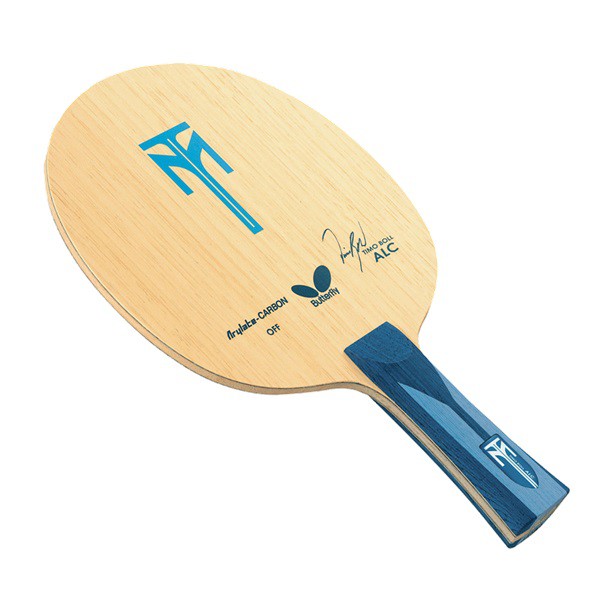
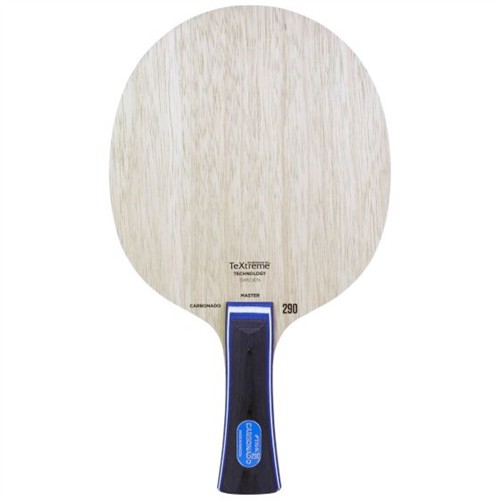
Butterfly Timo Boll ALC (rated 9.0) and Stiga Carbonado 290 (rated 8.3) are both OFF-class shakehand blades, but the axis data shows they are not really competing for the same buyer — the differences that matter here are not subtle.
The three axes that actually separate these blades
Weight is the biggest gap in the whole dataset for ALC comparisons: 6.8 versus 10.0 on the weight axis, a 3.2 point spread, backed up by real grams — ALC typically weighs around 86g, Carbonado 290 around 95g. Stiga’s own spec sheet calls this “doubled 200 gram TeXtreme carbon,” and the pros list is explicit that it delivers “extreme power,” while the cons list admits it is “stiff and on the heavier side, less forgiving than softer Carbonados.” That is not marketing spin, it is the blade’s own reviewers telling you the same thing the numbers say.
Hardness is the second big gap: 6.2 for ALC versus 8.1 for Carbonado 290, a 1.9 point delta. Stiffness follows the same pattern at 5.8 versus 7.3, a 1.5 point gap. Put together, these three numbers describe a blade that hits fundamentally harder and stiffer than ALC — TableTennisDaily and ExpertTableTennis reviewers both describe Carbonado 290’s feel as “very stiff, hard, crisp and direct… with a high-pitched sound,” which lines up exactly with what the hardness and stiffness axes predict.
Where they’re closer than you’d expect
Speed (9.0 vs 9.4, delta 0.4), control (8.7 vs 9.0, delta 0.3) and especially consistency (9.3 vs 9.4, delta 0.1) are all close enough to call a tie. That last one is worth sitting with: despite Carbonado 290 being marketed as an OFF+ blade “rated on par with a Jun Mizutani ZLC class blade,” its aggregated consistency score is essentially identical to ALC’s. Don’t assume the more aggressive-sounding blade is less dependable — on this data, it isn’t.
What the low throw actually costs you
Carbonado 290’s cons list flags something the radar axes don’t fully capture: “very low throw can cause netting until you adapt your bat angle.” Revspin, TTGearLab and Megaspin reviewers all reference this low, flat trajectory as the blade’s signature trait — it rewards players who already generate their own arc through technique rather than relying on the blade to loft the ball. ALC, by contrast, has a more conventional medium throw that is more forgiving of imperfect timing.
Fit and level
ALC’s case is attacking shakehand players with a developed stroke who want balance across speed, spin and control. Carbonado 290’s bestFor is narrower and more demanding: “advanced, aggressive attackers and offensive penholders who finish points fast with hard drives, smashes and blocking” — and its own cons list adds it is “not suited to chopping with long pimples” and “hard to keep consistent over long rallies for some techniques.” This is a blade built around finishing points quickly, not extending them.
Switching from ALC to Carbonado 290
This is a bigger jump than most upgrade paths in this category. You are not tweaking your setup, you are changing the fundamental feel of every shot — stiffer, harder, heavier, lower-throwing. If your game already relies on generating your own power and finishing at the table, the switch can genuinely raise your ceiling on smashes and counter-blocks. But if any part of your game depends on ALC’s forgiving medium throw or its famous synergy with Tenergy 05 for looping away from the table, Carbonado 290 will fight you, not help you — its own cons list says as much about long rallies and technique.
Going the other direction, from Carbonado 290 down to ALC, trades some peak power for a blade that plays more of your shots for you — more throw, more forgiveness, and a slightly more balanced feel across styles, at the cost of the raw finishing power Carbonado owners specifically buy the blade for.
Bottom line
Six independent sources — Revspin, ExpertTableTennis, TableTennisDaily, Reddit, TTGearLab and Megaspin — converge on the same description of Carbonado 290: stiff, hard, heavy, fast, low-throwing, built for players who already know how to finish a point. ALC is the more universal tool. The consistency scores say neither is less dependable than the other; the difference is entirely about how much raw stiffness and weight your stroke can handle and wants to handle.
Frequently asked questions
Is Stiga Carbonado 290 too advanced for intermediate players?
Its own bestFor description targets advanced, aggressive attackers specifically, and reviewers note a very low throw that can cause netting until you adapt your bat angle — it is not the forgiving option in this pair.
Which blade is more consistent, ALC or Carbonado 290?
They're essentially tied — 9.3 vs 9.4 on the consistency axis, a 0.1 point gap that is within normal review variance.
How much heavier is Carbonado 290 than ALC?
Around 9 grams in typical units (95g vs 86g), which shows up as a 3.2 point gap on the weight axis — the single biggest difference between these two blades.
Can I use Carbonado 290 for a defensive or chopping style?
No — its own cons list states it is not suited to chopping with long pimples, and its low throw and stiff feel are built around finishing points fast, not extending rallies.