Give New Table Tennis Equipment Time Before You Judge It
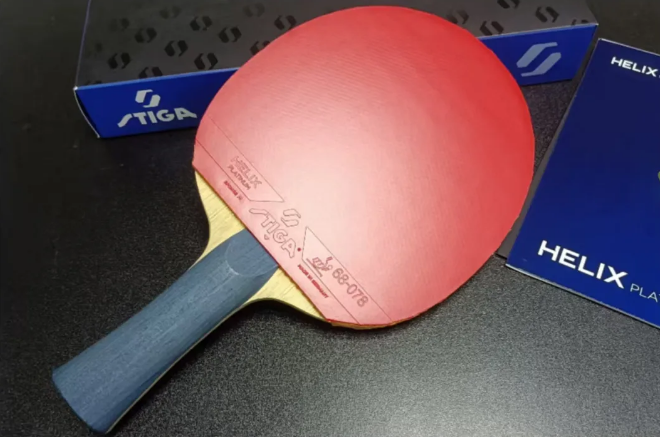
I have often said that national-team players are skilled enough to adapt to differences between blades. They can change fiber types, move between inner- and outer-carbon constructions, and still produce a high level of table tennis.
Lately, I have been thinking that the same principle matters much more for amateur players than we tend to admit. Provided the equipment is sound and within your ability to control, enough time with it can lead to fairly similar match results. A dramatic equipment-driven improvement is less common than a period of adjustment followed by a return to your usual level.
Even a promising change needs time
In an interview about Butterfly ZYRE-03, Shunsuke Togami described becoming more confident in the rubber after his World Cup and World Championships performances. He particularly liked what it offered on backhand flicks and punchier attacking shots.
He also said that opening against backspin took time to get used to. That detail matters. A product can offer something useful while still asking you to learn a different contact on another stroke.
Our first impressions can be real and honestly reported, yet still be incomplete. Accepting a new blade or rubber often means giving ourselves enough time to adapt to the parts that initially feel unfamiliar.
A brief trial can hide a useful trade-off
Many equipment enthusiasts, myself included, try a lot of products without staying with each one very long. We rely on previous experience to make a quick judgment.
If the new setup does not immediately feel like a clear upgrade, it may be put aside. Sometimes that means abandoning equipment that could produce a stronger ball simply because its behavior does not yet feel natural.
An unmistakable improvement from the first session does happen, but in my experience it is relatively rare. More often, the change brings a benefit in one area and an adjustment somewhere else.
Changing the backhand can change the forehand too
I experienced this with STIGA Helix Platinum on the backhand. The backhand itself felt well suited to me. But I had spent years with Tenergy 80 on the backhand and Tenergy 05 on the forehand, and I was accustomed to how that entire racket felt.
Changing the backhand rubber also changed the forehand response. Even though the forehand sheet had stayed the same, the familiar combination was gone.
At that point, I had a choice: spend longer adapting to the new setup, or return to the old one. It is psychologically difficult to leave a combination that has become comfortable over many years.
I had a similar experience when Tenergy 19 first appeared. On the backhand, its bite felt more immediate than Tenergy 80, and punch shots felt accurate. Yet I preferred the forehand support I felt with Tenergy 80 on the other side, so I set Tenergy 19 aside.
Looking back, I gave up its strengths because of a trade-off I did not want to accommodate. There is no perfect piece of equipment.
For more detail, see how the backhand rubber changes forehand performance.
Every useful characteristic has another side
A friend recently described the same dilemma. Dignics 09C gave his backhand a strong ball, but felt a little too resistant. Xiom Omega 8 China felt easier to use with the opponent’s pace, yet also a little too bouncy. He was unsure what to try next.
The qualities he disliked were connected to the qualities he liked. Dignics 09C’s resistance helped produce the gripping, spinny contact he valued. The easier response of Omega 8 China also made some extra liveliness hard to avoid.
Moving to something less lively might solve one problem while making it feel slower or more tiring. The next change still involves a trade-off.
Give the useful changes a fair chance
One friend, around 1900 on his local rating system, made an unconventional switch from a non-tacky backhand rubber to Hurricane 2. His forehand was already strong, but he wanted better serve receive, short-game control and reliability when opening against backspin.
For him, the change addressed those weaknesses. It also brought adjustments, including greater sensitivity to incoming spin in defensive play.
That is the part of equipment choice I keep coming back to: identify the benefit you actually need, accept that it may come with a drawback, and allow time to learn the new response. A few unfamiliar sessions are not always enough to judge whether the change can work.