Stiga DNA Dragon Grip Review: Elite Spin, Short Lifespan
Pros
- Category-leading spin generation — community ratings average 9.64 out of 10
- Effective even with half strokes — lower skill floor than most 55-degree rubbers
- Outstanding short-game control comparable to Chinese-style rubbers
- Moderate throw angle that balances aggression with net clearance
- C-Touch Tensor sponge absorbs shock well and softens after break-in
- Counter-looping off the bounce is particularly strong
- Blend of Chinese topsheet grip and European sponge response
Cons
- Tacky topsheet loses grip rapidly — noticeable degradation within 4-8 weeks
- Performance cliff is sudden, not gradual — the rubber goes from good to dead quickly
- Sensitive to humidity — plays poorly in non-climate-controlled environments
- High sponge hardness (55 degrees) requires an adjustment period
- Blocks feel stiff and uncomfortable for some players
- Replacement costs add up given short effective lifespan
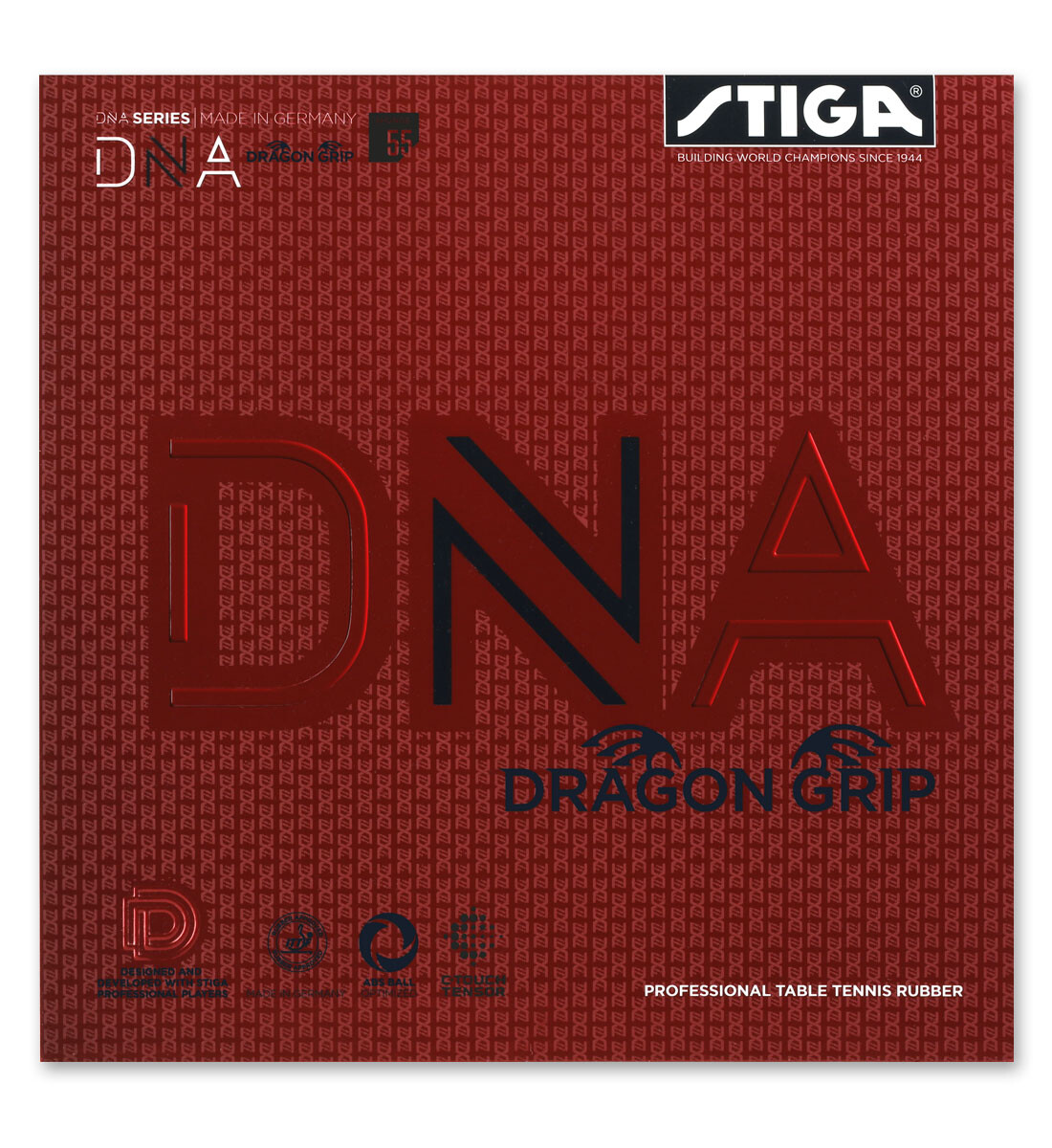
The Dragon Grip chases something specific: Chinese-style spin from a German tensor. It is a German-made, tensor-boosted sheet wearing a deliberately tacky topsheet, built for players who want the grip of a Chinese rubber with the speed and bounce of a European sponge underneath. It runs Stiga’s C-Touch Tensor technology, a sponge process Stiga says drew on AI analysis and elite-player feedback, carries a 55-degree hardness rating, and stands as the spinniest sheet in the DNA lineup. Beginners and passive players need not apply. It pays back committed brushing strokes and technical serve mechanics, and the players who put in the time say it raised their spin ceiling. The catch, raised in every major review community, is whether that ceiling is worth how fast the rubber dies.
Performance
Spin is the headline, and nobody argues. Tabletennis Reference community data puts the spin rating at 9.64 out of 10, and players on RevSpin, Megaspin, and Paddle Palace keep reaching for the same words to describe a fresh sheet: brutal, massive, exceptional. The tacky topsheet grabs the ball through serves, short pushes, and loop drives alike, so you load heavy rotation without a full brushing swing. Counter-looping stands out. The grip drags the ball back down over the net even on fast incoming topspin, handing you extra margin. Speed registers at a community-rated 7.55 out of 10, which lands lower than anyone expecting a hard-sponge rocket would guess. This plays like a controlled hybrid, not a flat-speed weapon. The throw angle is moderate, below Dignics 09C but above Tibhar MX-P, which fits attackers who build points through spin variation instead of pace.
The short game is the other surprise. It beats European speed rubbers like Tenergy or MX-P here, because the slightly tacky surface soaks up soft shots rather than springing them away, keeping pushes and drop shots in check. One Paddle Palace reviewer described it as Chinese-style in touch rallies but European-snappy on full loops. Control sits at a community-average 8.09 out of 10: forgiving on direction, demanding on technique. Block passively or swing half-heartedly and the results scatter; commit to the forehand and it tracks where you aim. The 55-degree sponge feels harder out of the package than most expect and softens after a 2-4 week break-in. On a soft or medium-stiff blade the pairing balances out. On a stiff or carbon blade it turns into a brick wall and the dwell-time advantage vanishes.
Durability is the line that splits the user base. Almost every reviewer reports a real drop-off within 4-8 weeks of regular use at 2-3 hours per day. The tacky topsheet fades first, leaving visible wear marks in the contact zone. It does not decline gradually. It falls off a cliff: one session it plays normally, the next the grip is mostly gone. Humidity speeds the whole thing up, and in a non-climate-controlled room moisture can shut the topsheet down for the day entirely.
What Reviewers Agree (and Disagree) On
RevSpin, Megaspin, Paddle Palace, and Tabletennis Reference agree on the strengths: heavy spin when fresh, strong short-game control, and a blend of Chinese and European traits you don’t often find in one sheet. The fights start over durability and what counts as an acceptable lifespan. Set it next to a Chinese rubber like Hurricane and people call the durability fine. Set it next to a European tensor like Tenergy and they call it short-lived. Speed splits the same way: players coming off boosted Chinese sheets find it fast, players coming off European tensors find it slow. The one thing nobody contests is that this rubber is wasted on passive or intermediate players. It needs active strokes, real technique, and the right blade to give back what it has.
Who Should Buy It
This is a rubber for advanced and competitive players who build around heavy topspin and want to squeeze every bit of spin out of the modern plastic ball. Forehand-dominant loopers who take the ball early and work points through spin variation will love it. The short game holds up well enough that players who fold in deft touch at the table can run it too. Look elsewhere if you put speed ahead of spin, if you play in a humid room with no climate control, or if you can’t or won’t swap rubber every 2-3 months. Beginners and intermediate players will fight the hard sponge and the technique it demands. It is also a reasonable test bench for anyone curious about hybrids who wants Chinese-style grip without going all the way to a Chinese sheet.
FAQ
How does the Stiga DNA Dragon Grip compare to Butterfly Dignics 09C?
Both are tacky hybrids aimed at spin-first attackers. The Dragon Grip is a touch less tacky than the Dignics 09C but throws at a comparable angle. The Dignics 09C lasts longer, holds up better in humidity, and costs a lot more. If the Dignics price is out of reach, the Dragon Grip is a strong budget-to-mid stand-in.
Is the Stiga DNA Dragon Grip suitable for backhand use?
Most reviewers keep it on the forehand. A minority run it on both wings. On the backhand the 55-degree hardness feels stiff and the throw angle overshoots unless you have a developed backhand loop. Skip it on the backhand if your blade is stiff.
How long does the DNA Dragon Grip last?
Figure on peak performance for roughly 4-8 weeks at 2-3 hours of daily practice. After that the tacky topsheet starts to fade, and once the grip is gone the drop is fast and sharp. Budget for a replacement every 2-3 months to keep it at its best.
Does the DNA Dragon Grip work well with boosters?
Yes. Several Megaspin reviewers saw clear gains with boosters and called the rubber ‘a weapon’ once boosted. The tensor sponge takes booster well, and both speed and spin climb noticeably.
What blade pairs best with the DNA Dragon Grip?
A soft all-wood or composite blade with medium flex is the sweet spot, and the Viscaria FL comes up again and again. Stiff all-carbon blades only sharpen the 55-degree sponge and cut dwell time, which fights everything the rubber does well. You want a blade that lends some softness back to balance the rubber’s hardness.