Palio CJ8000 2-Side Loop Review: Best Budget Looping Rubber for Beginners
Pros
- Hard to beat on cost: street prices often under eight dollars a sheet, with no tensor competing
- Soft top sheet makes opening backspin loops accessible for beginners
- Good spin ratings confirmed across multiple independent sources
- Works on forehand or backhand, and runs well on all-round blades
- Responds well to paraffin oil boosting for intermediate development
- Bundled on the Palio Expert 2 and Expert 3 premades, so easy to find and try
Cons
- Durability is limited, especially the red sheet which can degrade within four months
- Speed is low without boosting, limiting mid-distance attacking
- Spin diminishes at higher swing speeds, requiring technique adjustment
- Inconsistent quality control between individual sheets
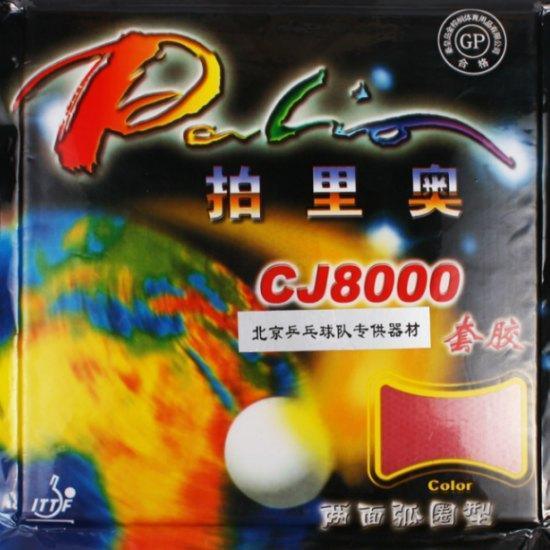
The Palio CJ8000 2-Side Loop has been in production for over fifteen years and still gets named whenever someone asks for an ultra-budget rubber. Palio, a Chinese maker, built the CJ8000 family for players who want European-style playability at a fraction of the cost. The 2-Side Loop with the 36-38 degree sponge is the popular configuration, medium-soft, and well suited to beginners learning to open loops against backspin. It ships on several Palio premade paddles, including the Expert 2 and Expert 3, which puts it in front of plenty of new players as a first rubber. At street prices often well under eight dollars per sheet, nothing in the tensor or high-end European category really competes with it on cost.
Performance
On the table the CJ8000 2-Side Loop has a clear identity: a slow-to-medium rubber built for spin and control, not power. The top sheet carries a light tack, noticeable but a long way short of a Hurricane 3, and it grips the ball well through slow and medium-pace loops. Opening against heavy backspin is the standout. The soft sponge soaks up the incoming spin, the grippy surface relaunches the ball on a medium-high arc, and the ball lands. Revspin reviewers came back to that backspin looping ease over and over as the rubber’s defining trait. Blocks close to the table are reliable and chops produce good spin, though low chops can find the net if your angle is off.
Speed is the ceiling. Out of the wrapper it’s slow next to even entry-level tensors, which makes mid-distance topspin exchanges a grind. There’s a well-documented fix, though: this rubber takes to paraffin or baby oil boosting unusually well. A few drops into the sponge soften it near-permanently and bump the spin, pushing performance toward Mercury 2 territory with a higher throw. The Palio JP sponge drinks the oil in, the feel settles after a couple of weeks, and it stays spinnier than stock even as the added speed slowly bleeds off. Unboosted, run it on all-round blades to make up for the missing speed; on offensive blades it gets livelier but you give back some control margin.
Durability is the weak spot, and almost every review says so. The red sheet wears faster than the black under heavy practice, and one detailed Revspin reviewer flagged visible wear after just two hours of multiball drill. The black sheet usually lasts longer. Wiping it down after every session helps, but plan on new sheets every three to five months under regular training. Quality control wobbles too, with sheet texture and tack varying a little between copies, which is par for the course with budget Chinese rubbers.
What Reviewers Agree (and Disagree) On
Across every source the verdict holds: for beginners, and especially for building looping technique, the CJ8000 2-Side Loop punches well above its price. Forum and community reviews line up on strong spin, good close-table control, and limited speed. The disagreement is over how long people stay on it. Some intermediates keep it happily for over a year; others hit the speed ceiling within a few months and move to faster rubbers. There’s a smaller split on which side it suits, with some preferring it on the backhand for its steady short game and others on the forehand, where spin development matters most during the beginner stage.
Who Should Buy It
The CJ8000 2-Side Loop is built for true beginners picking their first custom rubber and for coaches kitting out a roster of students on a club budget. It suits players learning topspin technique who need a rubber that rewards correct stroke form without demanding high swing speed. Budget-minded intermediates who want a training rubber for multiball drills, where the price matters more than how long it lasts, will get value out of it too. If you already loop comfortably at medium speed and want to push faster exchanges from mid-distance, step up to an entry-level tensor instead. Defensive or all-round players who chop a lot will hit the occasional unpredictable low chop, but at the table the rubber covers a lot of ground.
FAQ
How does the CJ8000 2-Side Loop compare to classic rubbers like Mark V or Sriver?
Several reviewers put its speed close to Mark V and Sriver L, but with clearly more spin. As a loop-focused sheet at a much lower price it has the edge, though it won’t last as long as those classics.
Is the sponge hardness rating on the Palio scale the same as DHS or ESN ratings?
No. Palio runs its own scale. The 36-38 degree rating works out to roughly medium-soft on that scale, and it does not line up with DHS 36 degrees or ESN 36 degrees. Read it as a rough guide, not a precise equivalent.
Can I boost this rubber with paraffin oil?
Yes, and the community pushes it hard. A light coat of paraffin or baby oil in the sponge lifts both spin and throw by a clear margin. On the Palio JP sponge the effect is near-permanent; it stays spinnier than stock even after the added speed settles back. Skip it on the 36-38 degree version if you mean to drop below 39 degrees effective hardness, because the sponge turns too soft to control.
Which side of the paddle should I put this rubber on?
Both work, and reviewers don’t agree. On the forehand you get the easy backspin looping and the spin development that helps technique training. On the backhand you get the steady short game and reliable blocks close to the table. On faster blades it leans backhand, where its control ceiling counts for more.
How long does this rubber last before needing replacement?
Roughly three to five months under regular training. The red sheet wears faster than the black, and some reviewers saw visible surface damage after around two hours of heavy multiball practice. Wiping it after every session and keeping it out of sunlight stretches the life.
Is this rubber suitable for intermediate players or only true beginners?
Mostly beginners and lower-intermediate players. One experienced community member did report a top-five nationally-ranked defensive player using it in competition, so in the right style it can hold up at higher levels. For most intermediates, though, the speed ceiling starts to bite once their mid-distance attacks become consistent.