Donic Bluestorm Z1 Turbo Review: High-Speed ESN Tensor for Advanced Attackers
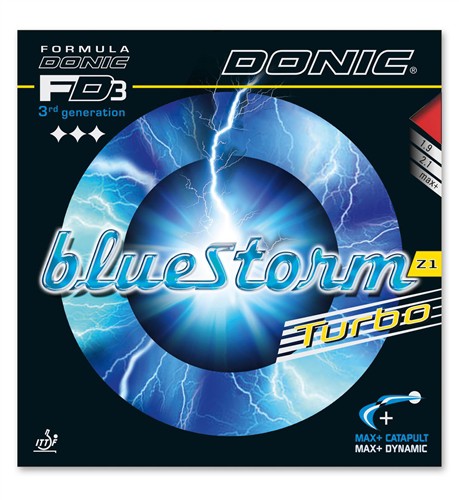
Pros
- Best-in-class speed ceiling among ESN tensor rubbers at its price
- Strong topspin arc on well-struck loops from mid and long distance
- Responds sharply to boosting, which opens up the closed sponge
- Softer in hand than the 50-degree sponge rating suggests
- Pairs with carbon, inner-layer, and all-wood offensive blades alike
- Excellent durability reported under heavy training loads
Cons
- Highly inconsistent and unstable without booster application
- Muffled, thick feedback makes it hard to gauge loop depth
- Short game is problematic: flicks overshoot, blocking is unreliable
- Not recommended for beginners or players with developing technique
The Bluestorm Z1 Turbo is the hardest, fastest rubber in Donic’s Bluestorm range. A 50-degree German ESN tensor sponge under a thin, high-tension topsheet aims it at offensive players who want maximum firepower off the forehand wing. It sits above the standard Z1, giving up some consistency for a real jump in raw speed and sponge responsiveness. An overall user rating of 9.34 out of 10 across nearly 30 independent reviews has earned it a name as a weapon in the right hands.
Performance
The Z1 Turbo leads with pace. Hard flat hits leave the bat on a low, fast line that opponents struggle to read. Mid-distance topspin is the strongest suit: a full swing at the right contact angle sends spin and speed together. Revspin reviewers handed it near-perfect speed and spin scores, and one veteran ran it on a Nittaku Accoustic and praised the magic at long range.
The low throw cuts both ways. Megaspin reviewers singled it out as strength and hazard at once: with the angle right, blocks come back like a shotgun shot, but a mishit flies wide or into the net.
The TableTennis11 expert review pinned the most important detail. The rubber is much better boosted. Unboosted, the 50-degree sponge is unforgiving and feedback comes across muffled and thick. Two layers of booster open the sponge and hand back the feeling of control. Boosted, counterloops from mid-table can win matches outright.
The short game is the clear weakness. Flicks overshoot, pushes pop up high, and table blocking is unreliable, so anyone leaning on a varied close-table game will struggle. Even so, the TableTennis Reference community scored its control at 8.21 out of 10, respectable for a rubber this fast, which says it stays manageable once your fundamentals are there. Uncut weight runs around 71 grams in 2.3mm, on the heavier side, and feeds the punchthrough feeling on drives.
What Reviewers Agree (and Disagree) On
All four sources agree the Z1 Turbo is fast and spin-capable, rewards experienced attackers, and punishes developing players. The split is over control. Revspin and TableTennis Reference users rate it acceptable for the speed, and one reviewer called it easy to control and recommended it across skill levels. The TableTennis11 expert review went the other way, calling the rubber unstable and inconsistent unboosted and ruling booster mandatory. The Megaspin aggregate leans positive on durability and range of use, while the TT11 blog is the harshest take. The bottom line everyone lands near: the rubber punches well above its price when handled right, but don’t buy it without understanding the boosting requirement and what it asks of your technique.
Who Should Buy It
Buy the Z1 Turbo if you’re an advanced forehand attacker already on medium-hard or hard rubbers and comfortable tuning with booster. It pairs naturally with carbon and inner-layer offensive blades and does its best work at mid to long range where you can throw full topspin swings. Coming off Tibhar Quantum X, Tibhar Evolution MXP-50, or similar hard tensors, you’ll adapt fast. Beginners, close-table blockers, and short-game-first players should go elsewhere, such as the standard Bluestorm Z1, which gives 95 percent of the Turbo’s speed with a lot more consistency.
FAQ
Does the Donic Bluestorm Z1 Turbo need to be boosted?
Expert reviewers push hard for boosting it. The 50-degree sponge feels closed and unresponsive without booster. Two layers open it up and sharpen both feel and consistency. It’s legal to play unboosted, but most advanced players who tested it want at least one layer for the best results.
How does it compare to the standard Bluestorm Z1?
The Turbo is meaningfully faster and harder at 50 degrees against the Z1’s softer rating. The standard Z1, though, rates as more consistent and stable for attacking play, especially unboosted. Reviewers put the Z1 at around 95 percent of the Turbo’s speed with a far lower error rate. The Z1 is the safer pick for most players; the Turbo pays off only if you actually need the extra ceiling.
What blade works best with the Bluestorm Z1 Turbo?
Reviewers have done well with carbon and inner-layer offensive blades. Praised pairings include the Timo Boll ALC and the Nittaku Accoustic. Inner-fiber carbon blades work because they add feel and damp the otherwise muffled feedback. All-wood offensive blades hold up too, especially if you want more dwell time.
Is the Bluestorm Z1 Turbo suitable for backhand use?
Most reviewers run it on the forehand. The high speed and low throw make it demanding on the backhand, where you have less reaction time. A few players have tried it there with okay results on a slower blade, but the steady advice keeps it on the forehand. For the backhand, the Bluestorm Z1 or a softer rubber is the usual choice.
How durable is the Donic Bluestorm Z1 Turbo?
Durability reviews come back positive for a rubber in this tier. At least one Megaspin reviewer got eight months of heavy use at roughly six hours of practice per week before it noticeably degraded. That beats the average for Donic rubbers and for European tensors as a group.
What is the approximate weight of the rubber uncut?
One reviewer weighed it at roughly 71 grams in 2.3mm at a 17cm by 17cm cut. That’s heavy for an inverted rubber, and it adds to the punchthrough feeling on drives and topspins.