Butterfly Hadraw VK Review: 5-Ply All-Wood Blade with Koto Precision
Pros
- Outstanding control — highest-rated attribute across multiple review platforms
- Natural wood feel with high dwell time for excellent spin generation
- Koto outer layer provides crisp, clear tactile and acoustic feedback
- Lightweight at around 80-85g, easy to manage with heavy rubbers
- Many gears — suits both aggressive topspin and controlled counter-attack
- High build quality and finishing consistent with Butterfly standards
Cons
- Speed output is moderate — may feel slow for all-out offensive players
- Can overwhelm returning or developing players when paired with fast rubbers
- Slightly too light for some players' service mechanics
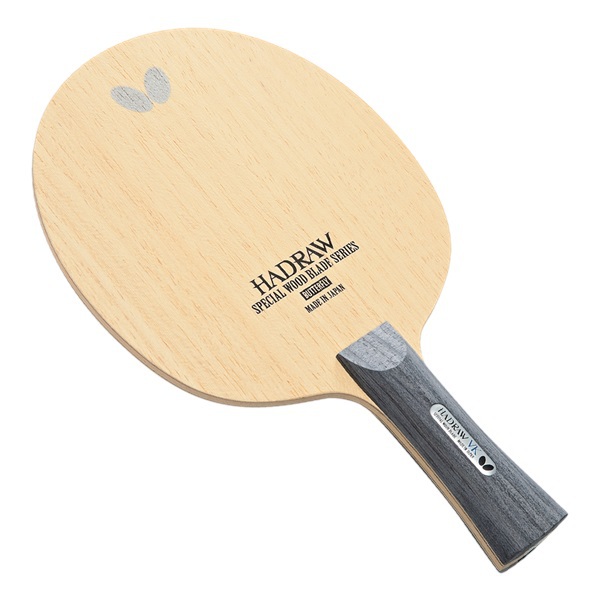
The Butterfly Hadraw VK is a 5-ply all-wood blade for offensive players who put touch, feel, and reliable spin ahead of sheer power. The name spells out the design: V for five plies, K for Petr Korbel, whose blade it was built to match on speed while refining the feel and the weight. A Koto outer veneer sits over a core of Hinoki, Kiri, and Ayous, and the contact sound is crisp and the feedback responsive, as you would expect from a premium Japanese-made Butterfly. At 5.7mm thick and around 80 to 85 grams unloaded it is one of the lighter blades in its class, yet it never feels fragile or unpredictable in play.
Performance
The Hadraw VK plays the way its construction reads: controlled, spin-friendly, and quick enough without tipping into the zone where placement gets hard. The Koto outer layer, the same veneer on marquee blades like the Zhang Jike ALC, gives it a crisp, slightly harder impact than softer all-wood options. Reviewers keep landing on the same point about the feedback: the blade tells you clearly what the ball is doing on each stroke.
Topspin is its home ground. The five-ply build holds the ball just long enough to maximize brush contact, so loop drives feel connected and players make spin consistently from mid-table and close to the table both. Counter-looping against heavy topspin is comfortable, and the multiple gears, stepping power up or down without losing control, suit the varied pace of modern plastic-ball play.
Passive shots lean on that high control rating. Blocking powerful attacks stays manageable because the blade absorbs pace without going dead, and pushing and flicking short balls is precise, the stiff-enough-but-flexible feel giving you confidence on touch shots around the table.
Set against the Petr Korbel blade it references, the Hadraw VK is rated at about the same speed but comes in lighter and less head-heavy, which matters for players who struggle to recover after wide-angle exchanges. Against the Zhang Jike ALC it is noticeably slower yet matches it in control, so it suits players who find the ALC’s Koto-driven power too much to hold consistently.
The limitation is plain. Players who built their game around carbon or arylate-carbon composites will find the Hadraw VK too slow for their attacking style. At OFF- it is offensive, not explosive, and anyone used to the direct, low-trajectory power of a composite will miss that bite.
What Reviewers Agree (and Disagree) On
Across Revspin, TableTennis Reference, and BladeRubber.net, with well over 60 player reviews between them, the verdict is consistent: the Hadraw VK is a high-quality, control-first offensive blade that delivers strong feedback and spin for pure wood. Everyone calls the speed moderate next to composite blades, and most treat that as a design choice rather than a flaw. The one mild disagreement is whether the speed is enough. Most advanced topspin players find OFF- satisfying; a minority, mainly people returning after a long break or coming down from faster setups, find the pace tough to manage at first when paired with fast rubbers. There is broad agreement on the rest: the Koto outer ply gives a distinctive, crisper feel than softer all-wood blades, and Butterfly’s manufacturing quality shows in the finished product.
Who Should Buy It
The Butterfly Hadraw VK fits intermediate and advanced players who want a pure-wood offensive blade with strong control, reliable spin, and real attacking punch at OFF- speed. It is a good match for loop-dominant players who work close to mid-distance, favor feel and placement over raw power, and want a lightweight setup that keeps its balance and stability. Players who are finding ALC composite blades too demanding — or who want to develop cleaner technique without the forgiveness of a softer all-around blade — will find the Hadraw VK a rewarding choice. It is not recommended for absolute beginners, pure defenders, or players whose game depends on the explosive speed of carbon composites.
FAQ
What does ‘VK’ stand for in the Butterfly Hadraw VK?
VK stands for ‘V’ meaning five plies and ‘K’ referencing Petr Korbel, the legendary Czech table tennis player. The blade was designed to reach approximately the same speed as the classic Petr Korbel blade while improving on weight balance and feel.
Is the Butterfly Hadraw VK suitable for beginners?
It is not ideal for absolute beginners. At OFF- speed, it carries enough pace to challenge players who are still building consistent stroke mechanics. Beginners would benefit from a dedicated control or all-around blade before stepping up to the Hadraw VK.
How does the Hadraw VK compare to the Zhang Jike ALC?
Both blades share a Koto outer veneer and similar dimensions, but the Hadraw VK is noticeably slower because it uses a pure five-ply wood construction rather than arylate-carbon layers. The control level is comparable, making the Hadraw VK a good choice for players who want the feel of Koto without the explosive speed of ALC.
What rubbers pair well with the Butterfly Hadraw VK?
Reviewers report excellent results with Butterfly Tenergy 05, Tenergy 05 FX, MX-P, and Donic Desto F3 Big Slam. Because the blade is on the lighter and more flexible side, moderately fast rubbers tend to work better than the heaviest or stiffest options.
What is the weight and thickness of the Hadraw VK?
The blade weighs approximately 84 to 85 grams uncut and measures 5.7mm in thickness. It is available in FL, ST, and AN shakehand handle styles.
Is the Butterfly Hadraw VK still in production?
The Hadraw VK has been discontinued by Butterfly and is no longer widely available as a new product. Players looking for a similar modern alternative may consider the Butterfly Hadraw 5 or other five-ply all-wood blades in Butterfly’s current lineup.