Andro Hexer Powergrip Review: 47.5° Sponge, Spin and Playing Fit
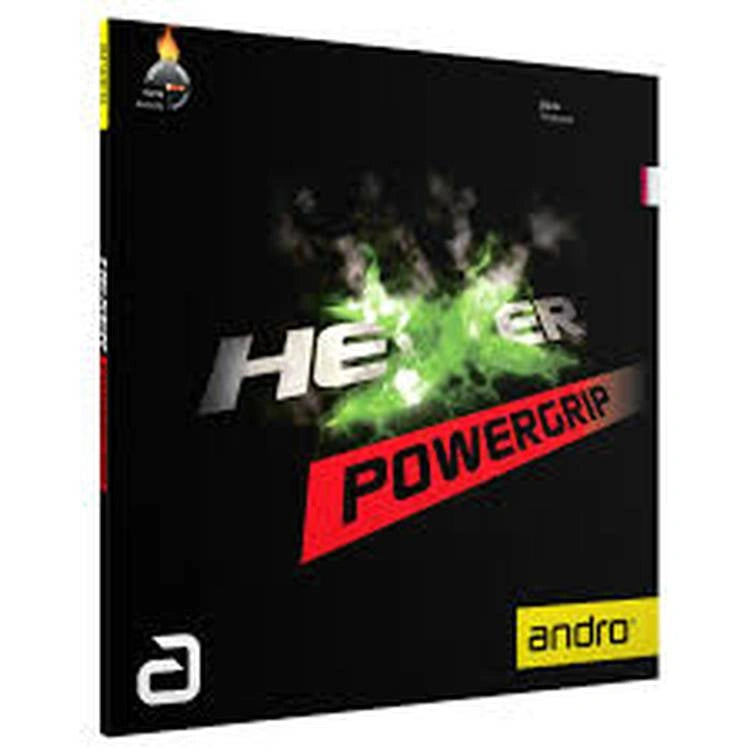
Pros
- Three sponge choices (1.7, 1.9 and 2.1 mm) let players tune the setup
- 47.5° porous sponge is designed for active spin and pace
- Natural-rubber topsheet is designed around the plastic ball
- Clear alternative within the Hexer line for players who want a firmer sponge
Cons
- The firmer sponge may demand more from a compact or slower stroke
- Catapult can make short-touch control a setup-dependent question
- Andro does not publish a standard cut weight or durability figure
Hexer Powergrip is the firmer, power-oriented choice in Andro’s Hexer Grip pair. Andro specifies a 47.5° sponge for Powergrip and a 45° sponge for Hexer Grip. Both have a natural-rubber topsheet and the same three thickness options. That comparison is more useful than assuming Powergrip is automatically faster or better for every stroke.
This is a specification-led buying assessment. UltraSpin has not published a controlled on-court test of this sheet. The product details below come from Andro’s current listing; the playing-fit advice is our interpretation, not a measured result from our own racket.
The specifications that matter
| Feature | Hexer Powergrip | What it means when choosing |
|---|---|---|
| Sponge hardness | 47.5° on Andro’s scale | Firmer than Hexer Grip’s 45°; compare within the brand, not directly with Butterfly’s hardness numbers. |
| Sponge thickness | 1.7, 1.9 or 2.1 mm | Choose the thickness you would actually use when trying a sheet. |
| Topsheet | 100% natural rubber, according to Andro | A composition claim, not a measured spin score. |
| Construction | Porous sponge with Tensor technology | Andro positions it for catapult, spin and power on active strokes. |
The degree number describes the sponge, not the feel of a finished racket. Blade stiffness, sponge thickness, glue and your contact point all change the result. Andro does not give a standardized cut weight, lifespan or independent speed measurement for this product, so a precise grams-after-cut or months-of-use promise would be misleading.
Powergrip or regular Hexer Grip?
Both sheets are sold in 1.7, 1.9 and 2.1 mm. The straightforward difference is the sponge rating: 47.5° for Powergrip and 45° for Grip. Andro presents Powergrip around spin and power, while it presents Grip around spin, feel and control. If your current Hexer Grip setup already gives you enough pace and your main problem is keeping returns short, the harder version has no obvious advantage. If your stroke is active and you want to try a firmer response without changing the whole rubber family, Powergrip is the more relevant trial.
Do not infer a universal two-and-a-half-degree change in ball speed or spin from those labels. They are product specifications, not head-to-head playing measurements.
A useful 20-minute club test
If you can borrow a racket with Powergrip, use the same balls and one regular practice partner. Try the thickness and blade you would actually buy. The following sequence tests the trade-offs that the specification cannot settle:
- Five minutes opening against backspin: Alternate slow, brushed openings with stronger loops. Count how many clear the net and land deep rather than judging only your best shot.
- Five minutes on serve and short receive: Play short backspin serves, short pushes and a few flicks. Notice whether you can keep the second bounce short without an exaggeratedly soft hand.
- Five minutes blocking and countering: Have your partner loop to the same spot. Compare the effort needed for a passive block and an active counter.
- Five minutes from mid-distance: Step back and loop with your normal stroke. Ask whether the extra effort produces useful depth consistently.
Compare those results with your present rubber on the same blade if possible. A borrowed racket with a very different blade can still reveal the general feel, but it cannot isolate the rubber’s effect. Also weigh the finished racket, because balance can matter more than an unverified sheet-weight estimate.
Who should consider it?
Powergrip is worth trying if you already swing actively and want a firmer, spin-oriented Tensor rubber. Start with the thickness you normally use rather than assuming 2.1 mm is the only serious option. Players still developing a full stroke, or anyone who values predictable short touch above extra power, should compare Hexer Grip as well.
The verdict is conditional: Andro’s construction makes Powergrip a plausible fit for an attacking game, but the maker’s description does not establish how it will block, receive or last on your particular blade. Use the club test above to decide those points before paying for a sheet.
FAQ
How hard is Andro Hexer Powergrip?
Andro lists a 47.5° sponge. Regular Hexer Grip is listed at 45° on the same brand scale. Neither number directly predicts the feel of your complete racket.
What sponge thicknesses are available?
Andro lists 1.7, 1.9 and 2.1 mm. A thinner option can be a sensible starting point if short touch and overall racket weight are priorities, but the right choice depends on your blade and stroke.
Is Hexer Powergrip better than Hexer Grip?
It is the firmer option, not a universal upgrade. Try Powergrip if you want a more power-oriented Hexer setup; keep Grip in contention if feel and control matter most.
How much does a cut sheet weigh, and how long does it last?
Andro’s product listing does not give a standard cut weight or measured lifespan. Both depend on blade size, thickness and use. We would weigh the finished racket and track play over time instead of quoting an unverified figure.