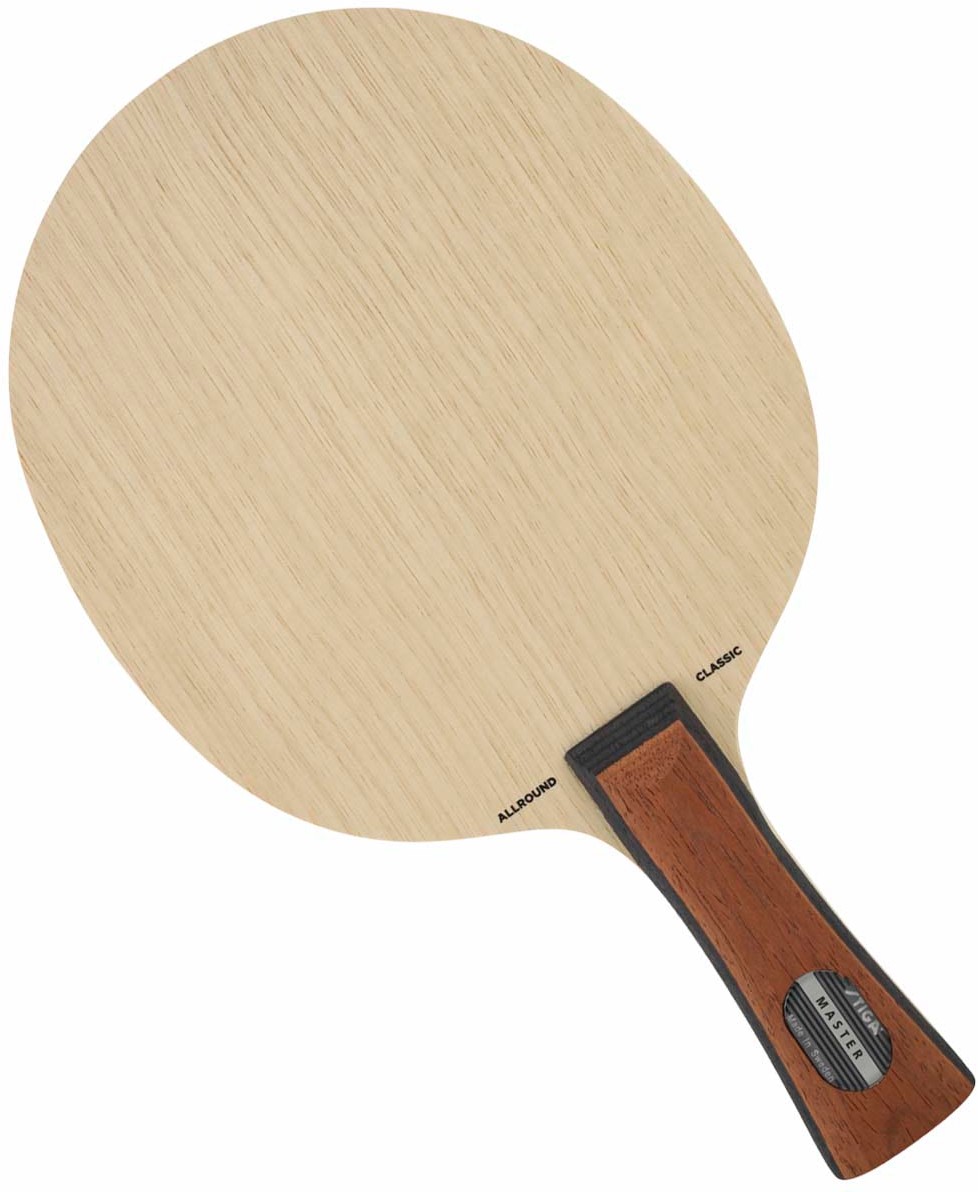
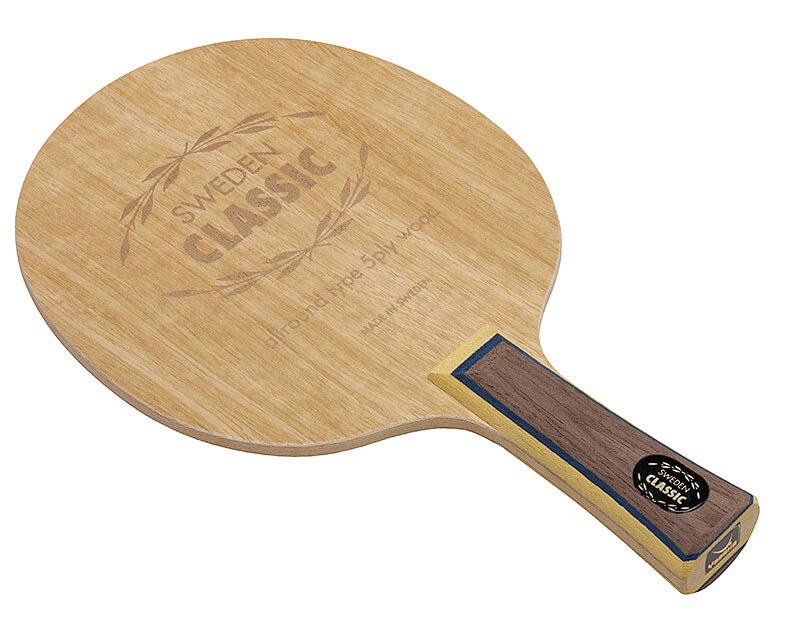
Stiga Allround Classic vs Yasaka Sweden Classic: Which Should You Buy?
| Stiga Allround Classic | Yasaka Sweden Classic | |
|---|---|---|
| Our rating | 8.4/10 | 8.2/10 |
| feel | soft, high control | Soft, flexible, high feedback |
| handle | FL/ST/AN | Anatomic / Flared / Straight |
| plies | 5W | 5-ply all wood |
| speed | ALL | ALL |
| thickness_mm | 5.1 | 5.35 |
| weight_g | 75 | ~82 |
We may earn a commission from links on this page. Learn more.
The Closest Pairing in This Whole Comparison Set — Except for One Axis
Overall ratings sit within 0.2 points of each other (8.4 for the Allround Classic, 8.2 for the Yasaka Sweden Classic), and on three of five axes — speed, control, stiffness — the gap is 0.3 points or less, close to noise for this kind of aggregated rating. If you stopped reading after the headline numbers, you’d reasonably conclude these are near-interchangeable blades. Then you get to consistency, where the gap is 2.5 points (8.6 vs 6.1) — by far the largest difference anywhere in this comparison, and one that says these two blades are not, in fact, interchangeable.
Speed: a Genuine Tie, and One That Checks Out Against the Manufacturer
Speed comes in at 6.6 for the Allround Classic and 6.7 for the Yasaka Sweden Classic — a 0.1-point gap that’s meaningless in practice. What’s notable is that Yasaka’s own manufacturer speed rating of 67 (on their 100-point catalog scale) lines up almost exactly with the aggregated community score of 6.7 on this dataset’s 10-point scale. That’s a useful trust signal: unlike some blade classifications elsewhere in this dataset where the marketing label and the measured data diverge, here the manufacturer’s own number and independent reviewer consensus agree closely.
Control: a Small Real Edge to the Sweden Classic
The Sweden Classic edges ahead by 0.3 points on control (9.2 vs 8.9) — both scores are excellent by any standard, and 9.2 is among the higher control ratings across this whole dataset. This is a real but small gap; don’t expect the Sweden Classic to feel dramatically more forgiving in a side-by-side hit. It’s the kind of edge that shows up over hundreds of shots, not in your first few minutes with the blade.
Consistency: the Number That Actually Separates These Two Blades
Here’s the gap that matters. A 2.5-point consistency deficit for the Sweden Classic (6.1 vs the Allround Classic’s 8.6) is large enough to change how each blade behaves in a match, not just how it feels on a single shot. The Sweden Classic’s own con list offers a clue why: “rubber pairing matters — very slow rubbers leave the setup feeling sluggish,” suggesting its playing character shifts more depending on what rubber you mount, which is exactly the kind of setup-sensitivity that would show up as a lower consistency score in aggregated reviews. The Allround Classic, by contrast, has built a reputation — reflected in its 8.6 consistency score — as a stable, predictable base you can build almost any rubber setup around.
Hardness: a Moderate, Real Gap
Hardness runs 4.5 for the Allround Classic against 3.5 for the Sweden Classic, a full point apart — the Sweden Classic is the softer-feeling blade of the two. Combined with its “high feedback” (per its own pros), that softness is likely part of why reviewers highlight it for players correcting technical errors — a softer blade telegraphs mishits more clearly through the hand.
Weight and Thickness: Minor Build Differences
The Allround Classic runs slightly lighter (75g) and thinner (5.1mm) than the Sweden Classic (roughly 82g and 5.35mm). Neither difference is dramatic, but if you’re sensitive to swing weight, the Sweden Classic will feel marginally more substantial in hand.
Who Actually Benefits From Which Blade
Both blades target nearly identical players on paper — beginners building strokes, control-first all-rounders who live close to the table, and defensive chop-and-block players. Given how similar their use cases are, the deciding factor should be the consistency gap: if you want the most stable, predictable platform to build technique on regardless of which rubber you eventually mount, the Allround Classic’s 8.6 consistency score is the stronger bet. If you’re chasing the last increment of control and you’re comfortable curating your rubber pairing carefully around the Sweden Classic’s setup-sensitivity, its 9.2 control score is the higher ceiling of the two.
Switching Between Them
Because these blades occupy almost the same niche, switching from one to the other isn’t really an “upgrade” in either direction — it’s a lateral move. The main reason to switch from the Allround Classic to the Sweden Classic would be chasing that extra 0.3 points of control while accepting reduced setup consistency. The main reason to go the other way — from Sweden Classic to Allround Classic — would be frustration with a rubber pairing not behaving predictably, which the data suggests is a documented weak point of the Sweden Classic specifically.
Bottom Line
This is the closest matchup in the set, and most of the axes genuinely don’t differentiate these two blades in a meaningful way. The one number worth remembering is consistency: the Allround Classic is measurably steadier across rubber pairings and shot types, while the Sweden Classic trades some of that steadiness for a slightly higher control ceiling that rewards a carefully chosen rubber.
Frequently asked questions
Which blade is faster?
Neither, meaningfully — both post nearly identical speed scores (6.6 vs 6.7), and Yasaka's own manufacturer rating of 67 confirms the community number.
Why does the Allround Classic have a higher overall rating despite a lower control score?
Its much higher consistency score (8.6 vs 6.1) more than offsets a small 0.3-point control deficit, making it the steadier overall platform.
Does rubber choice matter more on one of these blades?
Yes — the Sweden Classic's own con list notes that very slow rubbers leave the setup feeling sluggish, consistent with its lower consistency score.
Is either blade good for defensive chop-and-block players?
Yes, both are explicitly recommended for that style in their bestFor descriptions, alongside beginners and close-to-table all-rounders.