DHS Hurricane 3 vs Stiga Mantra M: Which Should You Buy?
| DHS Hurricane 3 | Stiga Mantra M | |
|---|---|---|
| Our rating | 8.5/10 | 8.2/10 |
| best_side | forehand | Backhand or Forehand |
| control | medium | High |
| speed | offensive | High |
| spin | extreme | High |
| sponge_hardness | 39–41° (DHS scale) | Medium (approx 45 degrees) |
| type | tacky inverted | Inverted / Pimples-in |
| weight_uncut_g | 70 | approx 64 |
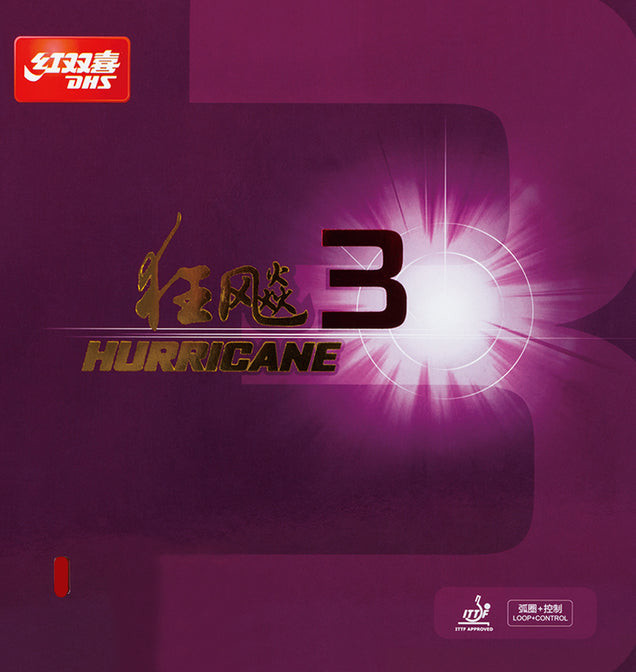
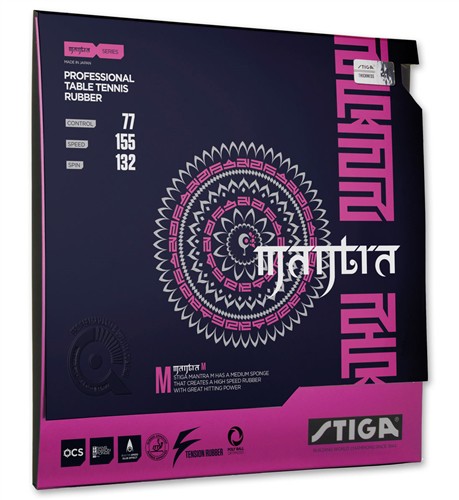
We may earn a commission from links on this page. Learn more.
Where the overall rating and the axis data disagree
DHS Hurricane 3 carries a higher overall rating than Stiga Mantra M, 8.5 versus 8.2, but the underlying axis data tells a more complicated story. Stiga Mantra M actually leads on speed by a full 1.0 point (9.1 vs 8.1) — the largest speed gap in this entire rubber lineup — and edges ahead marginally on spin (9.0 vs 8.9, a 0.1-point gap) and control (8.8 vs 8.6, 0.2 points). If you only looked at those three axes, you’d expect Mantra M to carry the higher score. It doesn’t, and the reason is almost entirely tackiness.
The 6.6-point axis that explains the rating
Tackiness favors Hurricane 3 by a massive 6.6 points (8.2 vs 1.6), and durability adds a further 0.7-point edge (7.6 vs 6.9). Hurricane 3’s own pros describe it as offering “among the highest spin and best low-throw, long-arc feel of any forehand rubber, ideal for brush-looping heavy topspin” — a description built entirely around tacky-surface mechanics that a simple speed, spin, and control comparison doesn’t weight heavily enough. Mantra M’s own pros, by contrast, lean on “forgiving control” with “wide error margins,” a different value proposition built around a non-tacky, higher-speed sponge.
What this actually means for your game
If your game depends on grip-driven spin variation — brushing serves, adding sidespin, manipulating short pushes — Hurricane 3’s 6.6-point tackiness advantage is not a footnote, it’s the rubber’s entire identity. Reviewers across Megaspin, Revspin, and TableTennisDaily consistently frame Hurricane 3 around exactly this quality: full-body technique rewarded, tacky topsheet, and “the same family… used at the very top of the sport.” If instead your game is built on raw pace and you want a rubber that “stays stable against incoming topspin without overreacting” while costing “a fraction of premium rubbers like Tenergy 64,” Mantra M’s 1.0-point speed edge and near-tied spin and control numbers are the more relevant story, and its own bestFor description explicitly targets intermediate players in the 1200 to 1800 USATT range.
Durability and hardness
Mantra M’s sponge sits around 45 degrees against Hurricane 3’s 39 to 41, and it’s the lighter rubber at roughly 64 grams uncut versus Hurricane 3’s 70. That’s a meaningfully different feel on the blade even before tackiness enters the picture. On durability, Hurricane 3’s 0.7-point edge (7.6 vs 6.9) is real but modest — and Hurricane 3’s own con list is honest that this edge disappears if you boost the rubber, since boosting “adds cost and upkeep and has a short lifespan.” Mantra M’s documented weakness, “topsheet wears out relatively quickly under regular play,” suggests the gap holds either way, just by less than the tackiness axis would imply.
The throw angle is close either way
Throw favors Hurricane 3 only slightly, by 0.2 points (5.4 vs 5.2), and both numbers sit on the low end of this data set. Neither rubber is going to give you a generous safety margin on opening loops; you supply the arc through your own stroke with both.
Should you switch?
A player on Mantra M looking for more short-game manipulation and serve spin variation will feel Hurricane 3’s tackiness advantage immediately, but should go in expecting the well-documented tradeoffs: needing to boost the rubber to unlock speed and arc, a confusing version ecosystem with real counterfeit risk, and a rubber that is “dead” on passive strokes. A player on Hurricane 3 who wants more raw pace without the boosting maintenance, and who plays with wider net clearance and less technical precision, may find Mantra M’s 1.0-point speed edge and near-tied spin genuinely liberating — at the cost of nearly all of that signature tacky short game.
Bottom line
The overall ratings (8.5 vs 8.2) undersell how close Hurricane 3 and Mantra M actually are on speed, spin, and control — Mantra M leads on all three by modest margins. Hurricane 3’s rating advantage rests almost entirely on a 6.6-point tackiness gap and a smaller durability edge, which is exactly the kind of nuance a single overall number cannot show you.
Frequently asked questions
Is Stiga Mantra M actually faster than DHS Hurricane 3?
Yes, by a full 1.0 point on the aggregated axis scale (9.1 vs 8.1) -- the largest speed gap anywhere in this rubber comparison set, despite Hurricane 3 carrying the higher overall rating.
Why does Hurricane 3 have a higher overall rating if Mantra M wins on speed, spin, and control?
The axis data shows the gap is almost entirely tackiness -- Hurricane 3 leads by 6.6 points (8.2 vs 1.6) -- plus a smaller 0.7-point durability edge. Those two axes outweigh Mantra M's modest leads on the other three in the overall score.
Is Stiga Mantra M a good budget alternative to Tenergy?
That is exactly how its own reviewers position it -- a smart budget pick for anyone chasing Tenergy-like spin without paying premium-rubber prices, aimed at intermediate players roughly in the 1200 to 1800 USATT range.
Does Hurricane 3 need boosting to compete with Mantra M on speed?
Largely yes. Hurricane 3's own documented cons state it is slow and dead on passive or short strokes and that most players boost it to unlock speed and arc, while Mantra M delivers its speed and spin without that extra step.