Butterfly Timo Boll Allround vs Stiga Carbonado 290: Which Should You Buy?
| Butterfly Timo Boll Allround | Stiga Carbonado 290 | |
|---|---|---|
| Our rating | 8.3/10 | 8.3/10 |
| feel | Medium-soft, classic all-wood dwell with good tactile feedback | very stiff, hard, crisp and direct carbon feel with a high-pitched sound; fast and linear with a low throw |
| handle | FL/ST/AN/XXS | FL |
| plies | 5-ply all wood (koto outer) | 5 wood + 2 carbon (7-ply), TeXtreme carbon |
| speed | ALL+ | OFF+ |
| thickness_mm | 5.5 | 6.2 |
| type | — | OFF+ |
| weight_g | ~85 | 95 |
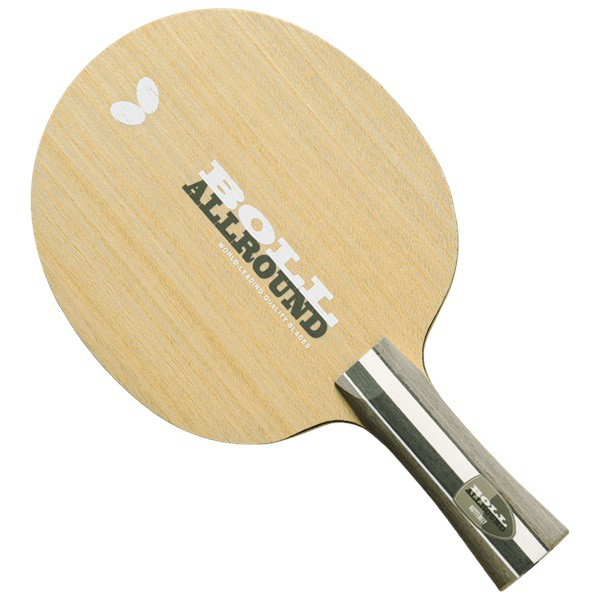
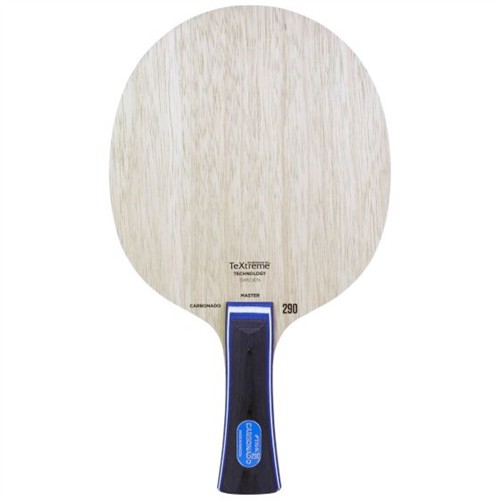
We may earn a commission from links on this page. Learn more.
Butterfly Timo Boll Allround and Stiga Carbonado 290 sit at almost opposite ends of every axis in this dataset — this is less a head-to-head and more a map of what a control-first all-wood blade and a maximum-power carbon blade each give up to get what they’re good at.
The four axes that separate them, in order of size
Consistency: 5.0 for Allround versus 9.4 for Carbonado 290, a 4.4 point gap — the largest in this pairing. Hardness: 5.2 versus 8.1, a 2.9 point gap. Stiffness: 5.0 versus 7.3, a 2.3 point gap. Speed: 7.5 versus 9.4, a 1.9 point gap. Every one of these is large enough to be felt, not just measured — and they all point the same direction, toward Carbonado 290 being the harder-hitting, harder-feeling, faster blade by a wide margin, backed by six sources including Revspin, ExpertTableTennis, TTGearLab and Reddit.
The one axis that barely moves
Control is the outlier: 8.7 for Allround versus 9.0 for Carbonado 290, just a 0.3 point gap. That is a genuinely important finding buried in an otherwise lopsided comparison — despite Carbonado 290 being dramatically stiffer, harder and faster, it is not meaningfully less controllable than the gentle, technique-focused Allround. Don’t assume a stiffer, faster blade automatically sacrifices placement; on this data, it doesn’t.
What the cons lists confirm independently of the numbers
Allround’s own cons state its “speed ceiling too low for players ready to move into offensive play” — consistent with the 1.9 point speed gap. Carbonado 290’s cons state it has “very low throw” that “can cause netting until you adapt your bat angle,” and that it is “not suited to chopping with long pimples” — consistent with a blade built entirely around the stiffness and hardness scores it posts. Neither blade’s listed weaknesses are surprises once you’ve seen the axis data; they’re the direct consequence of it.
Fit: essentially different sports
Allround’s bestFor is beginners and lower-intermediate players building technique before moving to something faster. Carbonado 290’s bestFor is “advanced, aggressive attackers and offensive penholders who finish points fast with hard drives, smashes and blocking” who “already have the technique to handle a very stiff, very fast OFF+ carbon blade with a low throw.” There is essentially no overlap in the intended buyer here.
Why this comparison exists at all
Since Allround is discontinued and its own cons note it now requires secondary-market sourcing, most people landing on this comparison are probably not choosing between these two for their first blade — they’re asking whether a Carbonado 290 is a reasonable direct upgrade path from an aging Allround. The honest answer, given the data, is that it is a legitimate destination but not a gentle one: every axis except control moves by 1.9 points or more.
Switching from Allround to Carbonado 290
This requires committing to a different game, not just a faster version of your current one. The low throw specifically will punish the passive, technique-building strokes Allround was designed to develop — you will need to have already built the active, aggressive stroke Carbonado 290’s own bestFor description assumes before making this switch pays off. If you try to make this jump before your technique catches up, expect exactly the netting problem Stiga’s own reviewers warn about.
If you’re not there yet, a smaller step — something closer to Allround’s control profile but with a modern in-production alternative — is the more honest recommendation than jumping straight to a maximum-power OFF+ blade.
Bottom line
Four of five axes show a 1.9 to 4.4 point gap in Carbonado 290’s favor toward more power, stiffness, hardness and, per the aggregated data, consistency. Only control stays close. This is a valid upgrade path for a player whose technique has already outgrown Allround’s ceiling, and a poor one for anyone still building that technique.
Frequently asked questions
Is Stiga Carbonado 290 a good direct upgrade from Butterfly Timo Boll Allround?
Only if your technique has already outgrown Allround's speed ceiling — the throw, stiffness and hardness are dramatically different (2.3 to 2.9 point gaps), and Carbonado 290's own bestFor description assumes an already-active, aggressive stroke.
Is control worse on Carbonado 290 despite it being so much stiffer?
No — control is nearly tied (8.7 vs 9.0, a 0.3 point gap), the one axis where these two blades are actually close.
Why is Allround's consistency score so much lower?
The data shows a 4.4 point gap (5.0 vs 9.4), the widest in this comparison — worth weighing alongside Allround's own listed con about being discontinued and requiring secondary-market sourcing.
Can Carbonado 290 handle a chopping or defensive style?
No — its own cons list states it is not suited to chopping with long pimples; it's built around fast, aggressive, close-to-table offense.