Friendship 729 Battle II vs Yinhe Big Dipper: Which Should You Buy?
| Friendship 729 Battle II | Yinhe Big Dipper | |
|---|---|---|
| Our rating | 8.5/10 | 8.4/10 |
| best_side | FH | forehand |
| control | 8 | high |
| speed | 8 | medium (offensive) |
| spin | 9 | extreme |
| sponge_hardness | hard | 38/39/40 degrees (provincial-style blue sponge; 39 measures roughly 51 ESN) |
| type | tacky | hybrid tacky (blue sponge) |
| weight_uncut_g | 68 | 68 |

We may earn a commission from links on this page. Learn more.
The short answer
Friendship 729 Battle II and Yinhe Big Dipper both land at almost the same overall rating, 8.5 against 8.4, and both are pitched as budget-friendly, forehand-first, Chinese-style attacking rubbers. Look past the headline number, though, and the axis data shows these two are solving different problems. The tackiness gap between them is 3.5 points, 8.6 for Battle II against just 5.1 for Big Dipper, which is the single largest axis delta anywhere in this whole set of comparisons, and it is the real reason to pick one over the other.
The number that actually decides this
Battle II is a classic hard, extremely tacky Chinese rubber: the ball grabs and holds on the sheet through the whole stroke, which is exactly what produces its elite serves and serve receive with huge spin from a small wrist motion. That same extreme tack is also what attracts dust and causes tackiness and arc to fade noticeably after roughly two months of regular play, per Battle II’s own known weak points.
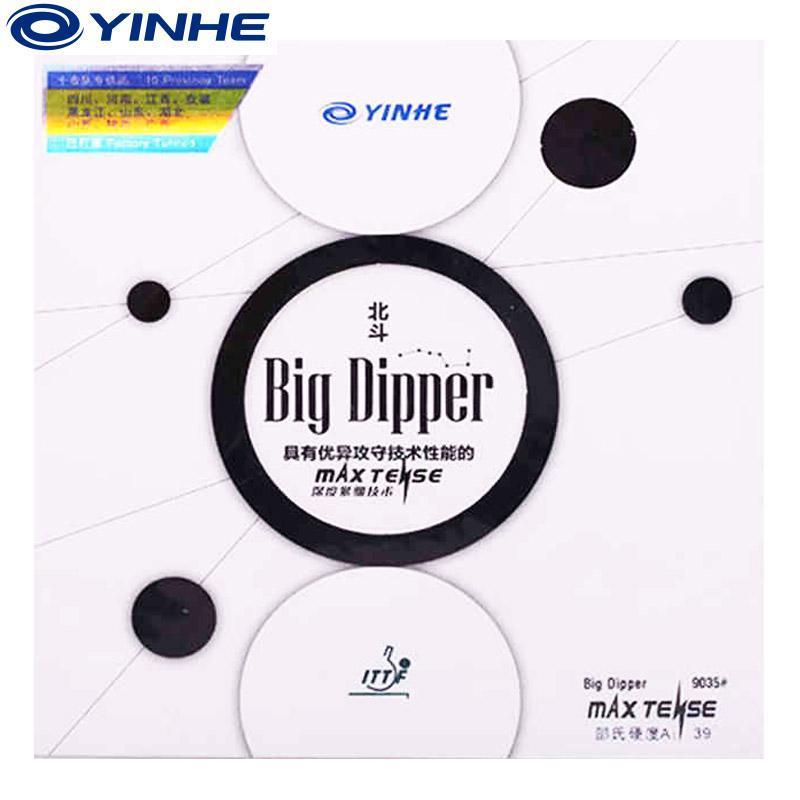
Big Dipper takes a different route. Its blue sponge is described as a modern, porous, hybrid tacky construction rather than a fully tacky sheet, and the tradeoff shows up directly in the numbers: outstanding stability and almost no ball slippage, according to its own listed strengths, at the cost of the extreme grab that defines Battle II. What is genuinely interesting is that despite giving up 3.5 points of tackiness, Big Dipper still holds a respectable 8.9 on the spin axis, only 0.3 behind Battle II’s 9.2, so its porous blue sponge is clearly doing real work to keep spin production high even without the tack. Racket Insight’s review and Tabletennis11’s blog, which directly asks whether Big Dipper is a Hurricane 3 alternative, both frame this low-tack, high-stability profile as the rubber’s defining trait rather than a weakness.
Where Battle II actually wins
Control favors Battle II by 0.4, 9.0 versus 8.6, the second-largest gap on the chart, and durability favors it by 0.6, 8.1 versus 7.5. Neither is dramatic, but both are consistent with reviewer notes: Big Dipper’s cons list mentions quality control variance between sheets and a stiff sponge that needs break-in time, which plausibly explains why it trails on both control and durability even though it wins narrowly on throw, 5.8 versus 5.6, a 0.2 gap unlikely to be noticeable in play, and is essentially tied on speed, 8.6 versus 8.7, a 0.1 difference.
Should you switch
If you already play with Battle II and are tempted by Big Dipper’s reputation as a Hurricane 3 Neo alternative, be clear about what you are trading: less control, less durability, and dramatically less raw tack, in exchange for a rubber that Reddit’s r/tabletennis community and Racket Insight both describe as more stable and less slippage-prone. That is a real upgrade only if dust sensitivity and tack fade have specifically been bothering you, otherwise Battle II’s higher control and durability numbers suggest you keep what you have.
Going the other way, if you already use Big Dipper and are considering Battle II for more raw spin grab, understand you are also signing up for tack that fades after about two months and a sheet that plays poorly on dusty floors until cleaned. Big Dipper’s National version, per its own pros, approaches a boosted blue sponge Hurricane 3, so players chasing that specific profile may find Big Dipper’s higher-hardness options, 38, 39 or 40 degrees, get them there without the maintenance Battle II demands.
Who each rubber actually fits
Battle II suits forehand-dominant attackers and improving players who want to learn Chinese-style looping and serving on a tight budget and do not mind a maintenance routine. Big Dipper suits intermediate to advanced, spin-oriented attackers who want Chinese-style tacky spin without full tack, and who are willing to play with full, active strokes; its own bestFor notes explicitly call out that it rewards hard active hitting and is not well suited to passive, low-power play. Pair Big Dipper with a fast blade if you want to offset its more demanding low-power feel.
Frequently asked questions
What is the biggest real difference between 729 Battle II and Yinhe Big Dipper?
Tackiness. 8.6 versus 5.1, a 3.5-point gap, the largest in this whole comparison set. Battle II grabs the ball hard, Big Dipper trades tack for stability.
Does Big Dipper spin less because it is less tacky?
Only slightly, 8.9 versus 9.2, a 0.3 gap. Its porous blue sponge compensates for the much lower tack.
Is Yinhe Big Dipper beginner friendly?
No. Its own bestFor notes call for full, active strokes and flag it as demanding at lower power, so it is not recommended for beginners.
Should I switch from Battle II to Big Dipper?
Only if dust and tack fade specifically bother you. You would give up 0.4 control and 0.6 durability in the trade.